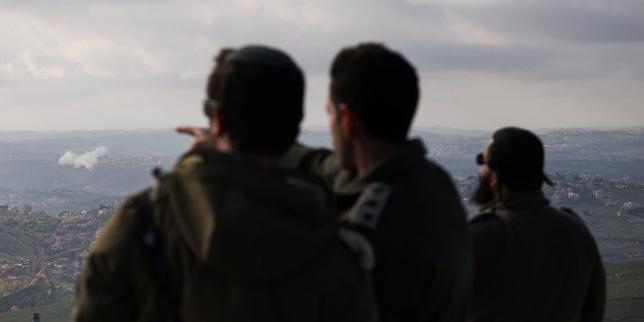
The ink on a peace treaty never smells like roses. It smells like damp concrete, cordite, and the metallic tang of old fear. In the high-ceilinged rooms of diplomacy, where the air is filtered and the water is served in crystal, a "cease-fire" is a series of clauses, sub-clauses, and geographic coordinates. But for a father sitting in the skeleton of a kitchen in southern Lebanon, or a mother listening for the whistle of a rocket in northern Israel, those clauses are the difference between a morning spent making coffee and a morning spent identifying bodies.
Right now, that difference is hanging by a fraying thread.
The logic of the current standoff is deceptively simple, yet it carries the weight of thousands of lives. Negotiators have hit a wall that isn't made of stone, but of definitions. One side views the conflict as a contained fire. The other sees it as a wildfire that ignores every border on the map. At the heart of this disagreement is a single, burning question: Can you stop a war in Gaza while the hills of Lebanon are still screaming?
The Ghost at the Table
Imagine a dinner party where everyone is pretending the person at the head of the table isn't there. That is Lebanon in these negotiations. For months, the diplomatic push has focused on Gaza—a narrow strip of land where the human cost has transcended statistics and entered the realm of nightmare. The goal was a pause, a breath, a cessation of the rain of steel.
But Hezbollah, the shadow that looms over the Lebanese border, has tied its fate to the Mediterranean coast. Their stance is a grim binary. If the bombs fall in Gaza, the rockets fly from Lebanon. This "unity of fronts" isn't just a slogan; it is a geopolitical knot that the world’s most powerful brokers are currently trying to pick apart with trembling fingers.
The disagreement threatening to unravel the entire peace process is about whether Lebanon should be explicitly written into the Gaza cease-fire. It sounds like a bureaucratic technicality. It is not. It is the core of the machine.
If Lebanon is excluded, the cease-fire is a glass house. One rocket from a Hezbollah hillside, fired in "solidarity" with a lingering skirmish in a Gaza alleyway, and the entire structure shatters. The Israeli response would be swift, calibrated for maximum deterrence, and suddenly, the "peace" is just a prelude to a wider, deeper grave.
The Architecture of Distrust
Why not just include them? Why not sign one piece of paper and call it a day?
The answer lies in the messy, jagged reality of sovereignty and survival. To include Lebanon in a Gaza deal is to officially acknowledge that Hezbollah—a non-state actor—has successfully dictated the terms of regional security. For Israel, this is a bitter pill that tastes like defeat. It signals to every neighboring group that the way to the negotiating table is paved with escalation.
On the other side, the Lebanese government is a spectator in its own tragedy. It sits in Beirut, watching the south burn, unable to command the fighters on its own soil. To exclude Lebanon is to leave the country in a state of permanent "gray zone" warfare, where the economy continues to liquefy and the population lives in a perpetual state of flinching.
Consider a hypothetical shopkeeper in Tyre. Let's call him Omar. Omar doesn't care about the "unity of fronts." He cares about the fact that his olive oil is spoiling because the roads are closed, and his children have forgotten what it feels like to sleep through a night without the low hum of a drone overhead. When he hears that the diplomats are arguing over "inclusion," he doesn't hear a policy debate. He hears that his life is a footnote. He hears that his peace is conditional.
The Regional Dominoes
The stakes are not confined to a few miles of rocky soil. They are tectonic.
When a cease-fire fails because of a geographic technicality, it sends a signal through the global markets, the oil pipelines, and the halls of power from Washington to Tehran. We are witnessing a moment where the old rules of war—where countries fought countries and signed treaties—have completely dissolved. We are now in an era of "linked conflicts," where a teenager in a basement in Yemen can influence the price of milk in London by firing a drone at a ship, all in the name of a conflict happening a thousand miles away.
The failure to bridge the Lebanon gap isn't just a local tragedy. It is an admission that the international community no longer knows how to stop a war that has no clear edges.
The negotiators are tired. You can see it in the way they walk to their motorcades. They are dealing with a puzzle where the pieces change shape the moment you try to fit them together. Israel demands a "buffer zone" that would essentially move the border. Hezbollah demands an end to the Gaza "aggression" before they even discuss their own position. And in the middle, the civilians of both nations are left holding their breath until their lungs ache.
The Weight of the Silence
There is a specific kind of silence that happens when a cease-fire is announced. It isn't a peaceful silence. It is an expectant one. It’s the silence of a man walking across a frozen lake, listening for the first crack.
If the disagreement over Lebanon’s inclusion isn't resolved, that crack will come. It won't be a diplomatic disagreement anymore; it will be the sound of an iron dome battery or the roar of a jet engine. The unraveling won't happen in a press conference. It will happen in the middle of the night, in a village that thought it was finally safe to turn on the lights.
We often talk about these events as if they are weather patterns—unavoidable, shifting, and distant. But these are choices. Every line in a treaty is a choice to value one person's security over another's pride. The current deadlock is a choice to prioritize the "purity" of a deal over its "reality."
A Gaza-only deal is a bandage on a severed limb. It might stop the bleeding for a second, but it doesn't save the patient. Until the diplomats acknowledge that the smoke over Gaza and the smoke over the Lebanese border come from the same fire, the ink will never dry.
The sun sets over the Mediterranean, casting long, orange shadows over the ruins of homes that were built with decades of labor and lost in seconds of fire. In the distance, the hills are quiet for now. But it is the quiet of a held breath. The world waits to see if the men in the high-ceilinged rooms can find a way to write a peace that includes everyone, or if they will continue to argue over the margins while the center continues to burn.
The map is bleeding, and you cannot heal a map one piece at a time.