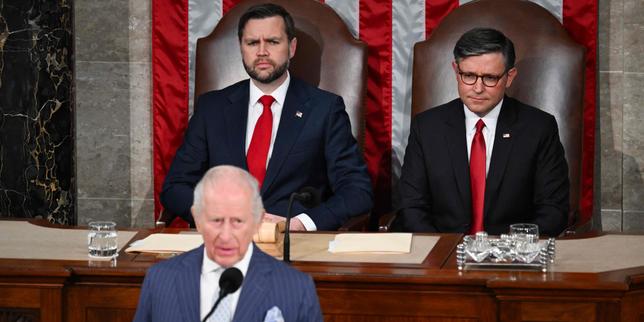
King Charles III is preparing to address a joint session of the United States Congress, marking the first time a British monarch has stood at that particular rostrum since his mother, Elizabeth II, did so in 1991. While the surface-level narrative focuses on the pageantry of the "Special Relationship," this visit serves a much more cold-blooded purpose. It is a calculated diplomatic gamble designed to re-anchor a post-Brexit Britain into the American sphere of influence while the United Kingdom grapples with its diminishing status as a global middle power. This isn't just about a speech. It is about survival.
Beyond the Pomp of 1991
When Elizabeth II spoke to Congress three decades ago, the world was a different place. The Cold War had just ended, the Soviet Union was collapsing, and the United Kingdom was a central, undisputed pillar of a unified Europe. Back then, the Queen was a symbol of a victory that the West was still celebrating. Today, Charles III arrives representing a nation that has spent the last eight years redefining its identity through the lens of isolation and economic restructuring. Also making waves recently: The Spectacle of Unity and Why the Special Relationship is a Ghost.
The 1991 visit was celebratory. This visit is transactional. The King is not merely coming to offer platitudes about shared history. He is the vanguard for a British government desperate to secure long-term trade assurances and defense cooperation in an era where Washington’s attention is increasingly pulled toward the Pacific. The "Special Relationship" has often been a one-way street, with London providing the diplomatic cover and Washington providing the muscle. Charles needs to prove that the UK still offers enough value to keep the lane open.
The Constitutional Tightrope
A British monarch is technically a "rubber stamp" for the government’s foreign policy, yet the King holds a unique form of soft power that no elected politician can match. Prime ministers come and go with the volatility of the British polls, but the Crown represents permanence. This is precisely why the invitation to address Congress is so significant. It is an acknowledgment from the American political establishment that they value the institution of the monarchy as a stabilizing force in an otherwise chaotic British political environment. More information into this topic are covered by NPR.
However, the King faces a minefield. His long history of advocacy for environmental causes and climate action—often referred to as his "Green Blueprint"—puts him at odds with significant factions of the American legislature. Unlike his mother, who was a master of the "blank slate" persona, Charles has opinions that are well-documented. If he leans too hard into climate policy, he risks alienating the Republican wing of the chamber. If he ignores it, he loses his most authentic platform for global leadership.
The success of this address depends on his ability to frame environmental preservation not as a progressive agenda, but as a matter of global security and economic resilience. He has to speak the language of the Pentagon and the Treasury, not just the language of the activist.
The Defense Industry Undercurrent
While the media will focus on the King's tailored suits and the protocol of the Capitol, the real business is happening in the shadows of the defense sector. The AUKUS pact—the security partnership between Australia, the UK, and the US—is the most significant defense development for the British in a generation. It binds the three nations together in a decades-long commitment to nuclear-powered submarines and advanced technology sharing.
Charles is effectively the Chief Salesman for this alliance. His presence in Washington reinforces the idea that the UK is "all in" on American-led security architecture. For the British defense industry, this is a matter of life and death. Without deep integration with American systems, British aerospace and maritime engineering face a slow decline into irrelevance. The King’s visit provides the high-level cultural lubricant required to keep these multi-billion-dollar gears turning.
Soft Power in an Age of Hard Realities
Critics often argue that the monarchy is an expensive anachronism. They are wrong, but perhaps not for the reasons traditionalists think. In the world of high-stakes diplomacy, brand identity is everything. The British "brand" is currently fractured. Brexit, domestic strikes, and a revolving door of leadership at 10 Downing Street have damaged the UK’s reputation for boring, predictable stability.
The Monarchy is the only part of the British state that still functions with 100% brand recognition and prestige. When Charles walks into the House Chamber, he brings with him a sense of historical weight that no trade envoy could ever manufacture. This is "prestige diplomacy." It is a tool used to bypass the bureaucratic gridlock of the State Department and speak directly to the American public and their representatives.
The King's challenge is to update this brand. He cannot simply be the "son of Elizabeth." He must be the "King of the Future." This means addressing modern concerns like artificial intelligence ethics, global wealth inequality, and the preservation of democratic institutions—all while maintaining the required royal neutrality. It is a nearly impossible balancing act.
The Shadow of the Commonwealth
Washington is also looking at Charles as the head of the Commonwealth, a 56-member association that covers a third of the world's population. As the US competes with China for influence in the Global South, the Commonwealth becomes a strategic asset. If Charles can demonstrate that he still holds the ear of leaders in Africa, Asia, and the Caribbean, his value to Washington triples.
But the Commonwealth is fraying. Several nations are considering removing the monarch as their head of state. This trip to the US is partly a signal to those nations: "The King is still a heavy hitter on the world stage." If he can command a standing ovation in the US Capitol, it makes it much harder for republican movements in Jamaica or Canada to argue that the monarchy is a spent force.
The Risk of Domestic Backlash
Back in London, the King’s trip is being scrutinized for its cost and its optics. The UK is currently navigating a cost-of-living crisis that has left many wondering why the state is funding a lavish diplomatic tour. Charles has attempted to counter this by signaling a "slimmed-down" monarchy, but the optics of a gold-trimmed visit to Washington are hard to manage when people at home are struggling to pay energy bills.
To mitigate this, the King must ensure the trip results in tangible "wins." These aren't necessarily trade deals signed on the spot—monarchs don't sign treaties—but rather a shift in the American perception of Britain. He needs to move the needle from "distressed former empire" to "vital strategic partner."
A Return to the World Stage
The significance of a monarch speaking to Congress cannot be overstated. It happens roughly once every three or four decades. It is a tool of last resort, used only when the relationship between the two nations needs a profound, symbolic reset.
By stepping onto that podium, Charles III is attempting to close the chapter on the post-Brexit identity crisis. He is asserting that the United Kingdom is not a declining island off the coast of Europe, but a global player with a permanent seat at the table where the world's most important decisions are made. The silence that follows his speech will tell us more than the applause. It will reveal whether the United States still views the British Crown as a relevant partner or merely a prestigious relic of a bygone era.
The King has been waiting his entire life for this level of responsibility. Now, in the halls of the American Capitol, he has to prove that the wait was worth it for his country.
The speech will not fix the UK's trade deficit or solve its energy problems overnight. It will, however, determine if the doors of the West Wing remain open for the next generation of British leadership. In the game of international influence, perception is the only reality that matters, and the King is the last great master of perception the British have left.