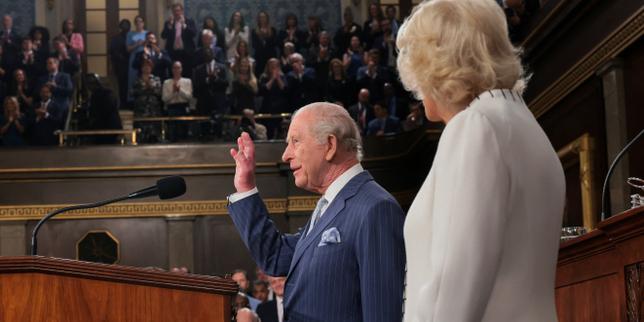
The wood of the rostrum in the United States Capitol is polished to a mirror shine, but it cannot hide the weight of the ghosts standing behind it. When King Charles III adjusted his notes under the watchful gaze of bronze statues and stone-faced lawmakers, he wasn't just a monarch delivering a speech. He was a man trying to convince a skeptical room that an old friendship isn't a museum piece.
Heritage is a dangerous drug. It makes us feel secure when we are actually stagnant. For decades, the bond between London and Washington has been treated like a vintage Bentley in a climate-controlled garage—admired, dusted occasionally, but rarely taken out on the highway where the salt and grit can test the engine.
Charles stood there, the weight of the Crown invisible but present, and told the assembled Congress something uncomfortable. He told them that the "Special Relationship" is dying of nostalgia.
The Myth of the Handshake
In the galleries, you could almost hear the echoes of Churchill. That is the problem. Every time a British leader crosses the Atlantic, we reach for the black-and-white photos of 1941. We talk about shared values and common languages as if those things are enough to pay the bills or stop a drone swarm.
History is a foundation, not a fuel.
Consider a hypothetical mid-level trade negotiator in a windowless office in Arlington, Virginia. Let's call her Sarah. Sarah doesn't care about the Magna Carta. She cares about supply chain resilience, semiconductor sovereignty, and why British regulations on data privacy don't mesh with American tech giants. To Sarah, the "Special Relationship" is a phrase that complicates her spreadsheets. It is a sentimental layer of paint over a very complex, very modern machine that is currently grinding its gears.
When the King spoke, he was speaking to the Sarahs of the world. He was acknowledging that the warmth of the past is no longer enough to heat the house.
The Cost of Resting
The numbers are often buried in the back of briefing papers, but they tell a story of drift. Since the late 2010s, the dream of a comprehensive UK-US free trade agreement has moved from a "top priority" to a "long-term aspiration." While the two nations remained distracted by internal tremors—political shifts, economic re-alignments, and the slow-motion hangover of global lockdowns—the rest of the world didn't wait.
New blocs formed. The Indo-Pacific became the center of gravity. Technologies that didn't exist when the Atlantic Charter was signed are now the primary weapons of economic warfare.
Charles pointed to this shifting map without using the dry language of a geographer. He framed it as a moral urgency. To "rest on past successes," as he cautioned, is to concede the future to those who have no interest in the democratic ideals the two nations claim to cherish.
If the alliance is a bridge, we have spent twenty years talking about the beauty of the stones and zero years checking the structural integrity of the steel cables. The cables are fraying.
The Climate of Necessity
There is one area where the King’s personal obsession met the harsh reality of modern statecraft: the planet. For fifty years, Charles was the lonely voice in the garden, talking about organic soil and carbon cycles while the world laughed. No one is laughing now.
In the halls of Congress, where climate change is often treated as a partisan football, the King presented it as the ultimate security threat. This wasn't a plea for "green living." It was a strategic assessment.
The alliance cannot survive a world where mass migration caused by crop failure destabilizes every border. It cannot survive if the two greatest innovators of the English-speaking world are not aligned on the energy transition. By weaving environmental stewardship into the fabric of the military and economic alliance, Charles did something subtle. He updated the definition of "defense."
Defense is no longer just about how many carriers you have in the drink. It’s about whether you can keep the lights on without funding a dictator's war chest. It's about whether the "Special Relationship" can produce the next generation of fusion power or if that breakthrough will happen elsewhere while London and Washington are busy arguing about the 1940s.
The Invisible Stakes
Why does any of this matter to someone buying a coffee in Des Moines or a pint in Manchester?
Because alliances are the invisible safety nets of our daily lives. They dictate the price of that coffee and the security of the job held by the person pouring it. When the US and the UK are out of sync, the world becomes more expensive and more dangerous.
The King's message was a wake-up call to the "Atlanticists" who think the bond is self-sustaining. It isn't. It is a living thing that requires constant, often painful, adaptation. It requires the United States to look at the UK not as a junior partner or a historical theme park, but as a high-tech laboratory and a strategic pivot point. It requires the UK to stop looking for a "paternal" blessing from Washington and start acting like a sovereign power that brings unique, indispensable assets to the table.
The Silence After the Applause
As Charles concluded, the applause was polite, even warm. But the real work began when the cameras turned off.
The speech was a bridge between the era of his mother—a queen who saw the transition from empire to alliance—and an era where the alliance itself must justify its existence every single day. There is no more "automatic" loyalty. There is only the cold, hard logic of mutual benefit.
He left the podium and walked back through the Statuary Hall, past the figures of men who built the world we are currently watching dissolve. The King knows that titles and traditions are fragile. He knows that the crown he wears is only as strong as the country it represents. And he knows that if the Atlantic alliance remains a ghost of the past, it will eventually vanish entirely.
The image that remains is not one of a King in a palace, but of a man standing before a room of preoccupied politicians, holding up a mirror. He didn't ask them to remember who they were. He challenged them to decide who they are going to be.
The mirror is still there, hanging in the air of the Capitol, waiting for an answer that involves more than just a handshake.