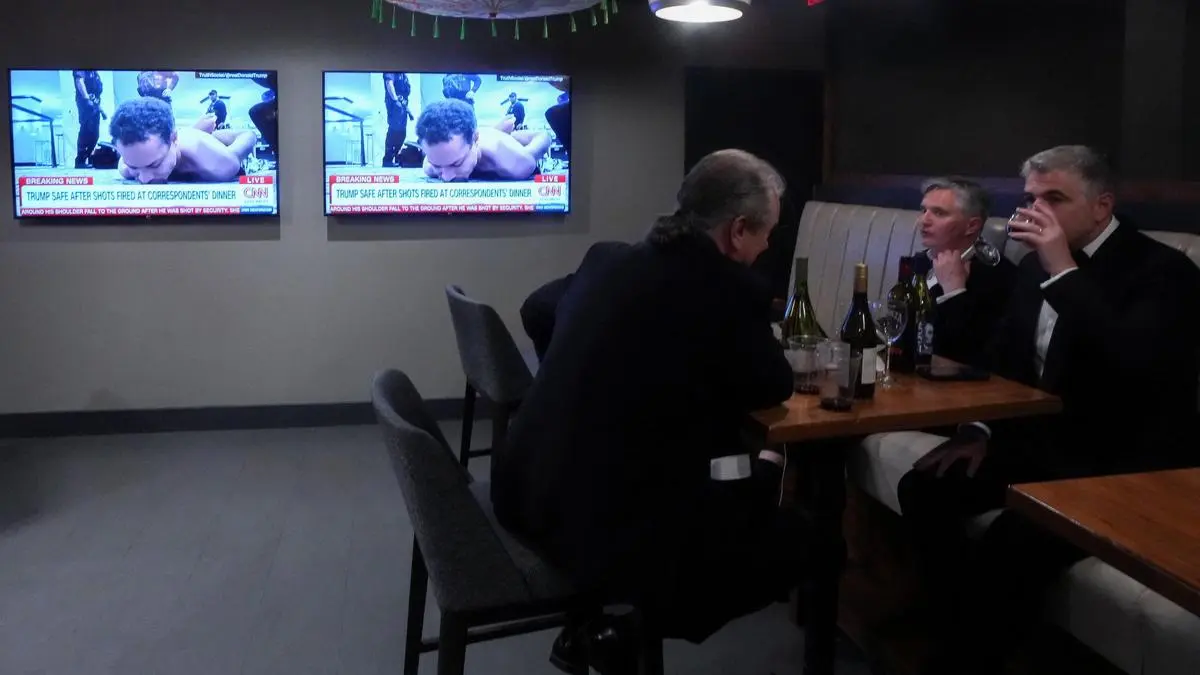
The Washington Hilton has a specific smell during the White House Correspondents' Dinner. It is a thick, cloying mixture of expensive perfume, floor wax, and the metallic tang of high-stakes anxiety. For decades, this room has been the ultimate intersection of power and punchlines. But on that Saturday night, the air changed. It didn't happen with a shout or a manifesto. It happened with a mechanical rhythm that tore through the sound of clinking silverware and forced a room full of the world’s most powerful people to realize how fragile their reality truly is.
At the center of the wreckage stood a man who, until that moment, was a ghost in the machinery of modern America. His name is Cole Allen.
To understand the shooter, you have to look past the mugshot. You have to look into the quiet, desolate spaces of a life that seemed to be evaporating long before he ever picked up a weapon. Allen wasn't a titan of industry or a political mastermind. He was a man who lived in the margins, a thirty-four-year-old whose digital footprint was a trail of breadcrumbs leading toward a cliff.
The Quiet Room in Ohio
Imagine a house where the blinds are always drawn. In a small suburb outside of Columbus, Cole Allen spent the better part of three years retreating from a world he no longer recognized. Neighbors remember him as the man who mowed his lawn at odd hours, never making eye contact, his shoulders hunched as if he were bracing for a blow that only he could see coming.
He had lost his job at a local logistics firm during a wave of automation and downsizing. It is a story we hear often, so often that we have become numb to the human cost. For Allen, this wasn't just a loss of income. It was the loss of a tether. Without the nine-to-five rhythm, the days bled into one another. He began to fill the silence with the loudest voices he could find online.
The descent wasn't overnight. It was a slow, agonizing erosion.
His browser history, later recovered by investigators, revealed a man obsessed with the idea of "The Great Filter." He wasn't just reading conspiracy theories; he was consuming them as if they were oxygen. He believed the people gathering in that ballroom in D.C. were the architects of his personal ruin. In his mind, the journalists and the politicians were laughing at the man in the dark room in Ohio. They were the punchline, and he was the joke.
The Geography of a Grievance
Washington D.C. is a city of circles and spokes, designed to make you feel the weight of history at every turn. When Cole Allen drove his aging sedan across the Potomac, he wasn't just crossing a river. He was entering the belly of the beast he had built in his imagination.
He stayed in a budget motel in Arlington, a place where the carpets are stained with the stories of a thousand transients. He didn't leave a note. He didn't record a manifesto video. He simply sat. He watched the news coverage of the upcoming dinner, seeing the red carpets and the tuxedoes, the celebrities and the cabinet members.
There is a specific kind of madness that takes hold when a person feels invisible. It is the desire to be seen, even if the seeing is done through the lens of a tragedy. Allen wasn't looking for a political shift. He was looking for an ending to the silence of his own life.
The Breach
The security around the President and the press corps is meant to be a fortress. It is a layered system of magnets, dogs, and eyes that never blink. Yet, human systems are only as strong as their most complacent moment.
Allen didn't look like a threat. He looked like the help.
Wearing a generic black suit and carrying a stolen service badge, he moved through the service entrances of the Hilton with the practiced indifference of someone who belonged there. He had spent weeks studying the floor plans of the hotel, learning the shifts of the catering staff, and identifying the blind spots in the perimeter.
When he stepped into the ballroom, the lights were low. A comedian was mid-sentence, a joke about the debt ceiling hanging in the air. The laughter was warm and collective.
Then came the first pop.
It sounded like a champagne cork. Then another. And another. The transition from a gala to a battlefield happens in a heartbeat. The human brain struggles to process the shift; it looks for excuses. A balloon popping. A speaker blowing out. Anything but the truth.
But when the screams started, the truth became undeniable.
The Anatomy of the Aftermath
The Secret Service response was a blur of black suits and drawn weapons. They are trained for the "unlikely event," but the reality is always more chaotic than the drill. In the sixty-one seconds it took to neutralize the threat, the room transformed. People who dictate the policy of nations were crawling under tables, their finery covered in the dust of the ballroom floor.
Cole Allen didn't run. He didn't hide. He stood there until the weight of the security detail brought him down.
When the smoke cleared, the tally of the physical damage was small compared to the psychic wound. Several members of the waitstaff and two journalists were injured in the crossfire and the ensuing stampede. But the real casualty was the illusion of safety that the capital usually affords itself.
In the interrogation room, Allen was eerily calm. He didn't shout about revolution. He didn't demand a lawyer. He asked for a glass of water and remained silent for six hours. When he finally spoke, he didn't talk about the people he had hurt. He talked about the sound of the lawnmower in Ohio. He talked about how the sun felt on the day he was fired.
He was a man who had already left the world; he was just waiting for his body to catch up.
The Echoes in the Hallway
The trial of Cole Allen will be a spectacle. There will be debates about mental health, gun control, and the radicalization of the American middle class. Experts will sit behind desks and analyze his digital trail, searching for the "why" as if it were a mathematical equation they could solve.
But the "why" is often simpler and more terrifying than we want to admit.
It is the story of a man who fell through every safety net our society has built. He fell through the economic net, the social net, and finally, the reality net. He was a person who became a ghost, and in his desperation to feel solid again, he chose to break the world around him.
The White House Correspondents' Dinner will happen again. The jokes will be told, the wine will flow, and the security will be tighter than ever. But there will be a shadow in the room. Every time a door slams or a glass breaks, eyes will dart toward the entrances.
We live in a time where the distance between a quiet room in Ohio and the center of global power is shorter than we think. It is a distance bridged by isolation and fueled by a sense of being forgotten. Cole Allen is not a monster from a movie. He is a mirror. He reflects the consequences of a culture that values the spectacle but ignores the spectator until he is holding a gun.
The ballroom has been cleaned. The carpets have been replaced. But if you stand in the center of that room and close your eyes, you can still feel the coldness of that night. It is the coldness of a life that went dark long before the first shot was fired.
He wanted to be the story. Now he is. And we are the ones left trying to figure out how to write a different ending for the next man sitting in a dark room, waiting for the world to notice he is still there.
The silence he left behind is louder than the gunfire ever was.