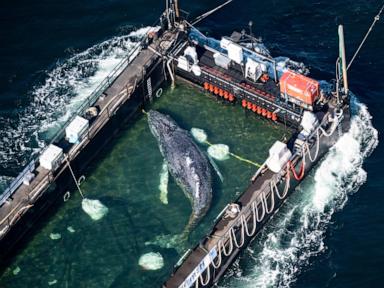
The relocation of a juvenile humpback whale (Megaptera novaeangliae)—specifically the individual identified as Timmy—from a captive or stranded environment to the North Sea represents a high-stakes intersection of marine engineering, physiological stress management, and seasonal migratory windows. Success in such an operation is not defined by the mere arrival of the vessel at its destination; it is measured by the whale's post-release metabolic stability and its ability to integrate into established migratory corridors. The logistical framework required to move a multi-ton marine mammal across international waters involves three primary critical paths: thermal regulation, structural load distribution, and the mitigation of "transport-induced immunosuppression."
The Physics of Cetacean Transport
Transporting a humpback whale on a barge introduces immediate physical challenges that do not exist in the animal's natural buoyancy-supported environment. On land or on a vessel, the whale’s skeletal structure and internal organs are subjected to the full force of gravity.
Hydrostatic Support vs. Gravitational Compression
In the water, a whale is supported by the density of the surrounding medium. On a barge, even within a specialized tank, the animal's massive weight compresses its lungs and internal vasculature. This creates a risk of organ ischemia—a restriction in blood supply to tissues—and can lead to muscle necrosis (rhabdomyolysis) if the transport duration exceeds the animal's physiological threshold for static positioning. To counter this, engineers utilize specialized slings or thick foam mattresses designed to distribute the load across the greatest possible surface area of the ventral pleats.
Thermal Conductance and Evaporative Cooling
Whales are insulated by thick layers of blubber designed to retain heat in cold water. Once removed from the ocean and placed on a barge, they lose the ability to dump heat through their skin via convection. A humpback whale’s core temperature can rise to lethal levels even in cool air temperatures due to metabolic heat production and the lack of a thermal sink. The cooling system on the barge must provide a continuous flow of seawater over the dorsal and pectoral fins, which act as heat exchangers. This is not merely for skin hydration; it is a critical life-support function to prevent hyperthermia.
The Logistics of the North Sea Transit
The selection of the North Sea as a release point is a strategic decision based on the availability of nutrient-rich feeding grounds and the proximity to known humpback migratory routes. However, the North Sea is one of the world's most congested maritime environments, introducing specific variables into the transport equation.
Navigational Risk and Acoustic Environment
The barge must navigate shipping lanes characterized by high vessel density. For a whale already experiencing the stress of transport, the acoustic pollution from the barge’s engines and nearby industrial traffic can elevate cortisol levels. Chronic stress in cetaceans inhibits the immune system, making them vulnerable to opportunistic infections once they return to the wild. The mission profile requires a "silent running" approach where possible, utilizing low-vibration propulsion systems to minimize the acoustic load on the animal.
The Seasonal Migratory Window
Humpback whales are highly migratory, moving between high-latitude feeding grounds and low-latitude breeding grounds. Releasing Timmy in the North Sea is only viable if the timing aligns with the presence of prey species, such as sand eels, herring, and mackerel. If the release occurs outside of peak productivity months, the individual may lack the energy reserves to complete its next migratory leg.
The Biological Viability Framework
The decision to move the whale is governed by a cost-benefit analysis of its long-term survival versus the immediate risks of the journey. This can be broken down into the following variables:
- Metabolic Reserve Index: Does the whale possess sufficient blubber thickness to survive a period of reduced feeding during and immediately after transport?
- Pathogen Exposure: The North Sea contains different microbial populations than the whale’s previous location. The animal's "immune memory" must be robust enough to handle local flora.
- Social Integration Capacity: Humpbacks are not as socially complex as orcas, but they do rely on acoustic communication to navigate and find mates. The release must happen in an area where Timmy can detect the vocalizations of other humpbacks.
Post-Release Monitoring Systems
The true success of the journey begins at the moment of release. The barge is equipped with specialized ramps or cranes to ensure a "soft release"—lowering the animal into the water at a controlled speed to prevent sudden pressure changes or physical shock. Once in the water, satellite-linked telemetry tags provide the data necessary to evaluate the mission’s outcome. These tags monitor:
- Dive Profiles: Deep, rhythmic dives indicate successful foraging and normal lung function.
- Velocity and Heading: Consistent northward or southward movement suggests the animal has successfully reoriented to migratory cues.
- Acoustic Feedback: Subsurface microphones can occasionally capture the animal's vocalizations, indicating its attempt to communicate with conspecifics.
Structural Bottlenecks in Marine Relocation
The primary bottleneck in this operation is the mechanical limitation of the barge's life-support system. In the event of a mechanical failure of the water pumps or a significant delay due to weather in the North Sea, the animal's health will degrade exponentially.
The second limitation is the legal and jurisdictional complexity. Moving a protected species across international maritime borders requires coordination between environmental agencies, coast guards, and port authorities. Any delay at a border or during a pilotage transfer increases the animal's "out-of-water" time, which is the single greatest predictor of mortality in these operations.
Strategic Implementation for Large-Scale Relocation
To maximize the probability of Timmy's successful integration into the North Sea ecosystem, the operational team must move beyond reactive animal care and toward a predictive physiological model. This involves:
- Real-time Blood Chemistry Monitoring: Utilizing portable analyzers to check for markers of muscle damage (creatine kinase levels) and dehydration during the transit.
- Dynamic Ballast Adjustment: The barge must maintain extreme stability. Rapid rolling or pitching can cause the whale to shift, leading to blunt force trauma against the sides of the transport tank.
- Pharmacological Intervention: The use of mild sedatives or electrolytes to stabilize the animal's heart rate and hydration levels during high-stress phases of the journey, such as crane lifts or harbor exits.
The relocation of Timmy is a pilot case for future "rewilding" efforts of megafauna. If the data from this journey confirms that a juvenile humpback can survive long-distance barge transport without significant physiological "debt," it opens the door for broader interventions in cases of habitat loss or climate-driven stranding events.
The operation must prioritize the transition from the artificial environment of the barge to the high-energy environment of the North Sea. This requires a release site characterized by low current velocity to allow the whale to regain its equilibrium before it is forced to swim against the North Sea's powerful tidal flows. The final maneuver—the immersion—must be executed during a slack tide to minimize the energy expenditure required for the whale's first breaths in the wild. Success is not a destination; it is the animal's first successful deep-water forage, occurring miles away from the barge that carried it.