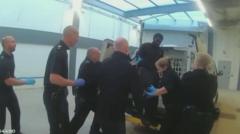
New footage of a killer kicking a police officer at a station has changed the tone of the ongoing inquiry into the death of Mzee Mohammed. It’s a messy, violent, and deeply uncomfortable watch. But it’s necessary for understanding the chaos of that night. You can't look at police restraint cases in a vacuum. You have to see the escalation. The Liverpool hearing recently viewed this CCTV, and it shows the sheer volatility the officers faced before the situation turned fatal.
Mzee Mohammed died in 2016 after being detained by several officers and security guards at the Liverpool One shopping center. For years, his family has fought for answers. They've questioned why a 18-year-old in mental distress ended up dead while in the "care" of the state. The inquiry isn't just a formality. It’s a grueling dissection of minutes and seconds.
The footage that changed the narrative
The inquiry recently shifted its focus to an incident involving another man, referred to in the proceedings as "the killer," who was being held at a station around the same time. This wasn't a minor scuffle. The video shows a sudden, explosive burst of violence where an officer is kicked while trying to manage a high-tension environment.
Why does this matter for Mzee’s case? It sets the scene. It shows the atmospheric pressure on the ground. When you're an officer and you've just seen a colleague get blindsided, your adrenaline is red-lining. Your threat perception changes. That doesn't excuse excessive force, obviously. But it provides the context of "tactical exhaustion" that often leads to tragedy.
The kick was a clear assault. It happened in the booking area, a place that's supposed to be secure. When the "secure" areas of a station become combat zones, the ripple effect hits every other interaction that night.
Mental health and the thin blue line
Mzee Mohammed was reportedly acting erratically before his detention. Witnesses saw him with a knife. He was clearly not in his right mind. This is where the system usually breaks down. We ask police to be mental health professionals, paramedics, and combatants all at once. Usually, they're only trained to be one of those things well.
In the inquiry, the focus has often landed on "positional asphyxia." That’s the technical term for someone suffocating because of how they're being held down. It's a common factor in custody deaths. If you're stressed, your heart is racing, and you're pinned to the floor, your body can just give up. The inquiry is looking at whether the officers recognized Mzee’s distress or if they were too focused on the "threat" he posed.
What the inquiry missed for years
For a long time, the public only saw the cell footage or the mall security tapes. We didn't see the peripheral violence happening at the station. This new evidence about the officer being kicked explains the "heightened state" of the force. If you’ve spent your shift dodging kicks and punches, you're less likely to be "gentle" during a restraint.
It’s a brutal cycle.
The jury has to decide if the level of force used on Mzee was "proportionate." That word gets thrown around a lot in legal circles, but in the real world, it’s a moving target. What's proportionate when a guy has a knife? What’s proportionate when he’s stopped moving? These are the questions that haunt these hearings.
The reality of police restraint training
Most people think police training is this rigid, foolproof system. It isn't. It’s often a few days a year of grappling in a gym. When you're out in a shopping center with hundreds of people watching and a teenager is screaming, the training manual usually flies out the window.
The Mzee Mohammed inquiry is highlighting a massive gap in how we handle "Acute Behavioral Disturbance" (ABD). This is a medical emergency that looks like a criminal act. The person is often hot to the touch, incredibly strong, and completely detached from reality. If you treat ABD as a standard "resisting arrest" scenario, people die.
The footage of the officer being kicked at the station serves as a grim reminder. The officers were dealing with multiple high-stakes incidents simultaneously. It was a pressure cooker.
Why this case refuses to go away
Eight years. That's how long the family has been waiting. The reason this case remains a flashpoint in Liverpool is the feeling that the full story was being edited. By showing the station attack now, the inquiry is finally putting all the cards on the table.
We need to look at the "Swiss Cheese Model" of failure here. Every hole in the system—bad training, high stress, mental health gaps, and physical violence—aligned perfectly to cause a death.
If you're following this, don't just look at the moment Mzee stopped breathing. Look at the two hours before it. Look at the chaos at the station. Look at the failed radio communications.
The inquiry continues to peel back layers. It's not about finding a single "bad guy" anymore. It's about showing how a dozen "good guys" can still end up involved in a catastrophe because the system they work in is broken.
The next step for anyone following this is to look into the Independent Office for Police Conduct (IOPC) reports on ABD. Understanding how medical distress is mistaken for aggression is the only way to prevent another Mzee Mohammed case. Read the guidelines. Look at the data on custody deaths. The more we know about the physiology of restraint, the better we can hold these institutions accountable.