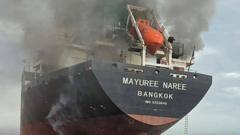
A single degree of steering. That is all it takes to shift a two hundred thousand ton steel behemoth from the path of prosperity to the center of a global firestorm.
If you stood on the jagged cliffs of Oman’s Musandam Peninsula, the water below would look deceptive. It is a deep, shimmering turquoise, appearing infinite. But for the global economy, this is a narrow, suffocating hallway. This is the Strait of Hormuz. Twenty-one miles wide at its tightest point. A choke point. A jugular.
Imagine a merchant sailor named Elias. He is not a diplomat or a grand strategist. He is a man who misses his daughter’s birthday because he is overseeing the transport of two million barrels of crude oil toward a refinery in Daesan, South Korea. For Elias, the "Strait" isn't a line on a map or a bullet point in a briefing. It is the sound of the bridge alarm. It is the sight of an Iranian fast-attack craft skipping across the wake like a water strider, its crew masked, its intentions unread.
When the news cycle talks about "maritime security" and "allied cooperation," they are really talking about whether Elias gets to finish his coffee in peace, or whether the price of heating a home in Manchester or fueling a truck in Ohio is about to double overnight.
The Mathematics of Fear
The world’s appetite for energy is a physical thing. One-fifth of the world’s liquid petroleum passes through this tiny gap. It is the exit door for the lifeblood of Kuwait, Qatar, Saudi Arabia, and the United Arab Emirates.
When the United States calls for a "coalition of the willing" to patrol these waters, it isn't just asking for ships. It is asking for a public declaration of sides. To send a destroyer is to say that the flow of oil is more important than the risk of a regional explosion. To refuse is to signal that the cost of American leadership has finally become too high to pay.
The tension exists because the Strait is not just a trade route; it is a lever. Tehran knows that if it can credibly threaten to close the door, it holds the world’s thermostat. For decades, the U.S. Fifth Fleet acted as the primary bouncer at this door. But the world has changed. The bouncer is tired, and the other guests at the party are starting to look at the exit.
The Reluctant Shield
Washington’s call for the "International Maritime Security Construct" (IMSC) was met with a silence that was louder than any political speech.
Consider the European perspective. Berlin and Paris didn't see a simple security mission. They saw a trap. They feared that joining a U.S.-led mission would be seen as an endorsement of "maximum pressure" tactics. They wanted the oil, yes, but they didn't want the war that might come with securing it.
Germany’s response was a masterclass in diplomatic hesitation. They spoke of "diplomacy first." They looked at their history and saw the ghosts of past entanglements. France and Italy eventually opted for a separate, European-led mission—Operation AGENOR. It was a polite way of saying, "We will guard the door, but we aren't standing next to you."
This fragmentation is a symptom of a deeper rot in the old alliances. When the UK eventually joined the U.S. mission, it wasn't because of a shared grand vision. It was a visceral reaction to the seizure of the British-flagged Stena Impero. It was personal. It was about sovereignty.
The deck of a ship is a lonely place when you realize your closest neighbors are arguing about the rules of engagement while a drone circles your mast.
The Dragon’s Calculation
While the West argued over who would pay for the fuel and who would take the blame, Beijing watched from across the Indian Ocean.
China is the world's largest importer of crude oil. Most of it comes through that twenty-one-mile gap. If the Strait closes, the lights in Shanghai don't just flicker—they go out. You would expect China to be the first to send a carrier group, the first to demand order.
Instead, they played a different game.
Beijing’s strategy is one of "strategic ambiguity" wrapped in a cloak of commerce. They have a base in Djibouti. They have a growing navy. Yet, they stayed largely on the sidelines of the formal coalitions. Why? Because they realized that as long as the U.S. is obsessed with being the world’s policeman, China can be the world’s customer.
They talk to everyone. They sign twenty-five-year cooperation agreements with Iran while simultaneously buying record amounts of Saudi crude. They don't want to be the bouncer. They want to be the person who owns the building.
When asked about sending ships, Beijing’s officials often point to the "complexity of the situation." It is a beautiful, empty phrase. It allows them to criticize "unilateralism" while reaping the benefits of the very stability the U.S. Navy provides. It is the ultimate free ride, and it is working.
The Ghost Ships and the Shadow War
The real story of the Strait of Hormuz isn't found in the official navy photos of gleaming frigates. It is found in the "dark fleet."
Thousands of tankers now navigate these waters with their AIS—the digital heartbeat that tells the world who and where they are—turned off. They are ghosts. They carry "blood oil," moving through the shadows to bypass sanctions.
This creates a terrifying reality for sailors like Elias. How do you maintain maritime law in a place where half the participants are pretending they don't exist? The risk of a collision is high; the risk of a miscalculation is higher.
We often think of war as a sudden, loud event. A declaration. A flash. But in the Strait, war is a slow, grinding process of attrition. It is a limpet mine attached to a hull in the middle of the night. It is a GPS spoofing signal that makes a navigator think they are in international waters when they are actually drifting into a trap.
It is a psychological war. Every time a ship is harassed, the insurance premiums for every vessel in the region tick upward. A few cents here, a few dollars there. By the time that oil reaches a gas station in a suburb, those "security costs" have been baked into the price of a gallon of milk. We are all paying for the standoff in the Strait, even if we’ve never seen the ocean.
The Invisible Stakes
We have a tendency to view these geopolitical chess matches as abstract. We see the names of the ships—the USS Abraham Lincoln, the HMS Duncan—and they feel like toys.
But consider the engine room of a VLCC (Very Large Crude Carrier). It is a cathedral of heat and vibrating metal. The engineers working there know that if a missile hits, they are in a steel coffin filled with fuel. There is no "diplomatic solution" when the hull is breached.
The U.S. allies are hedging because they are no longer sure the American umbrella is big enough to cover them. Japan, a nation almost entirely dependent on Middle Eastern oil, sent its own "information-gathering" vessel, carefully avoiding the U.S. command structure. India sent its own warships to escort Indian-flagged tankers.
This is the sound of a world breaking apart into islands of self-interest.
The "Strait" is becoming a laboratory for a new kind of world order. One where the old rules of "freedom of navigation" are being replaced by "protection for those who can afford it."
The Horizon
The sun sets over the Persian Gulf with a blood-orange hue that poets might find beautiful and sailors find ominous.
On the bridge of a tanker, the radar screen is a cluttered mess of green blips. Some are friends. Some are rivals. Some are predators. The captain watches the narrow passage ahead. He knows that his safety depends on the mood of a regime in Tehran, the political willpower of a distracted Washington, and the silent calculations of a rising Beijing.
There is no "solution" to the Strait of Hormuz. There is only management. There is only the daily, high-stakes gamble that today will not be the day a mistake becomes a catastrophe.
The ships will keep moving. The oil will keep flowing. The world will keep turning. But the silence between the allies, and the growing shadow of the Dragon in the east, tells us that the quiet on the horizon is fragile.
We are all riding on the back of those tankers. We are all drifting through that twenty-one-mile gap. We just haven't realized how thin the steel beneath our feet actually is.
Would you like me to analyze the current insurance premium spikes for maritime shipping in the region to see how they've fluctuated over the last quarter?