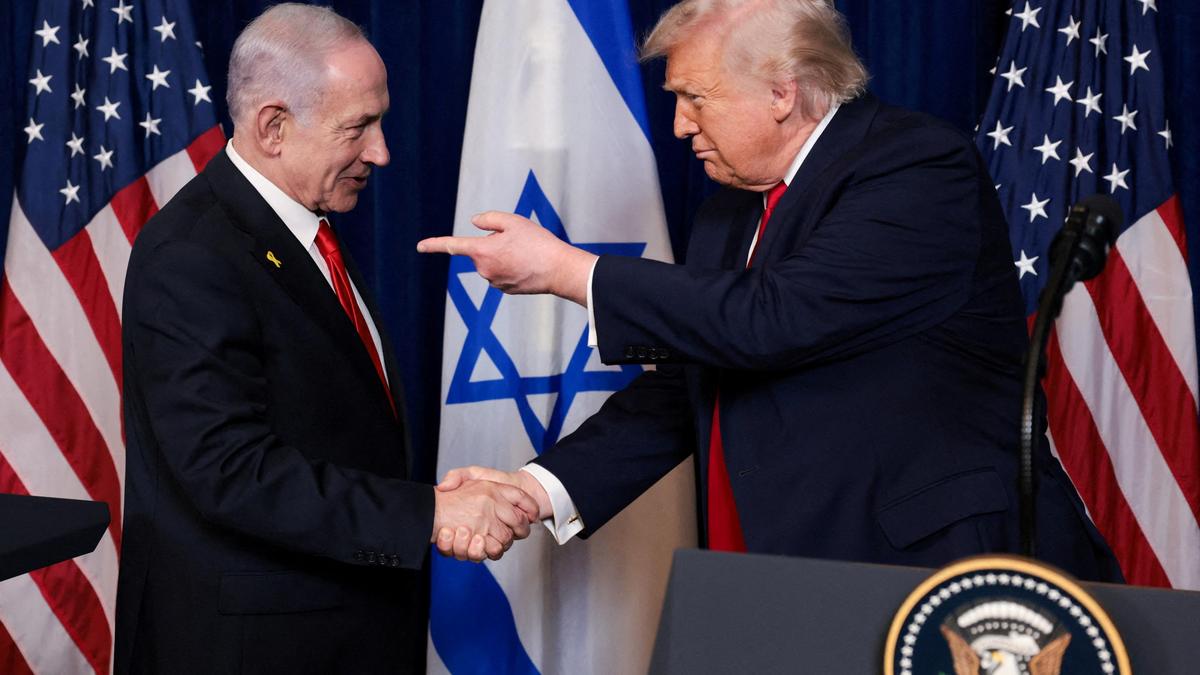
The convergence of Benjamin Netanyahu’s strategic objectives with Donald Trump’s transactional foreign policy creates a high-stakes feedback loop that fundamentally alters the security architecture of the Middle East. While surface-level reporting focuses on the personal rapport between the two leaders, the underlying mechanism is a rigorous alignment of domestic political survival and regional power projection. This partnership is not a diplomatic luxury but a structural necessity for both parties, driven by the need to bypass traditional multilateral constraints and establish a bilateral "security-first" hegemony.
The Triad of Strategic Alignment
To understand the trajectory of Israel-US relations under this specific alignment, we must deconstruct the partnership into three functional pillars: Regional Containment, Sovereignty Validation, and Domestic Political Leverage.
1. Regional Containment and the Iran Variable
The primary driver of the Netanyahu-Trump axis is the shared perception of the Iranian threat as an existential and systemic risk. Unlike previous administrations that sought to manage Iran through international frameworks like the JCPOA, this alignment prioritizes "Maximum Pressure" as a non-negotiable baseline.
The logic follows a clear cost-benefit function:
- Economic Attrition: By reimposing and expanding sanctions, the goal is to raise the cost of Iranian proxy funding (Hezbollah, Hamas, Houthis) until it becomes a domestic liability for Tehran.
- Kinetic Deterrence: The removal of self-imposed escalatory limits allows for more aggressive intelligence and military operations within Iranian territory.
- Coalition Architecture: The Abraham Accords serve as the operational framework for this containment, shifting the regional balance from an Arab-Israeli conflict to an Iran-Arab-Israeli standoff.
2. Sovereignty Validation and Territorial Precedent
Netanyahu’s strategy hinges on securing irreversible US recognition of Israeli territorial claims. The move of the US embassy to Jerusalem and the recognition of sovereignty over the Golan Heights were not merely symbolic gestures; they were shifts in the legal and diplomatic baseline.
In a renewed partnership, the focal point shifts to the West Bank (Judea and Samaria). The mechanism here is "Legal Realism"—the idea that long-standing facts on the ground should dictate diplomatic recognition rather than the other way around. This approach bypasses the "Land for Peace" formula, replacing it with a "Peace through Strength and Recognition" model.
3. Domestic Political Leverage
For both Netanyahu and Trump, foreign policy victories serve as critical shields against domestic legal and political challenges.
- The Netanyahu Benefit: Every diplomatic "win" with Washington reinforces his image as the "Irreplaceable Statesman," a core component of his electoral viability.
- The Trump Benefit: Demonstrating a "pro-Israel" stance solidifies his base, particularly evangelical voters and conservative donors, while allowing him to contrast his "decisive action" against the "strategic ambiguity" of his political opponents.
The Economics of Security Assistance
The financial relationship between the US and Israel is often misunderstood as a one-way subsidy. In reality, it functions as a highly sophisticated reinvestment cycle. Under the current Memorandum of Understanding (MOU), a significant portion of Foreign Military Financing (FMF) must be spent within the US defense industrial base.
This creates a specific economic dependency:
- Industrial Integration: Israeli combat-tested modifications to US platforms (like the F-35) provide the US military with invaluable real-world data and technological iterations.
- R&D Offsets: Cooperative development of missile defense systems (Iron Dome, David’s Sling, Arrow) allows the US to outsource high-risk R&D while retaining intellectual property rights and procurement options for its own forces.
- Regional Stability as a Cost-Saver: A militarily superior Israel reduces the need for large-scale US troop deployments in the Levant, effectively acting as a regional security "subcontractor."
The friction point arises when Israeli indigenous defense firms compete with US contractors for third-party exports. A Netanyahu-Trump alignment typically favors Israeli autonomy in this sector in exchange for intelligence sharing and strategic loyalty.
Operational Risks and Systemic Constraints
Despite the perceived synergy, the alignment faces significant structural bottlenecks. The first limitation is the "Transactional Volatility" inherent in the Trump foreign policy doctrine. Trump’s "America First" approach prioritizes immediate, tangible gains over long-term ideological commitments. If Israeli security needs conflict with US trade interests or isolationist impulses, the partnership enters a zone of uncertainty.
The second limitation is the erosion of bipartisan support in the US. By aligning so closely with a specific wing of the Republican Party, Netanyahu risks the long-term durability of the US-Israel relationship. The demographic shifts within the Democratic Party suggest that a future administration may view the "Netanyahu-Trump" era not as a blueprint, but as a provocation.
Thirdly, the regional escalation cycle presents a constant threat to the "Containment" strategy. If "Maximum Pressure" leads to a full-scale regional war, the US might find itself drawn into a conflict that its "America First" base is unwilling to fund or fight. This creates a paradox: the strength of the alliance increases the likelihood of the very conflict it seeks to deter through strength.
The Abraham Accords 2.0: Strategic Expansion
The next iteration of this partnership will likely focus on Saudi Arabia. The normalization of ties between Jerusalem and Riyadh is the "Grand Prize" of Middle Eastern diplomacy. For Netanyahu, this would signify the end of the Arab-Israeli conflict in its traditional form. For Trump, it would be a legacy-defining achievement that secures US influence in the global energy market.
The roadmap for this expansion requires three simultaneous concessions:
- US Security Guarantees for Riyadh: A formal or semi-formal defense pact that protects the Kingdom from Iranian aggression.
- Civilian Nuclear Access: Saudi Arabia’s demand for domestic uranium enrichment remains a significant hurdle for US non-proliferation advocates.
- Palestinian "Management": Unlike the initial accords, a Saudi deal will likely require a tangible, albeit limited, roadmap for Palestinian autonomy to satisfy Saudi domestic and pan-Islamic sensitivities.
Redefining the Red Lines
A critical component of the Netanyahu-Trump communications involves the recalibration of "Red Lines" regarding Iran’s nuclear program. The standard metric of "breakout time" (the time required to produce enough weapons-grade uranium for one bomb) has become increasingly obsolete as Iran masters the enrichment cycle.
The shift in strategy involves moving from monitoring enrichment levels to targeting the "Weaponization" phase. This requires a different intelligence posture and a readiness to engage in "Grey Zone" warfare—sabotage, cyber-attacks, and targeted eliminations—without triggering a total kinetic response. The Netanyahu-Trump alignment is uniquely positioned to execute this because both leaders are willing to tolerate higher levels of tactical risk than the traditional foreign policy establishment.
The Strategic Playbook
The current trajectory indicates a move toward a "Bilateral Fortress" model. Israel will continue to expand its defensive perimeter and consolidate its territorial position, betting that a sympathetic US administration will provide the diplomatic cover and military hardware necessary to sustain the status quo.
The immediate operational priority is the dismantling of the "Ring of Fire"—the network of Iranian-backed proxies surrounding Israel. This involves a two-pronged approach:
- Military Attrition: Systematic degradation of Hezbollah and Hamas infrastructure, regardless of international pressure for a ceasefire.
- Economic Isolation: Working with the US to cut off the financial arteries of these organizations, specifically targeting the "shadow banking" systems used by the IRGC.
The end state is not a negotiated peace in the 20th-century sense, but a 21st-century "Managed Conflict" where Israeli superiority is so absolute that the cost of resistance becomes prohibitive for its adversaries. This requires a US partner who views the Middle East through the lens of power dynamics rather than humanitarian or multilateral frameworks.
Deploying the "Abrahamic Security Pact" as a formal regional defense architecture is the ultimate objective. This would integrate Israeli air defense and intelligence with Gulf state resources, backed by US logistical and nuclear umbrellas. To achieve this, the Netanyahu administration must ensure that its domestic policy does not alienate the very US partners it requires for regional dominance. The strategy is to present Israel not as a client state in need of rescue, but as an indispensable technological and military hub that is essential for US interests in a multipolar world.