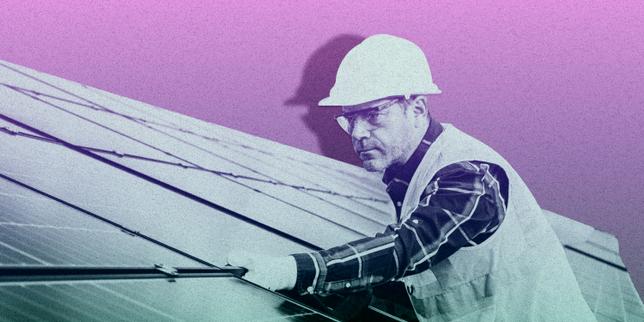
A cold wind bites through the high-visibility vests of workers at a sprawling construction site in Georgia. They aren’t thinking about geopolitics. They aren't debating the merits of the Paris Agreement or the nuances of carbon sequestration. They are bolting massive steel frames into the red clay, securing the skeleton of a multi-billion-dollar battery factory. This is the new American industrial heartland. And in a twist of irony that historians will likely chew on for decades, the man who arguably did the most to accelerate this transition is the one who spent his entire presidency trying to ignore it.
Donald Trump didn’t mean to save the planet. He meant to protect the old ways. He spoke of "beautiful clean coal" and promised to tear up every environmental regulation that crossed his desk. He wanted to freeze time. But the laws of physics and the brutal mechanics of the global market have a funny way of subverting a politician's intent. By attempting to turn the clock back, he inadvertently forced the rest of the world—and the American private sector—to sprint forward. Meanwhile, you can read other events here: The Caracas Divergence: Deconstructing the Micro-Equilibrium of Venezuelan Re-Dollarization.
The Great American Pressure Cooker
When a leader signals that the federal government is stepping back from the future, a vacuum is created. Nature hates a vacuum, but venture capital loves one. During the Trump administration, the sheer hostility toward renewable energy served as a massive, unintended stress test for the industry.
Think of a sapling. If you provide it with a stake and a gentle greenhouse, it grows straight but remains fragile. If you expose it to a gale, it either snaps or grows roots so deep they could crack bedrock. For four years, the American green energy sector was lashed by the wind. Subsidies were threatened. Rhetoric was scathing. The "green" label became a political lightning rod. To see the complete picture, we recommend the detailed article by CNBC.
The result? The industry stopped relying on the kindness of bureaucrats. It had to become leaner. It had to become profitable on its own merits. Solar and wind power didn't just survive; they became the cheapest sources of new electricity on the planet because they had to compete in a world where the government was actively rooting for the other team.
Consider a small-scale developer in the Midwest. In 2017, he might have been worried that the removal of federal incentives would kill his project. By 2019, he realized that the plummeting cost of hardware meant he didn't need a tax credit to make the math work. The hostility of the White House acted as a forge, tempering the industry into something that could no longer be stopped by a single pen stroke.
The Geopolitical Backfire
The world is a playground of unintended consequences. When the United States signaled its retreat from the global climate stage, it didn't stop the stage from moving. It just handed the lead role to someone else.
China watched the American withdrawal with the focused intensity of a predator. Every time the U.S. pulled back from an international agreement or questioned the validity of EV technology, Beijing doubled down. They saw the exit of American leadership not as a sign that green energy was a fad, but as a golden opportunity to corner the market on the next century’s oil: lithium, cobalt, and the processing of rare earth minerals.
But then, the pushback began.
The fear of Chinese dominance did what climate scientists couldn't. It turned the energy transition into a matter of national security. Even the most ardent skeptics in Washington began to realize that if the U.S. didn't build batteries, solar panels, and wind turbines, it would be trading a dependence on Middle Eastern oil for a total reliance on Chinese technology.
Trump’s protectionist "America First" stance created a paradox. To actually put America first in the 21st century, you have to win the technology race. You can’t win a race by pretending the track doesn't exist. This realization trickled down into "Red" states—places like South Carolina, Tennessee, and Ohio. These states began competing for "green" jobs not out of a sudden love for the environment, but out of a desperate, competitive need to secure the manufacturing jobs of the future.
The Red State Battery Belt
If you drive through the rural corridors of the American South today, you will see a landscape transformed. It is a world of massive gray warehouses and humming electrical substations. This is the "Battery Belt."
The irony is thick enough to choke on. The very regions that voted most enthusiastically for a candidate who mocked electric vehicles are now the regions whose economies are most dependent on their success.
Imagine a worker named Jim. Jim has spent thirty years in manufacturing. He’s seen plants close and towns wither. He doesn't care about the carbon footprint of a lithium-ion cell. He cares that the new plant down the road is hiring 2,000 people at $28 an hour. He cares that his son doesn't have to move to a different state to find a career.
This is the "involuntary service" Trump rendered. By making trade and manufacturing a central pillar of his platform, he forced a conversation about where things are made. He inadvertently laid the psychological groundwork for the massive industrial policy that followed. When the Inflation Reduction Act eventually passed under his successor, the infrastructure and the "buy American" sentiment were already primed.
The transition stopped being a lifestyle choice for people in San Francisco and started being a survival strategy for people in Spartanburg.
The Invisibility of the Shift
We often mistake loud voices for real power. We listen to the shouting on television and assume that is where the world is headed. But the real shift—the one that actually changes the trajectory of the human race—happens in the quiet.
It happens in the boardrooms of utility companies. These are not places of radical activism. They are places of spreadsheets and 30-year projections. During the years of "climate skepticism" at the top, these companies didn't suddenly decide to build more coal plants. Why? Because you can’t build a 30-year business plan on a four-year political cycle.
The markets saw through the noise. They realized that while a president can change a regulation, he cannot change the fact that the sun provides energy for free while coal has to be dug out of the ground, transported, and burned. The uncertainty of the Trump era actually accelerated the move toward renewables because investors hate uncertainty. They looked for the most stable, long-term bet available. In a world of volatile oil prices and shifting trade wars, a wind farm in Iowa looked like the safest place on Earth to put a billion dollars.
The Psychological Pivot
Perhaps the greatest service provided was the stripping away of the "elite" veneer of environmentalism. For a long time, the green movement felt like a luxury good—something for people who could afford a $100,000 sedan and organic kale.
By making the energy transition a point of intense conflict, Trump forced it into the mainstream. It became something worth fighting over. And in that fight, the arguments for green energy evolved. They moved away from "save the polar bears" and toward "beat China," "rebuild the middle class," and "energy independence."
This shift in language is permanent. You cannot un-ring that bell.
The debate is no longer about whether the transition is happening. The debate is now about who gets the credit and who gets the cash. That is a massive victory for the planet, achieved by the person who least wanted to see it happen. It is the ultimate historical prank.
The Georgia workers continue their task as the sun begins to set, casting long shadows across the valley. They are building the future, one bolt at a time, in a factory that was born out of a desperate need to compete in a world that refused to stay in the 1950s. The rhetoric of the past is just echoes now, drowned out by the sound of impact wrenches and the steady, unstoppable hum of a new grid being born.
History doesn't care about your intentions; it only cares about what you built, even if you were trying to build a wall against the tide.