The global Battery Electric Vehicle (BEV) market has shifted from a phase of speculative growth to a high-stakes struggle for manufacturing efficiency and inventory management. In the first quarter of 2024, Tesla reclaimed its position as the world’s leading BEV manufacturer by volume, delivering 386,810 units. This metric, while technically superior to BYD’s 300,114 BEV deliveries for the same period, represents a fragile equilibrium rather than a definitive victory. The reversal of the fourth-quarter 2023 ranking—where BYD briefly seized the crown—exposes the structural vulnerabilities in both companies' delivery pipelines and the shifting demand curves in their respective primary markets.
The Inverse Velocity of Contraction
The primary driver of the 2024 ranking shift was not a surge in Tesla’s performance, but a differential in the rate of decline. Both companies faced a significant retraction in sales velocity during Q1 2024, yet the magnitudes were asymmetrical:
- Tesla’s Contraction: A 20.1% decline in deliveries compared to Q4 2023.
- BYD’s Contraction: A 43% collapse in BEV deliveries from its record-breaking Q4 2023 peak.
This "race to the bottom" highlights a fundamental reality: Tesla’s global delivery footprint, though aging, possesses a higher baseline of resilience in Western markets where BYD’s brand penetration remains negligible. Conversely, BYD’s performance is hyper-sensitive to the Chinese domestic market’s seasonal cycles and the aggressive price wars it initiated to flush out domestic competitors.
The Infrastructure of the Delivery Miss
Tesla’s Q1 delivery shortfall was the result of a convergence of discrete operational bottlenecks rather than a singular failure of demand. These disruptions can be categorized through a framework of Supply Chain Fragility:
- Red Sea Geo-Politics: The diversion of shipping routes forced by regional conflict triggered a two-week production suspension at Giga Berlin. This directly constrained the supply of the Model Y to the European market.
- Infrastructure Sabotage: An arson attack on the power grid serving the German factory further exacerbated delivery lag, highlighting the physical security risks inherent in concentrated production hubs.
- The Highland Transition: The Fremont factory's retooling for the refreshed Model 3 (Project Highland) resulted in a planned but significant production dip.
In contrast, BYD’s decline was largely a "hangover" effect from its year-end push in 2023. To achieve its 2023 targets, BYD utilized aggressive dealer incentives and self-registration tactics that effectively pulled demand forward from Q1 2024 into Q4 2023.
Vertical Integration vs. Horizontal Diversification
The competition between these two entities is an experiment in divergent industrial strategies. Analyzing their cost structures reveals why the "top spot" is a moving target.
The BYD Margin Defense
BYD operates under a model of total vertical integration. By manufacturing its own semiconductors and LFP (Lithium Iron Phosphate) "Blade" batteries, BYD maintains a cost function that allows for extreme pricing flexibility. In early 2024, BYD lowered the price of its entry-level models by as much as 20%, bringing the Seagull model to a starting price of roughly $9,700. This strategy aims to commoditize the bottom 40% of the market, making it nearly impossible for Western legacy OEMs or Tesla to compete on pure price.
The Tesla Efficiency Frontier
Tesla’s advantage lies in its manufacturing process innovations, such as "unboxed" assembly and large-scale casting (Giga-casting), which reduce the bill of materials and labor hours per vehicle. However, Tesla’s reliance on a limited SKU count—specifically the Model 3 and Model Y, which account for 96% of its volume—creates a "Product Stagnation Risk." As these designs age, the company is forced to use price cuts as its primary lever for demand generation, which compresses gross margins.
The Inventory Disconnect
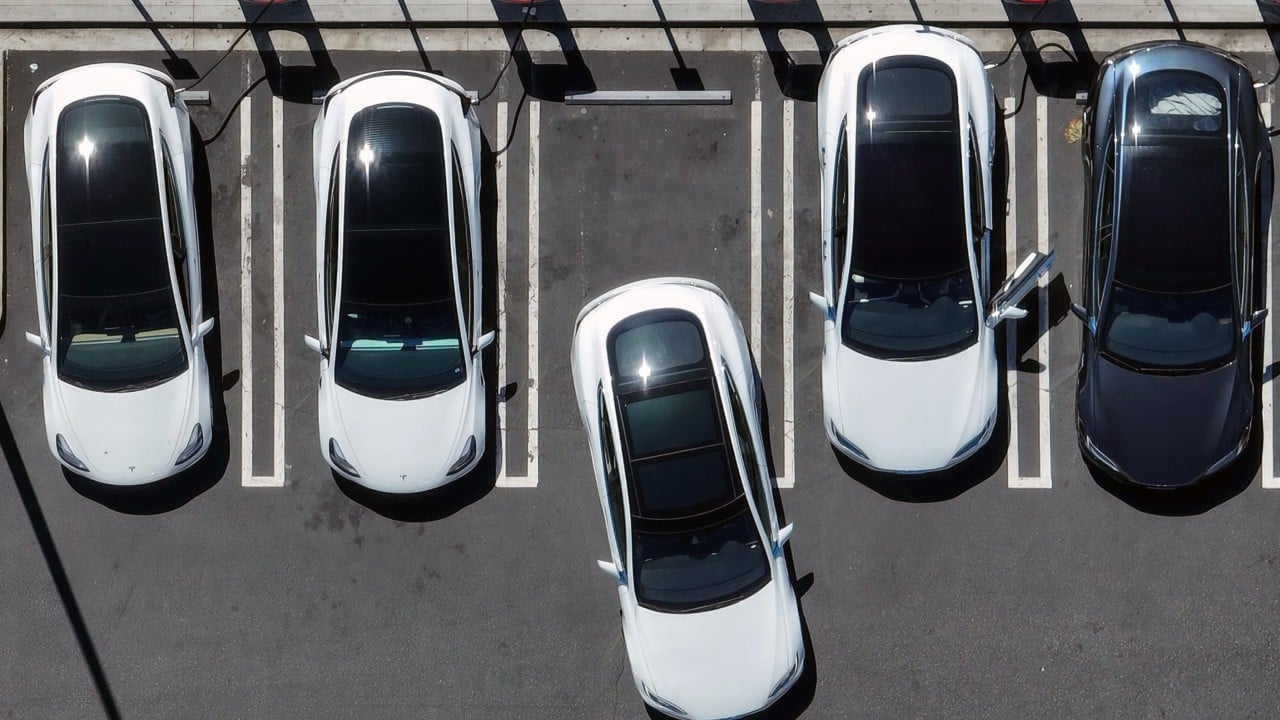
A critical metric often ignored in surface-level analysis is the Production-to-Delivery Gap. In Q1 2024, Tesla produced 433,371 vehicles but only delivered 386,810. This creates an inventory surplus of 46,561 units—the largest in the company's history.
This gap signals a breakdown in Tesla’s "Direct-to-Consumer" efficiency. When production outpaces deliveries by over 10%, it indicates that the bottleneck has shifted from the factory floor to the logistics and last-mile delivery network. It also suggests that the price-elasticity of demand for Tesla's current lineup is weakening; the market is no longer absorbing every unit produced at current price points.
Market Partitioning and Geopolitical Barriers
The "world's top spot" title is increasingly decoupled from actual market contestability due to regulatory fragmentation.
- The China Fortress: In the world's largest EV market, BYD and other domestic players (Xiaomi, Li Auto) benefit from localized supply chains and a consumer base that prioritizes software-defined vehicle features. Tesla remains the only foreign automaker with significant volume in China, but its market share is under constant pressure from Chinese firms that iterate on interior technology at twice the speed of Western OEMs.
- The Fortress of the West: Protectionist measures, such as the 100% tariffs on Chinese EVs in the U.S. and anti-subsidy investigations in the EU, act as a structural moat for Tesla. BYD cannot realistically challenge Tesla for the global top spot while being effectively locked out of the North American market and facing increasing headwinds in Europe.
Strategic Recommendation: The Pivot to Autonomy
The data indicates that the plateau for hardware-centric EV growth is approaching. For Tesla, regaining the top spot is a temporary tactical win; the long-term strategic play must be the transition from a capital-intensive manufacturing firm to a high-margin software platform. The buildup of unsold inventory suggests that further price cuts will yield diminishing returns.
Tesla must accelerate the deployment of its Full Self-Driving (FSD) v12 and the "Cybercab" platform to decouple its valuation and revenue from the physical delivery of hardware. For BYD, the mandate is different: it must prove it can maintain its 20%+ gross margins while expanding its service and dealer networks globally, transitioning from a high-volume Chinese manufacturer to a respected global brand.
The 2024 Q1 reversal is not a signal of Tesla's renewed dominance, but a warning that both leaders are now susceptible to the macro-economic gravity of a cooling global market.