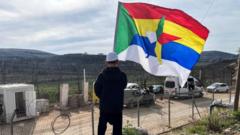
The air in Majdal Shams doesn't just sit; it breathes. On a clear day, you can stand on the edge of this Druze town in the Golan Heights and look across the valley toward the Syrian border. It is a view defined by apple orchards and cherry trees, but also by an invisible, jagged line that has dictated the rhythm of life for generations. This is a place where the geography of the heart often conflicts with the ink on a diplomat's map.
Last night, that air grew heavy.
It began not with a roar, but with a series of dull thuds that vibrated through the basalt foundations of the houses. The news reports will tell you that Israel launched strikes against Syrian military targets. They will mention "retaliation" and "regional stability." They will use sterilized language to describe the arc of a missile. But for the families sitting in the dark, watching the horizon flicker with an artificial, angry orange light, the story isn't about geopolitics.
It is about the breaking point of a community caught in a vice.
The Spark in the Square
To understand why the sky turned to fire, you have to look at the dust on the ground. For weeks, the Druze community has been locked in a bitter, visceral confrontation with Israeli authorities. The catalyst sounds mundane: wind turbines. To a planner in Tel Aviv, a turbine is a symbol of green energy and progress. To a Druze farmer in the Golan, those towering blades are steel giants planted in ancestral soil without their blessing.
The protests weren't just about land rights. They were an eruption of a deeper, simmering identity crisis. The Druze are a closed, resilient, and fiercely loyal faith group. In the Golan, many still hold Syrian papers while living under Israeli rule since 1967. They navigate a world where they must be neighbors with their occupiers and kin to those across the fence.
When the clashes turned violent—rubber bullets meeting stones, tear gas clouding the cherry blossoms—the equilibrium of the border shattered.
Imagine a young man named Adnan. He is hypothetical, but his reality is shared by thousands. Adnan spends his mornings pruning trees that his great-grandfather planted. He speaks Arabic, prays in a hidden language known only to the initiated, and watches Israeli jets scream overhead toward Damascus. When he sees the police line forming at the edge of his field, he doesn't see a "law enforcement action." He sees an erasure.
The Echo Across the Fence
The internal friction within Israel provided a window. In the brutal logic of Middle Eastern conflict, instability is an invitation.
As the Druze community’s anger boiled over, mortar fire began to leak across the border from Syria. The Syrian government, or perhaps the Iranian-backed militias that move through its territory like ghosts, saw an opportunity. If the Golan was bleeding from the inside, why not twist the knife from the outside?
The strikes that followed were the inevitable response. Israeli F-16s turned toward the north, targeting Syrian military infrastructure and observation posts. The military briefings called it a "clear message." But messages written in high explosives are rarely read the same way by everyone.
The strategy is a grim dance. Israel must project strength to deter Hezbollah and Iranian proxies, yet every bomb dropped near the border risks radicalizing the very people living under its shadow. The Druze are now watching their brothers across the border face the fallout of a conflict they feel trapped within.
The Weight of the Invisible
There is a specific kind of silence that follows an airstrike. It is a ringing, hollow quiet that settles over the mountains once the engines fade. In that silence, the people of the Golan are left to tally the cost.
The cost isn't just measured in the craters left in Syrian hillsides. It is measured in the erosion of trust. When the Druze elders sit in their councils, they aren't discussing the tactical efficacy of a precision-guided munition. They are talking about the fact that their sons are being arrested in the streets of their own towns while the horizon burns with the fire of a war they didn't ask for.
The complexity is staggering. On one hand, the Israeli state provides the infrastructure and security that has allowed these towns to thrive compared to their neighbors in war-torn Syria. On the other, the state often treats the land as a strategic asset rather than a home.
The turbines were the match. The border was the tinder.
A House Divided by History
The Druze are often called "the bridge." In Israel proper, Druze citizens serve in the highest levels of the military and government. They are the "blood brothers" of the Jewish state. But in the Golan, the bridge is swaying.
The recent strikes represent a nightmare scenario: the domestic grievances of a minority group merging with the existential threat of a foreign war. If the Golan Druze feel sufficiently alienated by land disputes and police crackdowns, their historical neutrality or quietism could evaporate.
The Syrian government knows this. They use the rhetoric of "liberating the occupied Golan" to stir the pot, even as they struggle to hold their own fractured country together. It is a cynical play, using the genuine pain of farmers to justify the movement of hardware and the firing of shells.
Consider the physical reality of the border. It is a fence, yes, but it is also a graveyard of old ideas. On one side, a high-tech military powerhouse; on the other, a shattered state being picked over by vultures. In the middle, a community trying to keep its culture alive in a world that demands they choose a side.
The Anatomy of the Strike
The technical details of the strike—the coordinates, the payload, the damage assessment—are the bones of the story. But the marrow is the uncertainty.
When the sirens go off in the Galilee and the Golan, the reaction is a practiced, weary reflex. People move to shelters. They check their phones. They wait for the "all clear." But there is no "all clear" for the soul. Each strike is a reminder that the peace here is a thin veneer, a coat of paint over a rusted structure.
The Israeli military officials stated that they hold the Syrian regime responsible for everything emanating from its territory. It is a standard line. It is also a terrifying one. It means that as long as Syria is a playground for militias, the people of the Golan will live in the crosshairs.
The Harvest of Shrapnel
Spring is supposed to be the season of the harvest. Instead, the farmers are finding shrapnel in the soil.
The protest over the wind turbines has paused, buried under the immediate urgency of a potential regional escalation. But the resentment hasn't disappeared. It has just gone underground, like a coal fire that can burn for years beneath the surface before collapsing the ground above it.
The stakes are higher than a few dozen turbines or a handful of military outposts. The stakes are the social fabric of the region. If the relationship between the state and the Druze community fractures completely, the "quiet border" of the Golan will become a memory.
The strikes in Syria were intended to stop a threat. But in the process, they highlighted a vulnerability. You can bomb a missile battery. You can't bomb a feeling of betrayal.
As the sun begins to rise over the Hermon mountain, the smoke from the strikes dissipates into the haze. The apple trees are still there. The turbines, half-constructed, stand like skeletons on the ridges. The people of Majdal Shams wake up and drink their coffee, looking out at the valley, wondering if the wind today will bring the scent of blossoms or the smell of cordite.
The border is quiet again. For now. But everyone knows that in this part of the world, silence is just the space between two screams.
The fire has been extinguished on the hillside, but the heat remains in the earth.