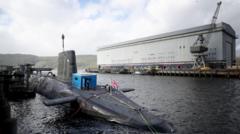
An Iranian man didn't just walk toward a nuclear base; he tried to talk his way into one of the most sensitive military installations on the planet. This wasn't a movie script. It happened at HMNB Clyde, better known as Faslane, the home of the UK's nuclear deterrent. When news broke that an individual of Iranian origin was detained while attempting to enter the site, it sent a shiver through the Ministry of Defence. It also raised a massive, uncomfortable question. How does someone even get close enough to try?
Security at Faslane is supposed to be impenetrable. We're talking about the place where Vanguard-class submarines carrying Trident missiles are docked. If you've ever driven past the Gare Loch in Scotland, you know the vibe. High fences, armed Ministry of Defence Police (MDP), and a constant sense of being watched. Yet, this incident proved that human intent is often more unpredictable than any physical barrier.
Why the Faslane Incident Matters Right Now
Context is everything. You can't look at a man trying to enter a nuclear base in a vacuum, especially when he's from a nation with a history of frosty—to put it mildly—diplomatic relations with the UK. The timing of this breach occurred during a period of heightened international tension. Intelligence agencies across the West have been on high alert for "asymmetric threats." That's fancy talk for individuals acting alone or in small cells to probe weaknesses in national infrastructure.
The man was stopped at the gates. That's the official line. The system worked, right? Well, yes and no. While the MDP did their job and neutralized the situation before he reached the high-security "inner" zones, the fact that an unauthorized individual felt emboldened to even make the attempt suggests a potential gap in the outer perimeter's psychological deterrent. It's about more than just a gate. It's about the intelligence gathered before someone reaches that gate.
What Actually Happened at the Gates
The details are chillingly simple. The individual approached the main entrance and attempted to gain access. He didn't have the right credentials. He didn't have a valid reason to be there. Most people who get lost and end up at a military gate apologize and do a U-turn. He didn't do that. His persistence triggered the immediate response of the MDP.
They detained him under the Section 44 of the Terrorism Act, or similar standing orders used for sensitive sites. Following the arrest, specialized units searched the area. They had to ensure he wasn't a distraction for something larger. They had to check if he'd left anything behind. It's standard procedure, but it's also a massive drain on resources.
Local reports and military sources confirmed that the base didn't go into a full lockdown, but the "threat state" was temporarily adjusted. This wasn't a casual trespass. It was a calculated move that forced the UK's hand.
The Problem With Nuclear Security
You might think a nuclear base is the safest place on earth. In reality, it's a giant target. Faslane has been the site of protests for decades. Peace camps have sat outside its gates since the 1980s. This creates a weird dynamic. The security teams are used to dealing with "known" entities—activists who want to hang banners or cut fences to make a point.
An individual with no ties to these groups is a different beast entirely. It's an unknown variable. Security experts often worry about the "lone wolf" or the "scout." Was this man testing response times? Was he checking how many guards appear when a certain alarm goes off? These are the questions the Security Service (MI5) asks behind closed doors.
Infrastructure Vulnerabilities
- The Perimeter: Faslane is huge. It covers a vast area of land and sea. While the land side is fenced, the coastal nature of the base makes it a logistical nightmare to monitor 24/7.
- Human Error: Cameras can fail. Sensors can give false positives. At the end of the day, it's a person at a gate who has to make a split-second decision.
- The "Soft" Approach: Not every threat comes with a bomb. Some come with a fake ID and a confident story.
Geopolitical Fallout and the Iranian Connection
Let's be blunt. If this had been a confused tourist from Canada, it would've been a footnote. Because the man was Iranian, it became a national security priority. Iran's Islamic Revolutionary Guard Corps (IRGC) has been accused of plotting various operations on European soil. The UK government has even considered designating the IRGC as a terrorist organization.
When you have a citizen of a hostile or semi-hostile state poking around your nuclear subs, you don't take chances. The investigation quickly moved from local police to national counter-terrorism units. They looked at his digital footprint, his travel history, and his contacts. They needed to know if he was a "self-starter" or if he was being handled by someone in Tehran.
Comparing Faslane to Other Global Breaches
This isn't the first time a high-security site has been poked. In the US, the "Nuns who broke into a nuclear site" story is legendary. In 2012, an 82-year-old nun and two other activists broke into the Y-12 National Security Complex in Tennessee. They wandered around for quite a while before being caught.
If an elderly nun can do it, a determined operative can too. The Faslane incident is a reminder that the UK isn't immune to these lapses. The difference here is the intent. Activists want a trial and a microphone. A foreign agent wants data and silence. The Iranian man's attempt sits in a murky middle ground that keeps analysts awake at night.
The Aftermath for Base Security
Expect changes. You won't see them, but they're happening. There's likely a push for more advanced biometric scanning at the primary checkpoints. We're also seeing a shift toward "integrated" security. This means using AI-driven surveillance that can spot "anomalous behavior" before a person even reaches the gate. If a car circles the perimeter three times, the system flags it. If a person walks with a specific gait or carries a specific type of bag, the guards are alerted.
The Ministry of Defence doesn't like to admit when they're rattled. But you can bet the debrief for this incident was long and painful. They'll have looked at every second of footage. They'll have grilled the guards on duty. "Why didn't you see him sooner?" "What did he say exactly?"
What You Should Watch For
If you're following this story, don't expect a transparent trial with all the facts laid out. National security cases involving foreign nationals usually happen in a black box. A lot of the evidence is "closed," meaning even the defendant's lawyers might not see all of it if it involves sensitive intelligence methods.
Keep an eye on the diplomatic noise. If the UK suddenly gets tougher on Iranian visas or increases its naval presence in the Persian Gulf, it might be a ripple effect from this single attempt at a gate in Scotland.
The next step for anyone concerned with national security is to demand better integration between local intelligence and site-specific security. We can't just rely on thick walls and big guns. We need to know who is coming before they ever put a foot on the road to Faslane. The arrest was a success, but the attempt was a warning we can't afford to ignore.