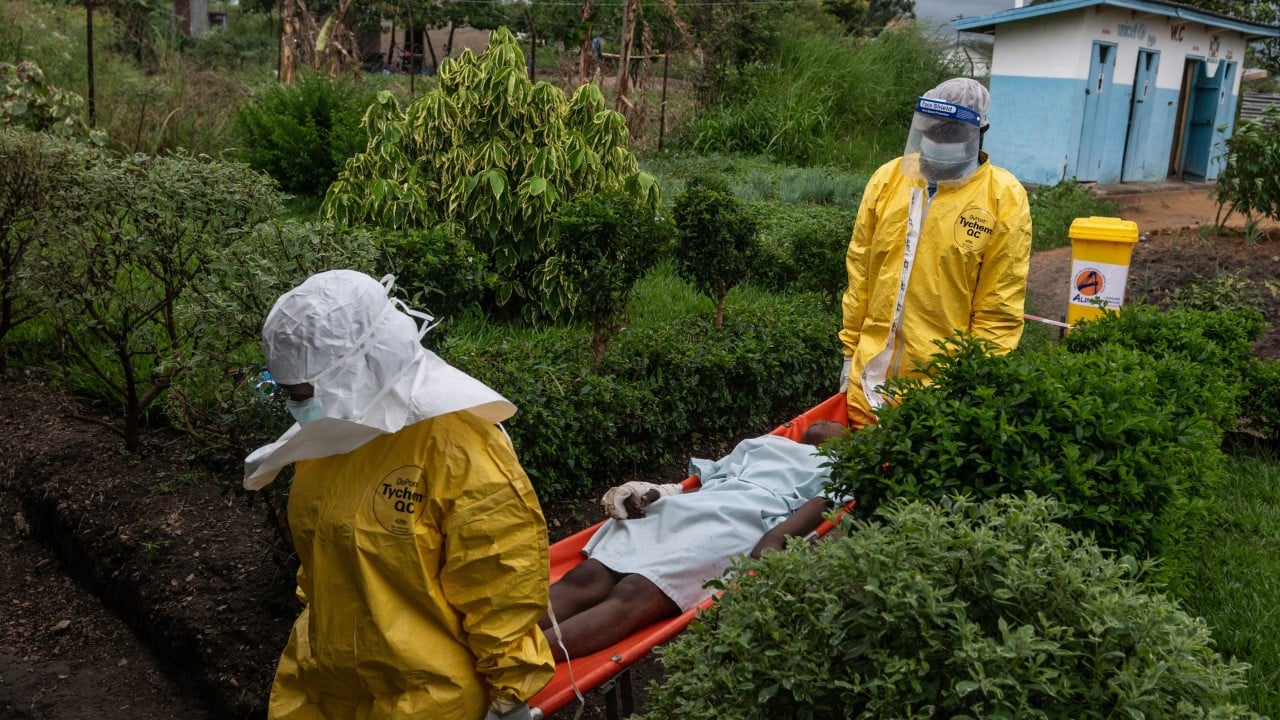
A standard protective glove weighs roughly nine ounces. It is thin, nitrile, and usually a sterile shade of violet or blue. For a doctor or a nurse working in the dust-choked heat of northeastern Democratic Republic of Congo, those nine ounces of synthetic rubber are the only barrier between a normal Tuesday and an agonizing death.
When you pull the glove on, your hand snaps against the wrist. The sound is sharp. Inside the isolation zones, that snap is the baseline rhythm of survival.
We are comfortable with numbers because they are clean. They stay neatly arranged on spreadsheets and wire service feeds. They do not sweat. They do not bleed through cotton sheets, and they do not cry out in the middle of the night for water that their bodies can no longer hold. A headline tells us that there are 1,274 confirmed cases of Ebola in this current outbreak. It tells us that 360 people have died. The mind processes these digits like ledger entries. One thousand two hundred seventy-four. Three hundred sixty.
But numbers lie by omission. They hide the smell of chlorine. They erase the terrifying silence that settles over a village when the markets suddenly close because people are too afraid to touch the coins in each other's palms.
To understand what is happening right now along the dirt tracks of North Kivu and Ituri provinces, you have to leave the statistics at the border. You have to look at the grease on a steering wheel.
The Mathematics of a Fever
Consider a hypothetical driver named Alphonse. He does not exist in the official medical logs, but five hundred men just like him do. Alphonse drives a motorbike taxi—a mototaxi—in the trading hub of Beni. His livelihood depends entirely on proximity. He sits inches away from strangers every hour of the day. His back absorbs the lean of their bodies as they navigate the deep ruts in the road.
One afternoon, a passenger climbs onto the back of his bike. The passenger is hot to the touch through Alphonse’s thin shirt. The man is coughing, a dry, rattling sound that mimics the common malaria or typhoid that everyone in the region expects to catch at least once a year. The passenger pays his fare in crumpled Congolese francs and walks away into the crowd.
Ebola is a master of disguise before it becomes a monster.
In its earliest stages, the virus looks like everything else. It feels like a standard hangover or a bout of flu. The incubation period can stretch to twenty-one days, a three-week countdown where the invisible enemy replicates inside the liver, the spleen, and the lining of the blood vessels. The virus systematically disables the body's interferon response—the chemical alarm system that tells your immune cells to fight back. It is a stealth takeover.
By the time Alphonse feels the first ache in his lower back, his body is already a manufacturing plant for millions of viral copies. When he returns home to his family, he is not just a father returning from a long shift. He is a walking biohazard.
This is how 12 cases become 120. This is how 120 cases climb relentlessly toward 1,274. The growth isn't a sudden explosion; it is a series of quiet, domestic interactions. A mother wiping her child's brow. A brother washing his sibling's body before a burial. The very impulses that make us human—compassion, duty, love—are the exact pathways the virus exploits to destroy us.
The Conflict in the Canopy
The science of managing an outbreak is remarkably straightforward on paper. You find the sick person. You isolate them. You track down every single human being they have interacted with over the past three weeks—a process known as contact tracing. Then you vaccinate those contacts using a ring strategy, creating a human shield of immunity around the infection.
If this were happening in a sterile laboratory or a highly organized western metropolis, the outbreak would likely be contained within a month.
But the eastern Congo is not a laboratory. It is an intricate maze of dense rainforest, ancient social structures, and decades of deep, earned political trauma. The people living in Beni and Butembo have survived waves of violence from dozens of active rebel groups. They have watched international corporations extract billions of dollars in cobalt and gold from their soil while their own clinics remained devoid of basic aspirin.
Suddenly, when Ebola arrives, white land cruisers fill the streets. Foreign workers arrive in positive-pressure suits that look like spacesuits. Massive funding pours into specialized treatment centers.
Put yourself in the sandals of a local resident. You have watched your children die of preventable malnutrition and malaria for years, and no one came to help. Now, a disease arrives that threatens the wealthy nations across the ocean, and suddenly millions of dollars materialize overnight. The trucks spray chlorine that smells of bleach and death. The workers tell you that you cannot bury your grandmother according to the rituals that have preserved your community’s sanity for centuries.
Suspicion is not ignorance. It is a survival mechanism.
When health workers arrive with their clipboards and thermometers, communities occasionally rebel. They throw stones. They burn the tents. They disappear into the deep canopy of the forest, taking their sick relatives with them. Every time a patient flees an isolation center to escape the strange men in plastic suits, the virus hitches a ride. The circle widens. The numbers on the dashboard click upward.
The View from Inside the Plastic
Inside the Ebola Treatment Unit, the world shrinks to the boundary of your visor. The heat is immediate. Within ten minutes of zipping into the full personal protective equipment, sweat pools in your boots. It runs into your eyes, but you cannot wipe them. To touch your face is to risk everything.
The air inside the suit smells of your own breath and the faint, chemical tang of the rubber mask.
You look through a foggy plastic pane at a child sitting on a cot. Her name is Marie, though she is too weak to tell you that today. She represents the terrifying reality behind the 360 fatalities recorded so far. Ebola causes what doctors call systemic vascular leakage. The virus destroys the endothelial cells that hold your blood vessels together. The pipes are bursting from the inside out.
Working in this environment requires a strange kind of emotional detachment coupled with intense physical focus. You must check the IV lines. You must administer the experimental monoclonal antibodies that lock onto the viral spikes and try to neutralize them before the organs fail. But you must do all of this while wearing three layers of gloves, which robs your fingers of the tactile feedback needed to find a collapsed vein in a dehydrated three-year-old.
The child looks at you, but she cannot see your face. She sees a white hood, huge goggles, and a mask. She sees a ghost.
The hardest part isn’t the risk of infection. The hardest part is the absolute isolation of the patients. They are dying in a world devoid of human touch. Every hand that touches them is encased in nitrile. Every word spoken to them is muffled by a respirator. When a patient dies behind the plastic barriers, they die alone in a clean, white room, surrounded by people who look like astronauts.
The Cost of the Last Mile
We often talk about global health as a grand logistical challenge. We analyze the cold chain distribution of vaccines, which must be kept at eighty degrees below zero Celsius in regions where the electrical grid is non-existent. We discuss the efficacy rates of the rVSV-ZEBOV vaccine.
But the real problem lies elsewhere. The real problem is the last mile.
The last mile is the bridge of trust. It is the realization that a vaccine is useless if people are too terrified to let you inject it into their arms. Containment doesn't happen through medical authority; it happens through humility. It happens when epidemiologists stop lecturing and start listening to the village elders who know how to manage crises without a master's degree from Johns Hopkins.
When the response teams began hiring local youth to do the contact tracing, the dynamic shifted. When they permitted families to watch the burials from a safe distance through clear mesh fencing, the anger began to thaw. Progress in an outbreak is measured in these tiny concessions to human dignity.
The current figure stands at 1,274 cases. It is a heavy, sobering reality that tells us the fire is still burning through the hillsides of the Congo. It tells us that the world is still vulnerable to microscopic threads of RNA that care nothing for national borders or political alliances.
But the next time you see that number on a screen, do not think of a statistic. Think of the sharp snap of a violet glove. Think of Alphonse turning the key in his motorbike ignition, wondering if the stiffness in his joints is just the long road or something else entirely. Think of the nine ounces of rubber that separate a person from the end of the world.


