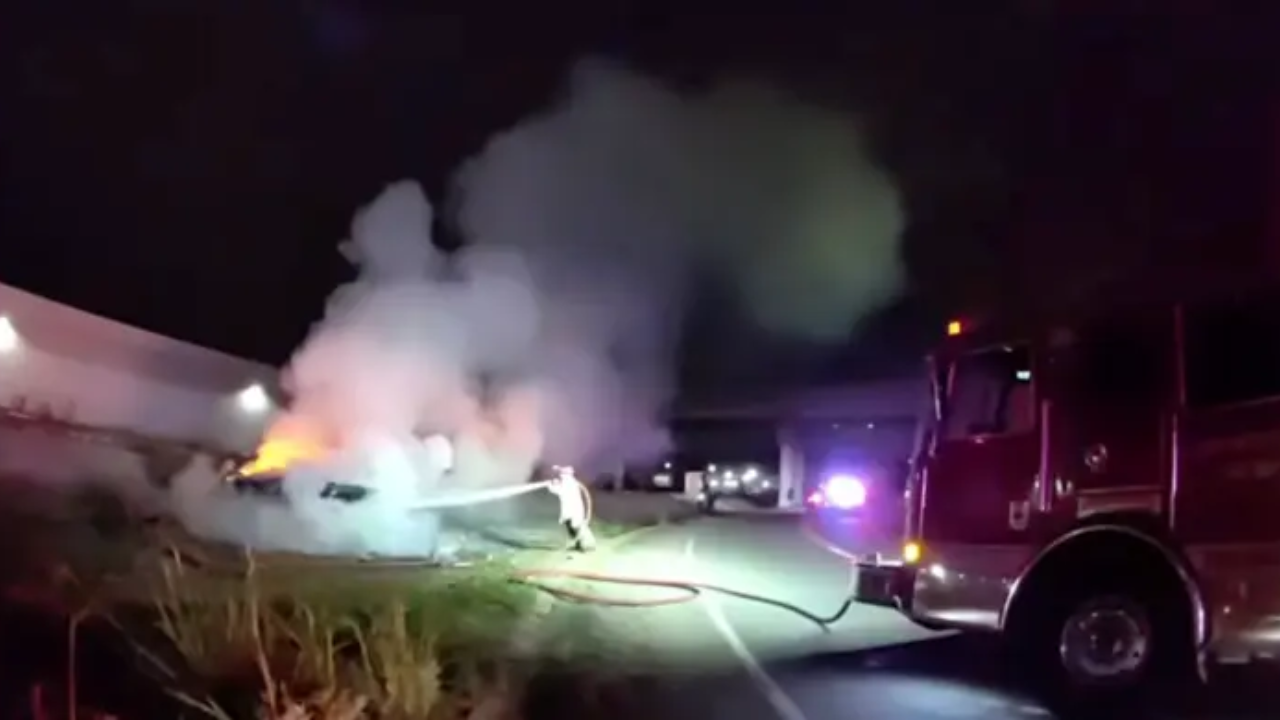
Everyone loves a hero story. A California police officer sprints toward a mangled, burning Mercedes-Benz resting on active railroad tracks, rips open a jammed door, and drags an unconscious 18-year-old out of the wreckage seconds before the flames consume the cabin. The bodycam footage hits the internet, racks up millions of views, and triggers an avalanche of predictable applause in the comment sections.
That applause misses the entire point.
Mainstream news outlets treat these viral rescues as pure, heartwarming triumphs of human bravery. They frame the story around the adrenaline, the split-second heroism, and the miraculous survival. By turning a catastrophic failure of infrastructure, vehicle design, and driver behavior into a feel-good Hollywood thriller, the media is feeding the public a lethal misconception about how train collisions actually work.
If you watch that bodycam footage and think, Thank goodness a cop was right there to pull him out, you are learning the exact wrong lesson. In the real world of rail safety and emergency response, relying on a last-second extraction from a burning car on the tracks is not a survival strategy. It is a statistical anomaly masquerading as a safety net.
The Myth of the Movie-Style Vehicle Fire
Look closely at the framing of the California Mercedes rescue. The narrative relies entirely on the ticking-clock trope: the car is on fire, the flames are spreading, and if the officer arrives ten seconds later, the teenager perishes in an explosion.
Hollywood has conditioned drivers to believe that crashed cars detonate like grenades, or that a fire in the engine bay instantly incinerates the passenger compartment. In reality, modern luxury vehicles like a Mercedes-Benz are engineered specifically to prevent rapid cabin intrusion from fire.
Firewalls—the literal physical barriers separating the engine compartment from the passenger cell—are built from stamped steel, aluminum alloys, and thermal insulation designed to hold back extreme heat for several minutes. Fuel tanks are mounted forward of the rear axle, encased in high-density polyethylene, and equipped with check valves that seal fuel lines the millisecond an impact occurs.
When a car catches fire after a train strike, the immediate killer is rarely the flames themselves. It is the toxic smoke from burning plastics, the blunt-force trauma of the impact, or—most critically—a second oncoming train.
By sensationalizing the fire and the heroic pull, coverage obscures the terrifying mechanical reality of why that 18-year-old was trapped in the first place. Modern crumple zones do a brilliant job of absorbing kinetic energy to keep your organs from liquefying, but they achieve this by deliberately deforming the chassis. That deformation frequently jams the doors shut and cuts power to electronic locking mechanisms. If you are unconscious inside a modern luxury sedan after a high-energy impact, the very safety engineering that kept you alive during the crash can lock you inside a steel box.
Why "Heroic" Bodycam Footage Distorts Public Risk
I have spent years analyzing emergency response protocols and transportation safety failures, and there is a consistent pattern whenever viral bodycam rescues dominate the news cycle. Departments release the footage because it is undeniable public relations gold. Newsrooms run it because high-stakes video guarantees clicks.
The casualty of this symbiotic relationship is context.
When a story focuses exclusively on the officer's sprint into danger, it erases the chain of preventable failures that put a teenager's Mercedes on the tracks in the first place. Notice what almost never makes it into the viral headline:
- Grade-crossing design: Was this an at-grade crossing with inadequate sightlines, confusing signage, or short preemption timing on nearby traffic lights?
- Driver decision-making: Did the driver try to beat the lowering gate arms, misjudge the speed of an approaching locomotive, or get trapped in traffic queuing across the tracks?
- Post-crash egress: Why did the driver fail to exit the vehicle before the train struck, or immediately after?
The public watches the clip and subconsciously absorbs the idea that rail collisions are survivable events where first responders swoop in to save the day. The data tells a brutally different story. According to the Federal Railroad Administration (FRA), a motorist is roughly 20 times more likely to die in a collision with a train than in a collision with another motor vehicle.
A freight train traveling at 55 miles per hour takes more than a mile to come to a complete stop after the engineer applies the emergency brakes. The physics are entirely one-sided. A 4,000-pound Mercedes-Benz is a tin can against a 15,000-ton locomotive. Surviving that impact is a fluke of impact angle—usually a glancing blow to the front or rear quarter-panel rather than a direct hit to the passenger compartment. Calling the aftermath a "miracle rescue" ignores the harsh truth that if the train had hit three feet further to the left or right, there would have been nothing left for the officer to pull out.
The Uncomfortable Truth About First Responder Exposure
Let us talk about the tactical reality of that rescue, because police academies and fire departments have furious internal debates over videos just like this one.
When an officer runs toward a burning vehicle sitting on an active rail corridor, they are violating fundamental scene-safety protocols to save a life. The officer does not know if the vehicle is carrying hazardous materials, if high-voltage lithium-ion batteries (in the case of hybrids or EVs) are entering thermal runaway, or if another train is barreling down the adjacent track at 70 miles per hour.
Train tracks are deceptive acoustic environments. Modern welded rail reduces the classic "clickety-clack" sound, and locomotives are remarkably quiet from the front due to directional exhaust and aerodynamic shaping. Emergency responders have been struck and killed on active tracks while focusing entirely on a victim inside a wrecked car, completely unaware that a second train was approaching on the parallel line.
Furthermore, dragging an unconscious trauma victim out of a car without cervical spine stabilization carries a massive risk of turning a survivable spinal injury into permanent paralysis. In emergency medicine, the only justification for a rapid, unstabilized "emergency drag" is an immediate, life-threatening hazard that will kill the patient faster than spinal trauma—such as an encroaching fire.
The California officer made the exact right call under impossible circumstances. His instincts were sharp, his courage was undeniable, and he saved a young man's life.
The problem is not the officer. The problem is how the media weaponizes his bravery to sell a simplistic narrative while ignoring the systemic reforms that would keep officers from having to risk their lives on train tracks in the first place.
What Drivers Actually Get Wrong at Railroad Crossings
If you ask the average driver what to do if their car stalls or gets stuck on railroad tracks, most will give you the wrong answer. They will tell you to put the car in neutral and push it, or to call 911 and wait in the vehicle, or to wave their arms at the train.
Every single one of those instincts will get you killed.
- Never try to push the vehicle. You cannot move a two-ton car over raised steel rails and uneven ballast before a train arrives.
- Never stay inside to call for help. Get out immediately. Leave your phone, your wallet, and your passengers' bags behind.
- Run toward the train, at a 45-degree angle away from the tracks. This is the single most counter-intuitive rule in driver safety, and almost nobody knows it. When a train hits a car, the wreckage and debris are blasted forward and outward in the direction the train is traveling, creating a lethal cone of shrapnel. If you run away from the train alongside the tracks, you are running directly into the debris field. You must run toward the oncoming train while angling away from the railbed.
Once you are safely clear of the tracks—and only then—you look for the blue and white Emergency Notification System (ENS) sign posted on the crossing gate mechanism or signal mast. That sign contains a direct phone number to the railroad's dispatch center and a specific DOT crossing ID number. Calling 911 routes you to a local municipal dispatcher who then has to figure out which railroad owns the track and find their phone number. Calling the ENS number puts you directly on the line with the person who can radio the locomotive engineer immediately.
The Engineering Failures Nobody Wants to Pay For
Why do we still have thousands of at-grade railroad crossings in the United States where cars can simply drive onto active tracks?
Money and jurisdiction.
Separating grades—building overpasses or underpasses so cars and trains never share the same physical space—eliminates crossing collisions entirely. It is a 100% effective engineering solution. It is also wildly expensive, often costing tens of millions of dollars per intersection and requiring years of environmental reviews and right-of-way acquisitions.
Instead of demanding infrastructure investment or questioning why municipalities allow high-speed rail corridors to intersect suburban roads with nothing more than painted lines and flimsy wooden gates, the public consumes viral rescue videos. We celebrate the individual hero who pulls a teenager out of a burning wreck, wipe away a tear, and change nothing about the deadly intersections waiting down the road.
Consider the alternative: what if that Mercedes had been equipped with automated post-crash door-unlocking systems that functioned independently of the main 12-volt battery, or mechanical interior/exterior release overrides that remain accessible even when the door frame buckles? Many European safety regulators and organizations like Euro NCAP actively test and score vehicles on post-crash extrication and rescue sheet accessibility. In the United States, federal motor vehicle safety standards lag years behind on post-crash electronic door-latch failure protocols.
The Downside of Cynicism
To be completely fair, dismissing the human element of these stories carries its own risk. Public trust in law enforcement and emergency services is fractured, and genuine acts of selflessness deserve recognition. When a police officer runs toward flames without hesitation, society should acknowledge that courage. Without those visceral reminders of human decency, public discourse becomes entirely mechanical and cynical.
There is also a real limit to how much infrastructure can protect people from reckless behavior. You can install four-quadrant gates, median barriers, and radar-based obstacle detection systems at a crossing, and a determined, distracted, or impaired 18-year-old will still find a way to drive around the barriers. Engineering reduces probability; it never eliminates human error.
Stop Watching the Rescue and Start Fixing the System
Viral bodycam videos are emotional junk food. They give you a quick hit of adrenaline and moral satisfaction without requiring you to confront uncomfortable truths about physics, vehicle engineering, or crumbling transportation infrastructure.
Next time you see a headline celebrating a miraculous last-second rescue from a burning car on the train tracks, look past the flames. Look at the warped steel of the door frame that trapped the driver. Look at the flat, unprotected asphalt crossing that invited a car into the path of a locomotive.
Praise the officer for doing their job under terrifying conditions, then demand to know why a teenager had to nearly burn to death on a set of railroad tracks just to give the internet a feel-good story.