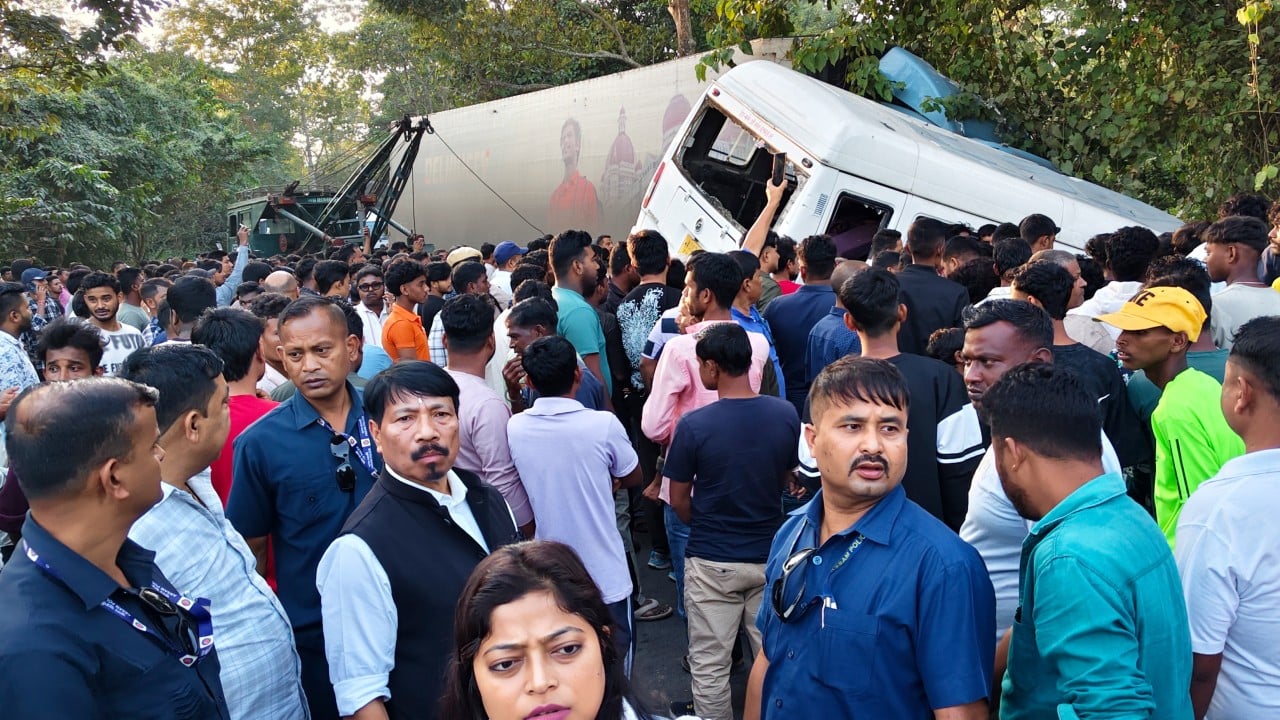
Two o'clock in the morning smells like diesel, damp asphalt, and cardamom tea cooling in a clay cup.
If you have ever ridden an overnight sleeper bus across the sprawling arteries of India, you know the specific, hypnotic vibration that rattles up through the soles of your shoes and settles behind your collarbone. It is the hum of a nation moving while it dreams. Above you, fluorescent strips flicker against vinyl curtains. Outside, white kilometer stones blur into a rhythmic strobe light. You trust the heavy steel frame beneath you. You trust the man behind the wheel, whose eyes are fixed on the twin cones of yellow light cutting through the fog. You fall asleep believing that morning will simply arrive, bringing with it the familiar chaos of a new city, a job interview, a wedding, or the warm threshold of your mother's front door.
Then, in the space between two heartbeats, steel meets steel.
When a news wire spits out a headline reading India road crash between bus, container truck kills 23, the brain performs an involuntary act of self-defense. It turns human beings into arithmetic. Twenty-three becomes a figure—larger than ten, smaller than fifty, tragic enough for a brief wince over morning coffee, abstract enough to forget by lunch. Wire reports are engineered for speed, not weight. They tell you the state, the highway number, the hour of impact, and the final tally pulled from the wreckage by gas cutters and bare hands before dawn.
They do not tell you about the phone still ringing inside a crushed backpack on the shoulder of the road.
To understand what actually happened when a passenger bus collided with a heavy container truck and claimed twenty-three lives, we have to step away from the cold ledger of police blotters and stand on the gravel beside the twisted chassis. We have to look at the invisible architecture of risk that governs millions of nightly journeys across the subcontinent—an architecture built on impossible freight deadlines, razor-thin transport margins, unlit stretches of national highway, and the quiet desperation of working people trying to bridge vast distances overnight so they do not lose a day's wages.
The Anatomy of the Third Shift
Consider a hypothetical passenger—let us call him Rohan—boarding that bus around nine in the evening. Rohan is not a real name from the manifest, yet he represents the exact demographic that fills nearly every sleeper berth between Tier-2 cities and industrial hubs across India. He is twenty-eight, an electrical technician carrying a scuffed laptop bag and a tin of homemade sweets packed by his aunt. He chose the night bus because a train ticket required booking three weeks in advance, and a flight cost half his monthly rent.
Across the median, moving in the opposite direction or lumbering ahead in the dark, is a multi-axle container truck. Let us imagine its driver, Harpreet, forty-four, two thousand kilometers away from his village, chewing betel nut to keep his eyelids from drooping. Harpreet is not a reckless monster. He is a contractor trapped inside an economic vice. If his cargo of textiles or auto parts misses the port window by four hours, the penalty falls on the fleet owner, who passes it directly onto Harpreet’s family ledger.
This is where the real tragedy begins—long before the headlights cross.
In standard accident reporting, police almost always default to a single, tidy phrase: driver negligence. It is the easiest box to check on a First Information Report. Dead men do not contest paperwork, and exhausted survivors rarely see the geometry of the lane markings in the pitch black before impact. Yet blaming a lone driver for a twenty-three-fatality collision is like blaming a single frayed thread when an entire suspension bridge snaps.
Think of a national highway at two in the morning as an overloaded circuit. During the day, traffic moves in visible waves; hazards announce themselves in bright sunlight. At night, the highway transforms into a high-speed freight corridor sharing narrow, often unseparated asphalt with intercity passenger coaches. Heavy container trucks, frequently loaded past their legal axle limits to offset rising fuel prices, crawl up gradients at thirty kilometers an hour without working rear reflectors. Meanwhile, private bus operators—competing fiercely on aggregator apps for the fastest arrival times—push their drivers to maintain eighty or ninety kilometers an hour through patches of blinding high-beam glare and sudden rural crossings.
I have stood on the shoulder of a four-lane highway in central India after midnight, waiting beside a punctured tire while forty-ton rigs roared past less than six feet from my knees. The wind shear alone feels like a physical blow to the chest. You realize within seconds that at those speeds, in that darkness, human reaction time is a myth. If a parked truck juts two feet into the fast lane without hazard triangles, or if a driver misjudges an overtaking gap by half a second, physics takes over with absolute, indifferent brutality.
When Steel Folds Like Paper
The mechanics of a bus-versus-container-truck collision are uniquely catastrophic, and anyone who has inspected the aftermath knows why the death toll climbs so violently in these specific crashes.
A modern container truck is essentially a battering ram mounted on high-tensile steel beams. Its cargo box sits high off the ground, reinforced at the corners to withstand crane lifts and ocean swells. A passenger bus, by contrast, is built for volume and weight efficiency. Most private sleeper coaches across India are constructed by local body-builders who weld tubular steel frames onto commercial truck chassis, skinning the exterior in thin aluminum or fiberglass sheets.
When the front corner of a bus strikes the rear or side of a container trailer at highway speed, there is no crumple zone to absorb the kinetic energy. The rigid steel floor of the container acts like a blade, shearing straight through the upper cabin at window height—the exact level where passengers lie asleep in double-decker berths.
Survivors of these crashes rarely describe a loud bang first. They describe the sudden, violent tilt of the world, the screech of tearing metal that sounds eerily like a train braking, and then a suffocating, pitch-black silence broken by the hiss of a ruptured radiator and the cries of people pinned beneath collapsed bunks.
In the rural stretches where most of these collisions occur, the "golden hour" of emergency trauma care is often a cruel fiction. Local villagers are almost always the first responders. Armed with flashlights, crowbars, and bare hands, farmers and highway dhaba workers run toward the smoke long before ambulances can navigate the traffic bottleneck piling up behind the wreckage. They pry open jammed emergency exits—which, in far too many budget coaches, are welded shut or blocked by extra luggage racks to squeeze in two more paying passengers.
It is messy, terrifying work. Gasoline mixes with spilled milk, shattered glass, and blood on the tarmac. The injured are lifted into the beds of pickup trucks and private cars because waiting for an advanced life-support ambulance from a district hospital forty kilometers away means watching someone bleed out on the gravel.
The Numbers Behind the Grief
It is tempting to look at a crash that kills twenty-three people and call it a freak accident—a terrible alignment of bad luck on a dark night. The data tells a far more uncomfortable truth.
According to official figures compiled by India’s Ministry of Road Transport and Highways, well over 150,000 people die on Indian roads every single year. That is roughly four hundred funerals every day, or seventeen lives extinguished every single hour. India accounts for roughly one percent of the world’s vehicles, yet it bears more than ten percent of global road crash fatalities.
Read those proportions again. One percent of the vehicles. Ten percent of the graves.
Among these fatalities, collisions involving heavy commercial vehicles—trucks, lorries, and intercity buses—carry the highest lethality rates. Unlike urban fender-benders where speed limits and congestion cap the kinetic force of impact, highway crashes happen at maximum velocity. Furthermore, bus passengers almost never wear seatbelts, even on newer coaches equipped with them, and sleeper berths offer zero restraint against lateral or frontal ejection. When a coach rolls or impacts a rigid trailer, the cabin turns into a centrifuge.
We also have to confront the quiet regulatory gaps that allow lethal vehicles onto the asphalt in the first place. Look closely at the rear of many container trucks rolling down Indian highways tonight. Federal regulations mandate Rear Underrun Protection Devices—heavy steel bars hung below the tail of a trailer specifically designed to stop a smaller vehicle from sliding underneath the bed during a rear-end collision. In practice, thousands of trucks either lack them entirely or carry flimsy, uncertified bars that snap on contact. Similarly, reflective retro-tape—a strip of material costing less than a tank of diesel—is frequently missing, caked in mud, or faded to uselessness.
On the bus side of the equation, commercial permits are routinely renewed through fragmented state transport offices where physical inspections can be bypassed with the right intermediary. Fire extinguishers sit expired behind the driver's seat. Emergency hammers are missing from their brackets. Drivers work back-to-back shifts with four hours of fragmented sleep in a cramped cabin behind the engine block, breathing exhaust fumes while they rest.
What the Wire Report Leaves Out
When I first read the bare bulletin—India road crash between bus, container truck kills 23—I felt that familiar, heavy ache in my stomach that comes from having covered transport disasters and having buried people I loved who never made it home from a routine drive. You realize how fragile the social contract of travel actually is. Every time we buy a ticket, we hand our lives over to an invisible chain of strangers: the mechanic who checked the brake pads, the inspector who signed the fitness certificate, the highway contractor who painted—or forgot to paint—the lane lines, and the tired man gripping the steering wheel at two in the morning.
When twenty-three people die in a single crash, twenty-three distinct universes collapse simultaneously.
Think about the ripple effect radiating outward from that stretch of highway by sunrise. In twenty-three separate homes, a kettle is put on the stove that will never be poured for the person expected home. An elderly parent who relied on a monthly remittance suddenly loses both their child and their financial lifeline in a single phone call from a district magistrate's office. Children wake up expecting toys or sweets from a father's suitcase and instead watch neighbors gather quietly on the veranda, laying out white sheets.
In India, road crashes are not merely a public health crisis; they are one of the single largest engines pushing lower-middle-income families back into poverty. The World Bank has repeatedly documented how road fatalities disproportionately strike working-age adults between eighteen and forty-five—the exact breadwinners holding extended households afloat. Compensation payouts from state governments, often announced in the heat of media coverage at two or five lakh rupees per victim, take months of bureaucratic paper-chasing to materialize and barely cover a fraction of a lost lifetime of earnings.
The Architecture of Prevention
Is this inevitable? Does rapid economic growth in a nation of 1.4 billion people automatically require a blood tax paid on the highways every night?
History says no. In the late 1960s and early 1970s, countries like Sweden, Japan, and the United States faced terrifying spikes in highway deaths as car and truck ownership exploded. They did not solve the crisis by begging drivers to be more careful. Public awareness campaigns alone rarely survive contact with human fatigue at two in the morning.
Instead, they redesigned the system around human fallibility.
Sweden pioneered the Vision Zero philosophy—a radical shift in engineering ethics built on a simple, uncompromising premise: human beings will always make mistakes, so the road and vehicle system must be designed so that those mistakes do not carry a death sentence.
Applying that logic to India’s deadly night corridors does not require futuristic technology. It requires enforcing the basics with ruthless consistency:
- Physical separation and forgiving roadsides. High-speed national highways must have continuous median barriers, rumble strips along shoulders to jolt drowsy drivers awake before they drift, and dedicated, well-lit truck lay-bys every twenty kilometers so exhausted freight drivers do not park half-submerged in active traffic lanes.
- Uncompromising commercial vehicle standards. Automated, corruption-proof fitness testing centers—where sensors, not human brokers, verify brake force, underrun bars, speed governors, and reflective markings—must become non-negotiable before any bus or container truck touches a highway.
- Electronic logging and fatigue enforcement. Just as aviation strictly regulates pilot duty hours, long-haul bus and truck operators must be bound by digital tachographs that lock out ignition if a driver exceeds safe continuous hours behind the wheel, shifting legal liability from the exhausted employee to the fleet owner who sets impossible schedules.
- Trauma corridors that actually work. Integrating highway toll plazas with GPS-dispatched trauma ambulances and verified roadside emergency responders can cut response times from forty-five minutes down to twelve—turning fatal injuries into survivable ones.
Progress is visible in pockets. New expressways equipped with automated traffic management systems, overhead gantry cameras, and strict access control have demonstrated dramatic drops in head-on collisions. Yet an expressway is only as safe as the vehicles permitted to enter it, and millions of travelers still rely on older state and national highways where regulation remains porous.
Before Dawn Breaks
By noon the next day, the cranes will have hauled the mangled bus and the scorched container truck to a dusty police compound outside the nearest town. Traffic will flow again over the fresh patch of sand thrown down to soak up the oil and blood. Another twenty-three-word wire story will scroll off the bottom of television screens, replaced by election rallies, cricket scores, and stock tickers.
Tonight, around nine o'clock, another wave of buses will pull out of crowded terminals across India. Young technicians, students, nurses, and migrant workers will climb up the narrow steps, tuck their bags under their heads, pull the thin curtains shut against the glare of oncoming headlights, and close their eyes, trusting the dark road ahead to carry them safely into tomorrow.