Silence.
Not the quiet of a library at midnight, nor the heavy hush that settles over a snowbound valley just before dawn, but the absolute, breathless void of a place where no air exists to carry a single vibration, and where a machine built with less computing power than the key fob sitting on your kitchen counter is currently crossing an invisible boundary that no human hand will ever touch.
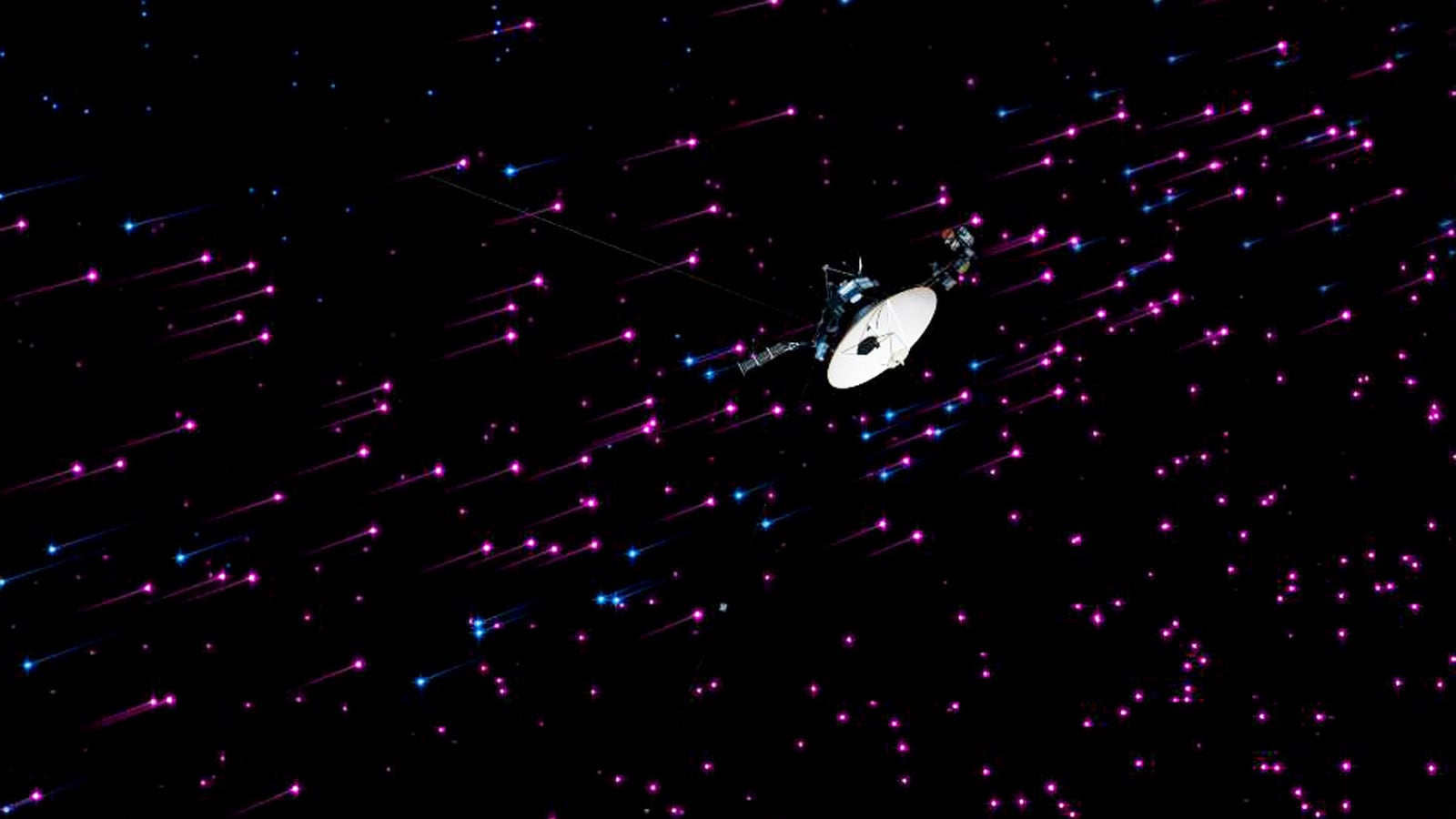
Right now, while you read these words, NASA’s Voyager 1 spacecraft is crossing a threshold that sounds like science fiction until you do the brutal, unforgiving arithmetic. It has reached a distance where a beam of light—the fastest thing in our universe, a photon capable of circling the Earth seven and a half times in a single second—takes twenty-four full hours to travel from our planet to the probe’s aging dish antenna. One whole rotation of our world. Morning to morning. Breakfast to breakfast. Just for a whisper of radio energy to cross the dark.
Think about what that actually means for the engineers sitting in the fluorescent-lit control rooms at the Jet Propulsion Laboratory in Pasadena, California.
Consider a hypothetical flight controller named Elena—let’s say she was born in 1998, twenty-one years after Voyager 1 roared off Launch Complex 41 at Cape Canaveral on a warm September morning in 1977. When Elena types a command into her terminal today to adjust a thruster or clear a corrupted memory register on the spacecraft, she hits the enter key and then goes home. She drives down the 210 freeway in evening traffic. She makes dinner. She argues with her partner about whose turn it is to walk the dog. She sleeps for eight hours, wakes up, brews coffee, commutes back to the lab, and sits down at her desk. And only then—a full day after she spoke—does her message finally arrive at the hull of Voyager 1. If the probe responds immediately, she will not hear its reply until tomorrow afternoon. A single "How are you?" and "I'm still here" takes forty-eight hours.
Most people read headlines about Voyager 1 and treat it like a pleasant trivia card. Launched in 1977. Took pictures of Jupiter and Saturn. Carries a gold record for aliens. Very far away. We skim the numbers—roughly 16.1 billion miles, or 25.9 billion kilometers—and our brains simply glaze over because human evolution never equipped us to comprehend sixteen billion of anything. We evolved to measure distances in paces, days of walking, or the flight of an arrow.
I used to look at space exploration that same way, with a polite, detached admiration, until the night I stood in a pitch-black desert basin in Nevada and watched a faint, unblinking satellite drift across the Milky Way. Standing there, shivering in a fleece jacket as the temperature dropped thirty degrees after sunset, a sudden wave of vertigo hit me—not from looking down, but from looking up. I realized that every human empire, every war, every love letter, every song ever hummed to a crying child had happened on a tiny, wet speck of rock suspended in an ocean so vast that our fastest messengers crawl across it like snails. And somewhere out past the edge of that ocean’s coastal shelf, a lonely aluminum spider was still calling home on a transmitter weaker than the bulb inside your refrigerator.
The Machine That Refused to Die
To understand why Voyager 1 makes grown engineers weep at their keyboards, you have to understand how fragile and absurd the mission actually was from the beginning.
In the mid-1970s, planetary scientists realized that Jupiter, Saturn, Uranus, and Neptune were swinging into a rare geometric alignment that occurs only once every 175 years. A spacecraft launched in late 1977 could use the gravity of each giant planet like a slingshot, whipping from world to world without burning precious fuel. There was just one catch: NASA didn't have the budget to build a spacecraft guaranteed to survive the twelve-year journey to Neptune. So they built Voyager 1 and its twin, Voyager 2, with an official warranty of four years. Just get past Jupiter and Saturn, the managers told the team, and anything after that is pure gravy.
The hardware inside Voyager 1 belongs in a museum next to rotary telephones and cassette tapes. Its three onboard computers carry a combined memory of roughly 69 kilobytes. A single low-resolution photo on your smartphone takes up forty times more space than the entire digital brain guiding humanity’s farthest emissary through interstellar space. Its data gets recorded onto an eight-track digital tape recorder—yes, an actual eight-track tape—before being beamed back toward Earth at 23 watts of power.
Pause on that number for a second. Twenty-three watts. By the time that radio signal travels across the one-light-day chasm and hits NASA’s massive 70-meter dishes in California, Spain, and Australia, its strength has faded to roughly a billionth of a billionth of a watt. Catching it is like trying to hear a mosquito sneeze inside a hurricane from ten miles away.
And yet, nearly half a century after Jimmy Carter was in the White House, Voyager 1 is still alive.
It wasn't supposed to be easy, and lately, it has felt almost miraculous. In late 2023, the spacecraft suddenly began speaking gibberish. Instead of sending back neat streams of telemetry data about magnetic fields and cosmic rays, its flight data subsystem got stuck in a loop, repeating a meaningless pattern of ones and zeros. For months, engineers who had come out of retirement—men and women in their seventies and eighties who hadn't touched the original assembly code since disco was on the radio—huddled with twenty-something programmers to perform open-heart brain surgery across billions of miles of darkness.
Think about the sheer vulnerability of that moment. You cannot send a mechanic. You cannot reboot the router by unplugging it from the wall. Every single diagnostic guess requires waiting two full days just to see if the patient twitched. When the team finally discovered that a single tiny chip responsible for storing part of the memory had died—likely struck by a stray cosmic ray—they had to rewrite the software from scratch, chop the code into pieces, and tuck those fragments into empty corners of the remaining memory banks like refugees hiding in an attic. In April 2024, the spacecraft finally blinked back to life and sent coherent data home. The control room erupted. Not because a new scientific paper was about to be published, but because an old friend had woken up from a coma.
Crossing the Invisible Shore
People often ask when Voyager 1 actually "left" the solar system, and the honest answer is a little messy because space doesn't have border walls or welcome signs.
If you define the solar system by the reach of the Sun’s gravity—specifically the Oort Cloud, a vast spherical shell of icy comets surrounding our neighborhood—then Voyager 1 hasn't even come close to leaving. At its current blistering speed of about 38,000 miles per hour, it will take another three hundred years just to reach the inner edge of that comet cloud, and perhaps thirty thousand years to pass all the way through it.
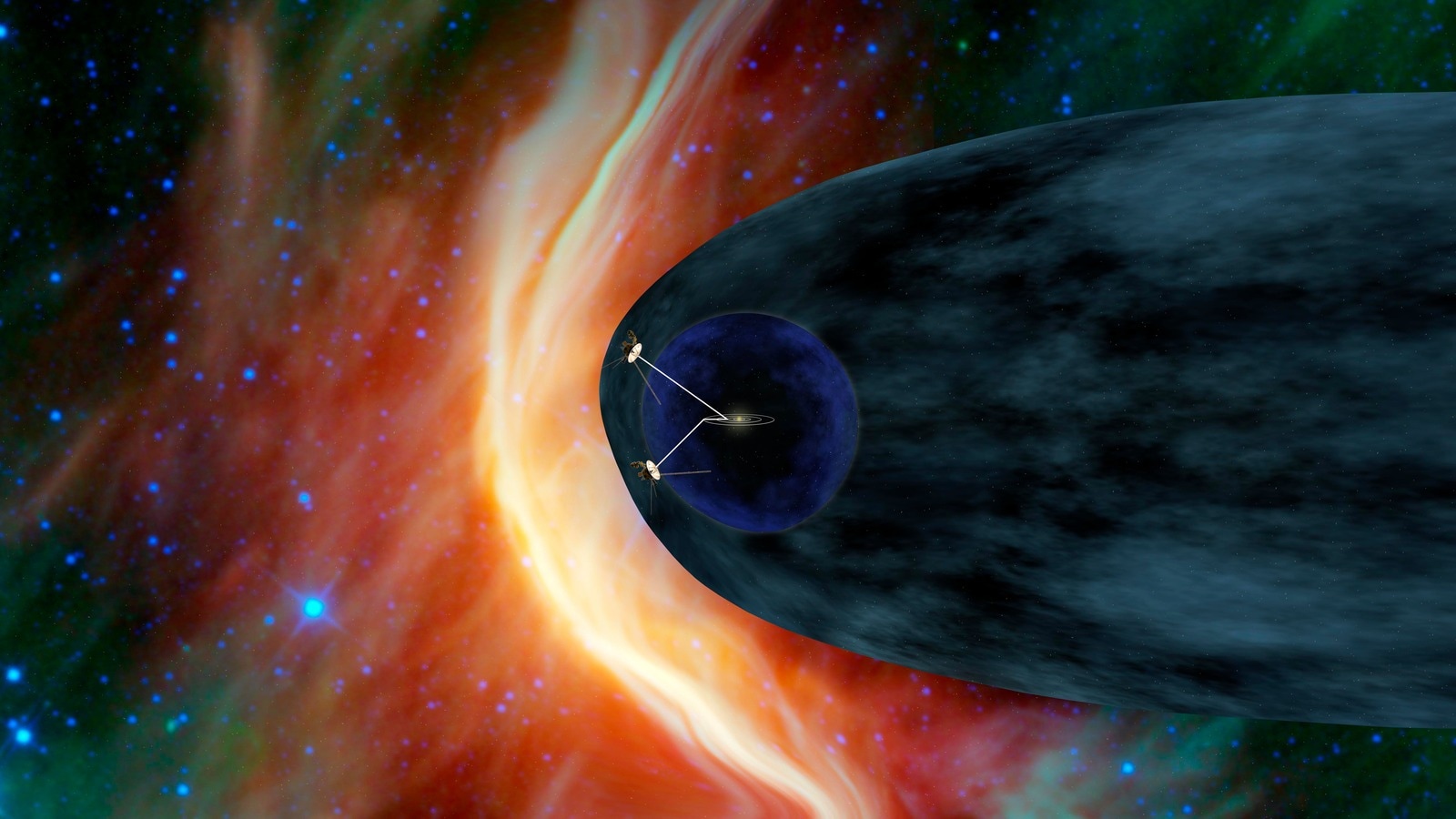
What Voyager 1 crossed back in August 2012—and what it is now leaving far behind as it hits the one-light-day mark—is the heliopause.
Here is an intuitive way to picture it. Imagine standing under a giant lawn sprinkler on a windy afternoon. As long as you stay close to the sprinkler head, the outward spray of water pushes the wind back, creating a protective bubble around you. Our Sun does the exact same thing, blowing a constant, million-mile-per-hour gale of charged particles called the solar wind out in all directions. That wind carves out a giant magnetic bubble around all the planets. Outside that bubble lies the interstellar medium: the cold, dense plasma and radiation blown off by ancient exploding stars across the Milky Way.
The heliopause is the exact boundary where the Sun’s breath runs out of strength and the galactic wind pushes back. When Voyager 1 crossed that line, its instruments registered a sudden, dramatic drop in solar particles and a sharp spike in galactic cosmic rays. For the first time in the four-billion-year history of life on Earth, an object built by terrestrial creatures had escaped the protective cocoon of its home star and entered the open ocean of the galaxy.
What We Packed in the Dark
If the engineering of Voyager 1 is a triumph of stubborn human ingenuity, the gold-plated copper phonograph record bolted to its side is a triumph of pure, unguarded hope.
In 1977, Carl Sagan and a small team of artists, writers, and scientists were given just six weeks to assemble a time capsule representing the entirety of Earth’s civilization. They weren't naive. Even Sagan admitted that the odds of an alien civilization stumbling across a washing-machine-sized spacecraft drifting through the vast emptiness between stars were vanishingly small. Voyager 1 won't even pass within two light-years of another star—a red dwarf named Gliese 445—for another forty thousand years.
So why bother? Why spend precious weeks agonizing over whether to include Chuck Berry’s "Johnny B. Goode" alongside Bach’s Brandenburg Concertos, or how to etch instructions onto an aluminum cover showing an extraterrestrial how to play a 16-and-two-thirds RPM analog record using a uranium-238 clock as a timer?
Because the Golden Record was never really meant for aliens. It was a mirror held up to ourselves during the darkest, most paranoid decade of the Cold War.
In 1977, the United States and the Soviet Union had tens of thousands of nuclear warheads aimed at each other’s cities. Humanity lived under the daily, suffocating shadow of total self-annihilation. Yet when Sagan’s team sat down to curate the 115 encoded photographs, the greetings in fifty-five languages, the sounds of surf, thunder, a mother’s kiss, and a human heartbeat, they left out every single image of war, poverty, hatred, or nuclear mushroom clouds. They didn't include those things not because they were trying to deceive potential alien finders, but because they were desperately trying to remind us of who we could be at our best.
Listen to the story behind the brainwaves recorded on that disc. Ann Druyan, the creative director of the project, had just fallen deeply, fiercely in love with Carl Sagan days before she went into a New York hospital to have her brain activity and heart rate recorded for an hour. While the electrodes taped to her scalp captured the electrical storms of her mind—to be compressed into sound and etched onto gold—she intentionally meditated on the history of human cruelty, the wonder of scientific discovery, and what it felt like to fall in love. Somewhere out beyond the one-light-day frontier right now, flying through absolute zero at ten miles every single second, is the literal electrical signature of a woman falling in love in 1977.
That is the part that gets lodged in your throat when you think about it too long.
The Fading Pulse
We have to be honest about how this story ends, because pretending otherwise would cheapen the sacrifice of the machine.
Voyager 1 does not run on solar panels; out where it travels, the Sun is no brighter than a pinpoint streetlamp seen from miles away. Instead, the probe draws its life from three radioisotope thermoelectric generators—lumps of decaying plutonium-238 that generate heat as they break down, which thermocouples convert into electricity. Every single year, that plutonium loses a tiny fraction of its heat, dropping the spacecraft’s power supply by about four watts annually.
Over the past decade, engineers have been forced to play a slow, heartbreaking game of triage. First they turned off the cameras—right after Voyager 1 turned around on Valentine’s Day 1990 and snapped the famous "Pale Blue Dot" portrait of Earth suspended in a sunbeam. Then they turned off the heaters keeping the instruments warm, gambling that the forty-year-old electronics would keep functioning at temperatures below minus 100 degrees Fahrenheit. Somehow, miraculously, they did.
But physics is non-negotiable. Sometime around the end of this decade or the early 2030s, the power supply will drop below the minimum threshold required to run even a single scientific instrument or keep the main radio transmitter locked onto Earth. One day, Elena—or whoever sits in her chair at JPL—will send a routine command across the twenty-four-hour void, wait forty-eight hours for the echo, and hear nothing back but the hiss of cosmic background radiation.
Voyager 1 will go blind and mute.
Yet it will not stop moving. With no atmosphere to create drag and no friction to slow its momentum, the dead spacecraft will continue gliding through the spiral arm of the Milky Way for hundreds of millions, perhaps billions of years. Long after our sun swells into a red giant and boils Earth’s oceans away, long after our cities have crumbled into dust and our languages have been forgotten by the universe, that twelve-inch disc of gold-plated copper—sealed inside a protective aluminum jacket designed to resist micrometeorite erosion for a billion years—will still be intact.
One full day for a beam of light to reach it today. Two days in a few decades. A thousand years in a millennium. And still it goes, carrying the sound of rain, a child’s laughter, a Navajo night chant, and the heartbeat of a woman in love, out into the endless dark.