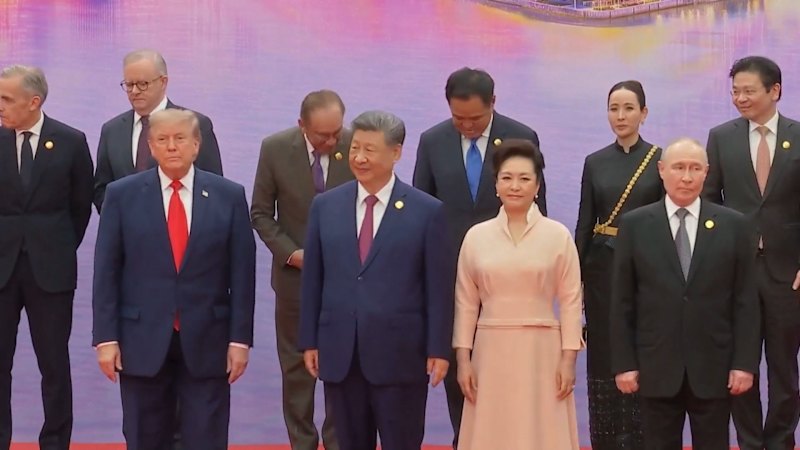
Cable news anchors are tripping over themselves to call the trilateral summit between Donald Trump, Xi Jinping, and Vladimir Putin a "historic breakthrough." They are selling you a fairy tale. When three leaders with fundamentally irreconcilable core interests sit at the same table, the result is rarely a grand bargain. It is a photo op designed to buy time, manipulate domestic markets, and project strength to audiences back home.
If you are adjusting your portfolio, restructuring your supply chain, or breathing a sigh of relief because the world's three most consequential strongmen shook hands, stop. You are falling for the oldest trick in modern statecraft. For a closer look into similar topics, we recommend: this related article.
The Lazy Consensus of Great Power Diplomacy
Mainstream coverage of this summit relies on a deeply flawed assumption: that global conflict is merely a communication problem. The prevailing narrative suggests that if you put pragmatic dealmakers in a room without bureaucrats getting in the way, they can hash out spheres of influence like corporate executives dividing up market share.
I have spent two decades advising institutional investors and multinational boards on sovereign risk. Every single time a board bets capital on a "historic handshake" between authoritarian or populist leaders, they get burned. I watched energy firms lose billions in the 2010s betting on bilateral resets that evaporated the moment domestic political winds shifted. For further context on this topic, comprehensive analysis can also be found at USA Today.
Personal rapport does not override structural reality. Trump operates on transactional leverage and four-year election cycles. Xi operates on century-long ideological survival and state-capitalist dominance. Putin operates on regime preservation and territorial buffer zones. These are not minor policy disagreements that can be smoothed over with a private dinner. They are existential operating systems that collide by design.
Misunderstanding the Term Spheres of Influence
Pundits love throwing around the phrase spheres of influence as if we are living in 1815 at the Congress of Vienna. Let us define what that actually means in modern geopolitics. A sphere of influence is not a polite gentleman's agreement to stay out of each other's backyards. It is a continuous, expensive enforcement mechanism requiring military deterrence, economic coercion, and total informational control.
When analysts claim Trump, Xi, and Putin can simply carve up the globe, they ignore the agency of everyone else on the board. Europe, Japan, South Korea, India, and the ASEAN nations are not passive chess pieces waiting to be traded. If Washington signals a retreat from security guarantees to appease Moscow or Beijing, regional powers will not quietly submit. They will nuclearize, build independent defense blocs, and fracture global trade into hostile, heavily armed camps.
You cannot negotiate stability by weakening the very alliances that kept the peace for eighty years. Doing so does not create a multipolar equilibrium. It creates a power vacuum.
What Each Leader Actually Wants From the Cameras
To understand why this summit is theater, look at the domestic pressure cooker each man is trying to vent. None of them showed up to save the world. They showed up to save their own leverage.
Donald Trump Needs a Headline Win
Trump’s political brand rests entirely on the image of the master negotiator who bends foreign adversaries to his will through sheer force of personality. By staging an unprecedented three-way summit, he instantly dominates the global news cycle and undercuts critics who claim his unilateralism isolates the United States. He does not need a ratified treaty—which would die in the Senate anyway—to claim victory. He just needs joint communiqués vague enough to spin as concessions on trade deficits, fentanyl precursors, or defense spending.
Xi Jinping Needs Economic Breathing Room
Beijing is wrestling with a structural demographic cliff, a sluggish property sector, and severe capital flight. Western tariffs and export controls on advanced semiconductors have bitten harder than state media admits. Xi is not suddenly embracing free-market transparency. He is executing a classic tactical pause—known in strategic circles as taoguang yanghui (hiding capabilities and biding time)—to cool Western decoupling long enough for Chinese domestic tech and manufacturing to achieve self-sufficiency.
Vladimir Putin Needs Legitimacy
For Putin, simply sitting as an equal alongside the leaders of the world's two largest economies is the entire prize. Years of Western sanctions and diplomatic isolation were meant to turn him into a pariah. Standing on a stage with Trump and Xi shatters that narrative instantly. It tells the Russian elite and the Global South that Moscow remains an indispensable pillar of the international order, regardless of the economic ruin or military quagmire grinding away at home.
Why the Real Deal-Killers Were Left Off the Agenda
Notice what was conspicuously absent from the official readouts. Whenever a diplomatic summit produces glowing headlines about "mutual respect" and "constructive dialogue," look at the issues they agreed not to mention.
- The Dollar Hegemony vs. Alternative Settlement Systems: Beijing and Moscow have spent years building parallel payment infrastructures to bypass SWIFT and neutralize American sanctions power. Washington cannot tolerate the erosion of the dollar's reserve status, and Beijing cannot tolerate permanent vulnerability to Treasury freezes. No handshake resolves this.
- Technological Chokepoints: Control over artificial intelligence compute, lithography machines, and rare earth refining is a zero-sum race. Both Washington and Beijing view dominance in these sectors as synonymous with national survival. Sharing the crown is not an option.
- Taiwan and Eastern European Security Architectures: Tactical ceasefires or temporary freezes along current lines of control are not peace treaties. They are operational pauses for rearmament.
Political scientist John Mearsheimer has long argued in The Tragedy of Great Power Politics that great powers are inherently revisionist when they believe the balance of power is shifting in their favor. They do not seek status-quo harmony; they seek hegemony to guarantee their own survival. Expecting three nuclear-armed powers to voluntarily cap their ambitions because they had a productive afternoon is naive.
Answering the Questions Investors Are Actually Asking
When news of the summit broke, the most searched queries were predictable: Will this end global inflation? Are tariffs going away? Is the threat of World War III over?
Every single one of those questions is built on a false premise. They assume geopolitics works like a light switch—flipped from "conflict" to "cooperation" by a single event. Here is the brutal reality behind what people are really trying to figure out.
Will This Lower Consumer Prices and Ease Supply Chain Friction?
No. The era of hyper-globalization—where efficiency and lowest-cost production dictated where factories were built—is dead. Even if punitive tariffs are temporarily paused or tweaked as a goodwill gesture, no Fortune 500 CFO is moving critical manufacturing back to single-source geopolitical flashpoints. Redundancy, nearshoring, and friend-shoring are permanent structural costs now baked into the global economy.
Does a Trilateral Summit Mean Sanctions Are Ending?
Sanctions are easy to impose and notoriously difficult to lift. In the United States, many core sanctions on Russia and technology restrictions on China are codified into law by Congress, not merely held in place by executive order. A president can waive certain penalties temporarily, creating massive compliance headaches for global banks, but the underlying legal architecture remains a minefield.
Are We Entering a New Era of Peaceful Coexistence?
We are entering an era of managed friction. Diplomatic summits do not eliminate rivalry; they merely establish rules of engagement so that competition stays below the threshold of direct kinetic war—most of the time. Confusing crisis management with genuine peace is how markets get caught flat-footed when the next naval standoff or cyberattack hits the wires.
The Downside of Cynicism
To be fair, my contrarian view carries its own blind spot. Skeptics who dismiss every diplomatic overture as meaningless theater can miss genuine tactical windows. Even temporary truces create real, tradable market rallies and short-term supply chain relief. If you sit completely in cash waiting for permanent geopolitical harmony, inflation will eat you alive. And if you ignore short-term tariff pauses because you know the long-term rivalry will resume, your competitors will capture the margin during the thaw.
The goal is not to ignore the summit. The goal is to price it accurately as a short-term tactical trade rather than a long-term structural shift.
How to Operate When Strongmen Make Promises
If you run a business, manage capital, or simply want to protect your financial footing in an era of erratic statecraft, stop watching the press conferences. Watch the capital flows and the hardware.
- Follow defense budgets, not joint statements. If all three nations continue ramping up naval shipbuilding, missile defense, and drone production the week after the summit, the rhetoric means nothing.
- Treat every tariff reduction as a 90-day option. Never sign multi-year fixed-price contracts assuming bilateral trade peace will outlast the current news cycle. Build contractual force-majeure clauses specifically around executive trade actions.
- Hedge against currency fragmentation. As bilateral trade between Moscow, Beijing, and their partners increasingly settles outside the dollar, commodity pricing and cross-border liquidity will experience sudden, localized shocks.
- Invest in physical bottlenecks. Regardless of who wins the diplomatic spin war, every major power is racing to secure domestic energy grids, copper, lithium, and industrial automation. Hard assets outlast political handshakes.
The Illusion of Control
History shows us how this movie ends. In 1938, leaders returned from Munich waving pieces of paper and promising peace for our time. In 1972, Nixon went to China and reshaped the Cold War—not because he and Mao became friends, but because both wanted to gang up on the Soviet Union. Today, there is no common external enemy uniting Washington, Beijing, and Moscow. They are each other's primary threats.
When the cameras turn off and the motorcades leave the tarmac, the structural collision between these three powers will resume right where it left off. Do not mistake a ceasefire in the headlines for peace in the real world.