Cotton.
To most of us, a plain white cotton t-shirt is the ultimate symbol of comfort, something soft enough to sleep in after a long day. But for a child born with Epidermolysis Bullosa, that exact same weave of cotton acts like sandpaper, catching on microscopic imperfections in the skin and tearing it right off the bone. For a different view, consider: this related article.
Think about the mechanics of a simple hug. When you pull someone you love close to your chest, your palms press against their shoulder blades, creating a tiny amount of lateral friction that healthy human skin absorbs without a second thought. Now, strip away the molecular glue that holds the layers of that skin together, and watch what happens when those hands pull away.
I still remember the first time I walked into a pediatric dermatology ward and saw a morning bandage change in progress, the air thick with the metallic tang of topical antiseptics and the quiet, exhausting ritual of scissors snipping through layers of non-stick gauze. The mother standing beside the bed moved with the practiced, terrifying precision of a bomb disposal expert, her fingers trembling slightly not from fear, but from the sheer physical toll of knowing that a single slip of her thumb could trigger an hour of agonizing pain. Watching her peel back a blood-soaked dressing from a toddler's forearm rewires your brain permanently, making every mundane complaint you have ever uttered about a paper cut or a stubbed toe feel obscene. Further coverage on this trend has been shared by Wall Street Journal.
The Architecture of Fragility
To understand why a grunge icon from Seattle spends his nights auctioning off custom Fender Telecasters and pouring rare red wine for billionaires, you first have to understand what happens beneath the surface of an EB patient's body. Imagine a multi-story building where the concrete slabs and the steel support beams were never properly bolted together, leaving every floor resting precariously on gravity alone until the slightest tremor sends the walls sliding apart. In healthy skin, a protein called collagen VII acts as microscopic Velcro, anchoring the outer epidermis to the deeper dermis so the surface can stretch, bend, and withstand the violent friction of daily life.
Epidermolysis Bullosa—known clinically as EB, and poetically by those who live with it as "butterfly skin" because the tissue is as delicate as a monarch's wing—is what happens when a genetic mutation erases those protein anchors. Without that cellular Velcro, the outer layer of skin simply floats over the raw tissue beneath, shearing away at the slightest touch, a tight sock, or a warm bath. Even swallowing a piece of toasted bread becomes a calculated gamble, because the friction of food moving down the esophagus causes internal blistering that slowly scars the throat shut until a child can no longer eat solid food.
Statistically, the condition is classified as rare, affecting roughly one in every twenty thousand live births in the United States, which translates to about thirty thousand people living with the disease nationwide and half a million globally. In the cold calculus of pharmaceutical economics, thirty thousand patients is a rounding error, a market too small to justify the billion-dollar gamble of traditional drug development when Wall Street is demanding blockbuster statins and weight-loss injections. For decades, families were handed rolls of specialized bandages, tubes of petroleum jelly, and a quiet, devastating prognosis that offered management of symptoms rather than any genuine hope of a cure.
When Rock Stars Step Into the Breach
Enter a guy who spent the early nineties screaming into a microphone about societal alienation and hanging from the rafters of arena lighting rigs. Eddie Vedder and his wife, Jill, did not stumble into the EB crisis through a publicist's calendar or a corporate charity mixer; they were pulled into it by friendship and proximity when the son of their close friends, Ryan and Heather Fullmer, was diagnosed with the condition. When you watch a child you love endure three-hour daily wound dressings while the medical establishment shrugs its shoulders over funding gaps, the abstract concept of philanthropy suddenly turns into a street fight.
In 2010, the Vedders joined forces with the Fullmers and a small group of determined parents to launch the EB Research Partnership, refusing to accept the traditional, sluggish pace of academic fundraising. They looked at the charity gala circuit—usually a graveyard of rubber-chicken dinners, polite applause, and stagnant endowments—and decided to treat it like a guerilla campaign for venture capital. The premise was brutally simple: raise massive amounts of money quickly, bypass the bureaucratic bottlenecks of conventional grant-making, and fund the high-risk, high-reward genetic therapies that big pharmaceutical companies were too timid to touch.
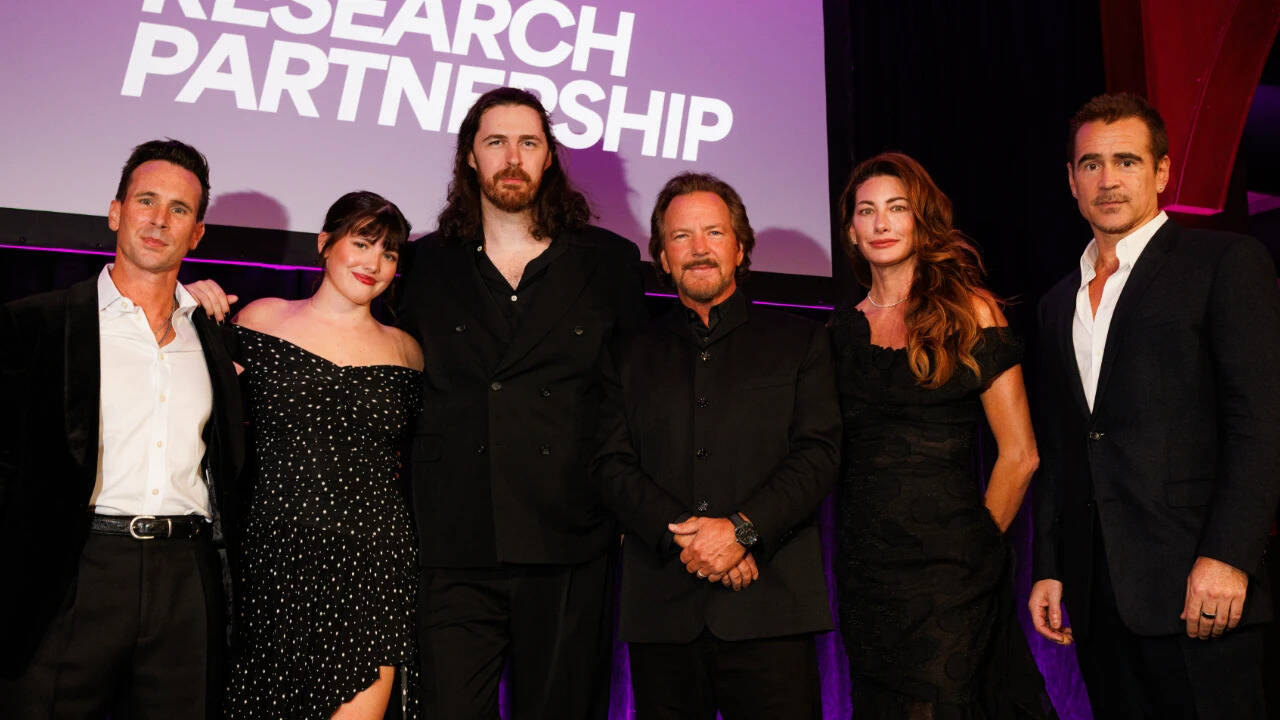
This brings us to the recent gala that made headlines across entertainment and medical circles alike, an evening where the glitz of Hollywood and the raw urgency of a pediatric ICU collided in the same room. Surrounded by A-list actors, musicians, and Silicon Valley heavyweights, Vedder did what he has always done best when the stakes are high—he stripped away the polite veneer of the room and forced everyone to confront the human cost of inaction. By the time the final gavel fell on the live auction and the last acoustic chord faded out, the event had pulled in three million dollars in a single night.
Three million dollars.
On a spreadsheet in a Manhattan hedge fund, three million dollars is pocket change, barely enough to cover a quarterly bonus or a modest real estate closing. Inside the lean, hyper-focused ecosystem of rare disease research, however, three million dollars is rocket fuel capable of pushing a promising clinical trial across the finish line from laboratory mice to human patients.
Follow the Money Into the Petri Dish
It is easy to feel cynical about celebrity charity events, and frankly, you would be foolish not to question where the money actually goes when cameras are flashing and champagne is flowing. We have all seen the bloated non-profit structures where seventy cents of every donated dollar disappears into executive salaries, glossy brochures, and overhead before a single researcher ever touches a pipette. What makes the EB Research Partnership an anomaly in the charitable world is that they structured their organization like a Silicon Valley venture fund rather than a traditional soup kitchen for science.
Instead of handing out blank checks and hoping for the best, the organization utilizes a venture philanthropy model that demands skin in the game from the biotech companies and university labs they fund. When EBRP invests a chunk of that three-million-dollar gala haul into a startup developing a gene-editing therapy or a topical protein replacement, they negotiate equity or royalty stakes in the resulting intellectual property. If a treatment succeeds and eventually makes it to market, the financial returns flow directly back into the foundation's war chest, creating a self-sustaining financial engine that funds the next wave of research.
Consider what happens next in a laboratory in Stanford or Boston when a wire transfer clears from an event like Vedder's gala. A team of molecular biologists suddenly has the runway to run toxicology studies on a new viral vector designed to deliver healthy collagen genes directly into a patient's skin cells. Another group gets the green light to manufacture clinical-grade batches of a spray-on gene therapy that can be misted directly onto open wounds during a bandage change, effectively rewriting the genetic code of the healing tissue in real time.
We are no longer talking about theoretical science fiction, because that exact spray-on therapy—developed with critical early funding from EBRP—recently became the first-ever FDA-approved topical gene therapy for Dystrophic Epidermolysis Bullosa. Before this breakthrough, treating EB meant wrapping a child in gauze like a mummy and praying against sepsis, the bacterial blood infection that claims the lives of far too many young patients before they reach adulthood. Now, doctors can apply a gel containing a modified herpes simplex virus that carries working copies of the missing collagen gene straight into the wound bed, prompting the body to finally manufacture its own microscopic Velcro.
The Invisible Toll Nobody Auctions Off
Yet even with FDA approvals and three-million-dollar headlines, there is a quiet, lingering terror that haunts every parent living inside this reality, a truth that no gala speech can ever fully capture. Science moves at the speed of peer review and regulatory caution, while a child's body degrades at the speed of friction, infection, and relentless inflammation. When you talk to families navigating the daily grind of severe EB, you realize that the disease does not just attack the skin; it wages a war of attrition on the entire architecture of a human life.
Think about the sheer mathematics of survival for a teenager with recessive dystrophic EB, the most severe form of the condition. Every single day, their body is burning thousands of extra calories just trying to heal massive, open wounds that cover up to eighty percent of their torso and limbs, leaving them chronically malnourished and exhausted. At the same time, their fingers and toes gradually fuse together inside scar tissue—a devastating complication called mitten deformity—slowly robbing them of the ability to hold a pencil, play a video game, or button a shirt.
And then there is the shadow that looms over every patient who survives into their twenties and thirties: aggressive squamous cell carcinoma. Because the skin cells are constantly dividing at a frantic pace to repair chronic wounds, the genetic machinery eventually breaks down, triggering a lethal form of skin cancer that behaves far more aggressively than the sun-induced cancers most people recognize. For many young adults who have spent their entire lives fighting through daily agony, it is not the blisters that finally take them, but a malignancy born directly out of their body's desperate attempt to heal itself.
This is the invisible clock ticking beneath the surface of every fundraising dinner, every acoustic set, and every auction bid. When Eddie Vedder stands on a stage and asks a room full of wealthy strangers to open their wallets, he is not asking them to buy a nice feeling or a tax write-off; he is asking them to buy time for kids who are running out of skin.
Why a Grunge Icon Refuses to Let Go
I used to wonder why certain artists burn out on activism after a single benefit concert, while others sink their teeth into a cause and refuse to let go for decades. Looking back at the history of music and social movements, the difference usually comes down to whether the artist views the issue as a PR accessory or a personal reckoning. For someone who built a career giving voice to the outcasts, the damaged, and the overlooked, walking away from children trapped inside their own bodies would be a betrayal of everything those early songs claimed to stand for.
There is a specific kind of vulnerability required to keep showing up for a disease that still breaks hearts on a weekly basis, because rare disease advocacy means attending far too many funerals of kids you watched grow up. Every year, the community loses fierce, brilliant young ambassadors—kids like Jonathan Pitre, the "Butterfly Child" from Canada whose courage captured the world before he passed away at seventeen, or countless others whose names never made the evening news. You cannot stand next to those families year after year without absorbing some of their grief, and you cannot absorb that grief without realizing that polite incrementalism is an insult.
When you watch footage from these EBRP events, you notice something striking about the dynamic in the room: the celebrities are not the stars of the night. The real gravity belongs to the kids sitting in the front rows, wrapped in protective sleeves, laughing at jokes while their parents quietly monitor their posture to make sure a chair edge isn't rubbing against an exposed shoulder. Those kids possess a terrifying, luminous maturity that makes every adult in the room sit up straighter, stripping away the usual Hollywood vanity within seconds.
The Ripple Effect Beyond Thirty Thousand Lives
Here is the secret that the pharmaceutical industry rarely advertises when they dismiss rare diseases as niche markets: cracking the code on an ultra-rare genetic disorder almost always unlocks treatments for millions of everyday people. History has proven this pattern repeatedly, from cholesterol drugs born out of rare familial lipid disorders to targeted cancer therapies discovered by studying obscure inherited syndromes. When scientists figure out how to safely deliver missing proteins into fragile human skin without triggering an immune meltdown, they are simultaneously building the blueprint for treating diabetic ulcers, severe burn victims, and age-related tissue degeneration.
By pouring three million dollars into the hands of researchers studying butterfly skin, Vedder's coalition is essentially funding the R&D department for the future of regenerative medicine. Every breakthrough in gene-editing precision, every new biocompatible wound dressing that reduces bacterial load without sticking to raw tissue, and every successful clinical trial protocol creates a roadmap that other rare disease foundations can immediately copy and deploy. Currently, there are more than seven thousand known rare diseases affecting over three hundred million people worldwide, and ninety-five percent of them still lack a single FDA-approved treatment.
What EBRP has built over the last sixteen years is more than a charity; it is a proof of concept that a furious, organized group of parents and allies can force the medical-industrial complex to care about lives that don't fit neatly into a quarterly profit projection. They have raised tens of millions of dollars, funded over a hundred distinct research projects globally, and watched the number of active clinical trials for EB explode from a measly two when they started to more than forty today.
Still, if you ask any parent who spent four hours this morning draining fluid-filled blisters with a sterile needle and wrapping their child's legs in tubular bandages, three million dollars is not a victory lap. It is simply the ammunition needed for tomorrow morning's battle, another batch of viral vectors shipped to a lab bench, another clinical trial bed opened for a kid who just wants to wear a normal cotton shirt without bleeding through it.
Late at night, long after the gala tables have been cleared and the donated guitars have been packed into velvet-lined cases, the real work begins again in quiet bedrooms across the country. A parent reaches for a pair of blunt-tipped surgical scissors, takes a deep, steady breath, and gently begins to unwind the white gauze from a sleeping child's arm, praying that somewhere in a brightly lit laboratory, the glue that holds human skin together is finally being stitched back into existence.