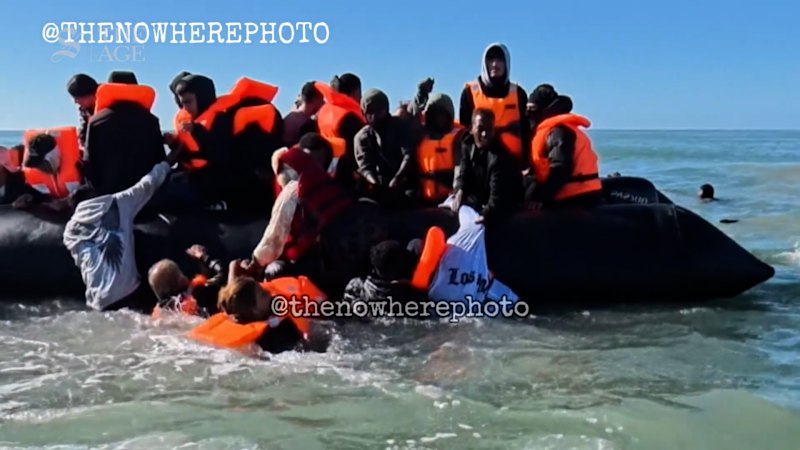
Every single morning, Westminster treats the English Channel like a weather forecast. Newspapers track the rubber dinghies the way meteorologists track hurricanes, gasping at the volume, wringing their hands over the optics, and demanding an emergency session of Parliament. Prime ministers cycle through podiums, swearing absolute control, promising to stop the flow, and manufacturing new acronyms for enforcement bills that sound impressive on evening news broadcasts.
It is all theater. Expensive, exhausting, highly choreographed political theater.
The lazy consensus in every mainstream newsroom is that the small boat surge is an unsolvable moral puzzle or a failure of pure police willpower. If only the Royal Navy patrolled harder, if only the laws were slightly harsher, if only we shouted louder at French authorities, the boats would stop. This is a comforting delusion for people who prefer talking points to structural mechanics. The reality is far more clinical, far more boring, and entirely detached from the daily panic cycle.
You cannot police your way out of a global supply-demand mismatch with a few patrol boats and a press release.
Let us look at the mechanics of what is actually happening.
The Anatomy of a Broken Pipeline
When an asylum seeker steps off a rigid-hulled inflatable boat onto a shingle beach in Kent, they are not entering a lawless void. They are entering a sprawling, bureaucratic holding pattern designed by decades of legislative compromise and institutional exhaustion.
The prevailing narrative claims that people cross the Channel because Britain is a soft touch. That sounds punchy in a parliamentary debate, but it collapses under the weight of basic migration data. People do not risk hypothermia and drowning because they read a pamphlet about British welfare provisions. They move because their home countries—whether torn apart by conflict, state collapse, or structural economic decay—offer zero future, while European transit hubs offer exploitation, detention, and dead ends. Britain represents stability, a common language for many, and existing diaspora networks that can absorb arrivals.
Yet, the British state reacts to this reality by treating immigration enforcement as a public relations problem rather than an operational supply chain.
Consider the backlog. When thousands of applications sit in administrative limbo for months or years, the system creates its own gravitational pull. If you leave people in legal limbo without the right to work, housed in converted hotels at immense taxpayer expense, you achieve two things simultaneously: you enrage the public over the cost, and you incentivize unauthorized arrivals because the processing delay itself guarantees years of residency while cases wind through appeals.
Every crackdown that fails to address processing speed is like trying to bail out a sinking ship with a teaspoon while complaining about the rain.
The Economics of Smuggling Networks
Let us talk about the supply chain. The cartels and networks facilitating these crossings operate with the cold efficiency of modern logistics firms. They do not care about political speeches. They do not watch the news. They respond to pricing signals and risk management.
When enforcement tightens at specific ports or transit terminals, the smugglers do not pack up and go home. They pivot. They upgrade to unseaworthy rubber dinghies because the profit margins on mass transit across open water are astronomical. Each boat carries dozens of people paying thousands of pounds upfront. The risk of losing a vessel is factored into the business model as a minor operational overhead.
Governments love to talk about smashing the gangs. It sounds like an action movie script. But you cannot smash a decentralized network of opportunistic operators simply by passing a new statute. As long as there is immense pent-up demand to escape desperate conditions, and as long as legal pathways are narrow, expensive, or entirely inaccessible, black-market operators will find a way to monetize the gap.
Prohibition never stopped the supply of anything demanded by human desperation or desire. It merely drove the market underground, increased the profit margins, and made the product more dangerous. The small boat phenomenon is the direct economic consequence of prohibition economics applied to human movement.
The Myth of the Deterrent Effect
Politicians are addicted to the fantasy of the deterrent. Every new piece of legislation comes wrapped in the promise that if the punishment is severe enough, people will simply choose to stay in active war zones or destitution.
History laughs at this assumption. People fleeing genuine desperation do not run a cost-benefit analysis weighted against a future deportation flight to a third country. Their immediate calculus is binary: stay and face destruction, or leave and take a gamble on survival. When the alternative is starvation or persecution, the threat of legal penalties in a distant country registers as background noise.
Worse, performative deterrence measures often backfire operationally. They consume massive amounts of political capital and financial resources while clogging up the courts with endless legal challenges. Meanwhile, the actual throughput of the immigration system remains choked.
Imagine a factory manager who spends eighty percent of his budget on angry press releases about broken conveyor belts while refusing to hire mechanics to fix the machinery. That is British immigration policy in a nutshell.
The Perverse Incentive of Perpetual Crisis
Here is the most cynical truth about the small boat debate: the political class does not actually want to solve it.
A resolved crisis is a useless political asset. As long as the boats keep arriving, every party has a reliable cudgel. The opposition can point to the numbers as proof of incompetence, while the governing party can point to obstructionist judges, activist lawyers, or uncooperative foreign powers as the villains keeping them from victory. It is a closed loop of mutual finger-pointing that generates endless media cycles without requiring a single constructive solution.
Think about the immense institutional machinery built around the management of this issue. Entire departments, private contractors running accommodation sites, security firms, legal aid practices, and pundits all depend on the friction. When you commercialize and politicize border management, you create stakeholders who benefit from the continuation of the friction.
If a CEO ran a supply chain the way governments run migration management—blaming external weather events while refusing to fix internal bottlenecks—they would be fired within a quarter. Yet in politics, incompetence is rewarded as long as it sounds passionate on television.
Let us also look at the absurdity of offshore processing schemes—the grand panaceas cooked up every few years to ship applicants thousands of miles away. These programs are monumentally expensive, legally radioactive, and operationally sluggish. They serve one purpose only: to signal toughness to a domestic audience while achieving negligible throughput. They are the policy equivalent of buying an expensive gym membership to cure a chronic back injury while refusing to touch physical therapy.
Redefining the Question
When commentators ask how to stop the boats, they are asking the wrong question entirely. It is a lazy framing designed to elicit simple answers to complex systemic failures.
The question should not be how to stop desperate people from moving across the surface of the earth. Throughout human history, populations have migrated in response to violence, poverty, and state collapse. You cannot legislate away human movement any more than you can pass a law outlawing economic gravity.
The real question is how to build an administrative architecture that absorbs global mobility without breaking domestic institutions.
Answering that question requires stripping away the moral preening on both sides. It means acknowledging that unmanaged, unregulated movement strains public services, depresses administrative capacity, and fuels legitimate social friction. But it also means recognizing that pretending we can seal the borders with magic spells and navy cutters is a fool's errand that only enriches criminal networks.
The Mechanics of Competence
Real governance is boring. It does not fit into a ten-second clip or a fiery front-page headline.
It looks like hiring hundreds of additional caseworkers, streamlining judicial review boards, establishing regional screening centers before people ever reach a rubber dinghy, and penalizing domestic employers who exploit undocumented labor in the shadow economy. Notice how rarely politicians talk about cracking down on illegal domestic labor markets. Why? Because cheap off-the-books labor benefits certain sectors of the domestic economy, creating a silent hypocrisy at the heart of the entire debate.
We scream about the people arriving on the beaches while quietly ignoring the economic magnet humming away in our own backyard. As long as businesses can hire undocumented workers with zero consequence, the incentive to make the dangerous journey across the Channel remains intact.
Stop looking to Westminster for a savior on the water. They are not looking at the sea; they are looking at the polls. Until the electorate stops rewarding theatrical failure and starts demanding operational competence, the dinghies will keep launching, the politicians will keep shouting, and nothing will change.