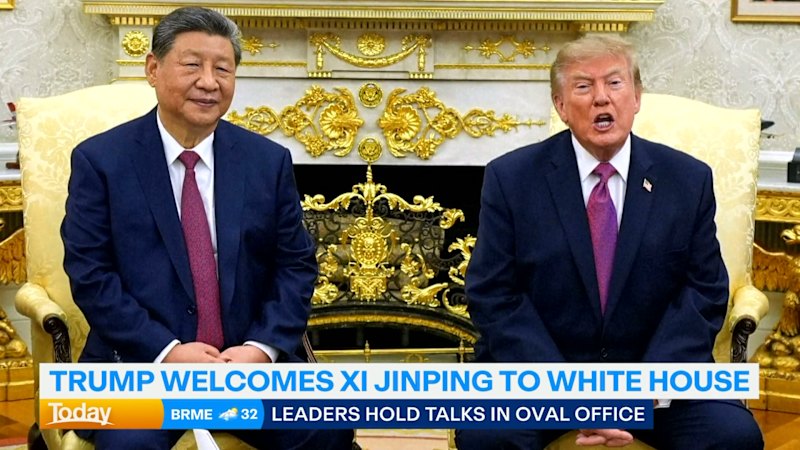
Every time a US president rolls out the red carpet for a Chinese leader at 1600 Pennsylvania Avenue, the media treats it like the geopolitical equivalent of the Super Bowl. Analysts lose their minds over body language, necktie colors, and handshake durations. It is pure political pageantry designed to distract a gullible public from the brutal, unromantic machinery of global trade.
I have watched corporate boards panic over these staged handshakes for over two decades. Millions are burned on reactionary risk-mitigation strategies every single time two leaders sit across a mahogany table and sign a stack of non-binding communiques. The consensus view is that these summits chart the course of international commerce. That view is dangerously naive. Read more on a connected issue: this related article.
The Mirage of the Bilateral Breakthrough
Look past the press briefings and the pomp. Real economic dominance is not negotiated behind closed doors in the Oval Office; it is forged through supply chain gravity, semiconductor lithography, and raw capital allocation. When a headline screams about a landmark trade accord signed in Washington, check the implementation timeline. Most of it is diplomatic smoke.
The lazy consensus holds that high-level presidential meetings can reverse structural economic gravity. They cannot. Beijing and Washington are locked in an inescapable technological and economic rivalry that no amount of catered state dinners will soften. Presidents come and go, but the structural imperatives of domestic industrial policy and national security remain fixed. Additional reporting by The Guardian explores related views on this issue.
Let us dismantle the core myths driving the modern panic over these summits.
Myth One: Tariffs Solve Trade Deficits
Politicians love tariffs because they are loud, easy to explain on a six o'clock news segment, and project strength. They are also fundamentally useless at fixing trade imbalances. Slapping a thirty percent levy on imported goods does not bring manufacturing jobs back to the Rust Belt; it simply reroutes supply chains through Vietnam, Mexico, and Indonesia.
I have seen supply chain executives spend quarters re-architecting entire logistics networks just to bypass a single tariff line item, only to find their component costs spiking by fifteen percent. The market always routes around political damage. Tariffs act as a tax on domestic consumers disguised as protection for domestic workers.
Myth Two: Decoupling is an All-or-Nothing Switch
The media loves to frame the economic relationship between these two superpowers as an impending complete divorce. Complete decoupling is a physical impossibility. Try telling a consumer electronics firm to rip out every supplier in Guangdong and rebuild that infrastructure in Ohio within five years. It cannot be done.
Instead, we are seeing a messy, hyper-expensive process of selective bifurcation. Critical sectors like advanced microchips, biotechnology, and artificial intelligence are locked behind steel walls, while consumer goods, low-end electronics, and basic chemicals continue to flow across oceans unabated. Understanding this distinction is the difference between making money and losing it.
The Real Power Equation
While pundits obsess over diplomatic protocol, the real power lies in three unsexy domains.
First, talent retention in foundational research. The nation that controls the pipeline for doctoral researchers in material science and quantum computing wins the next century. Second, maritime choke points and logistics resilience. Third, energy independence backed by rare earth refining capacity.
Notice how none of these require a photo-op on the White House lawn.
When you read that a summit has concluded with a commitment to "enhanced dialogue," translate it correctly. It means neither side had the leverage to force the other's hand, so they agreed to keep talking while quietly fortifying their own positions.
Stop waiting for a grand bargain to save your portfolio or your business strategy. There is no grand bargain coming. There is only the relentless, unyielding grind of competitive friction. Adjust your operations accordingly, or get crushed by the people who already have.