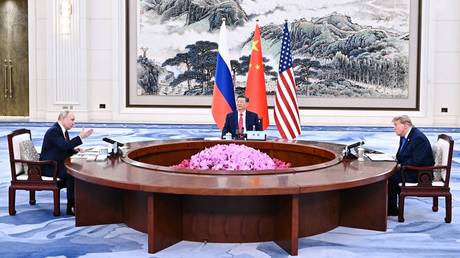
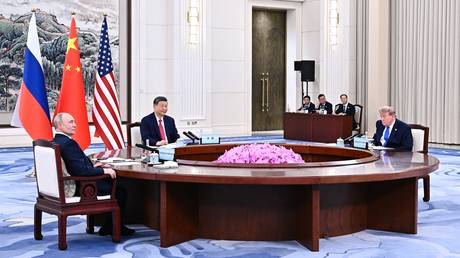
Mainstream foreign policy analysts are tripping over themselves to frame the Shenzhen meeting between Donald Trump, Vladimir Putin, and Xi Jinping as a historic inflection point. They see three strongmen in a room and immediately start drafting blueprints for a grand bargain. They point to the optics of Shenzhen—a gleaming monument to global trade and rapid modernization—and assume the location signals a pivot toward economic pragmatism over kinetic warfare.
They are completely wrong.
While pundits dissect handshake angles and motorcade routes, Russian missiles continue to tear through Ukrainian infrastructure. That simultaneity is not a contradiction. It is not a failure of diplomacy, nor is it a rogue military ignoring political leadership. The strikes and the summit are two halves of the exact same operational strategy.
If you want to understand what is actually happening in Shenzhen, stop listening to cable news commentary about "off-ramps" and "de-escalation." Look at the cold, mechanical reality of coercive diplomacy.
The Myth of the Diplomatic Pause
For decades, Western diplomatic orthodoxy operated on a linear model: first comes the ceasefire, then come the talks, and finally comes the settlement. Every mainstream take on the Shenzhen trilateral is infected by this outdated assumption. Reporters express shock that Moscow would launch heavy strikes on Ukraine while Putin sits across from Trump ahead of a broader session with Xi. They frame it as a slap in the face to the American president or a reckless escalation that threatens to derail negotiations before they begin.
I have spent twenty years watching statecraft fail in real time, and I can tell you this: the idea that violence stops so talking can begin is a luxury reserved for wars where neither side holds existential leverage.
In great-power competition, kinetic strikes during high-level summits are standard operating procedure. Look at the historical record. During the 1972 Paris Peace Talks, the United States launched Operation Linebacker II—the most intense heavy bomber strikes of the Vietnam War—specifically to force North Vietnam back to the table on American terms. During the Korean War, armistice negotiations at Panmunjom dragged on for two years while artillery barrages and infantry assaults killed tens of thousands of soldiers along the 38th Parallel.
Putin is not sabotaging the Shenzhen talks by striking Ukraine. He is pricing his assets.
Every transformer destroyed, every air defense interceptor expended, and every square kilometer contested on the ground is calculated to alter the exchange rate inside the conference room. In classical deterrence theory—the kind articulated by Thomas Schelling in Arms and Influence—military force is rarely used just to defeat an enemy outright. It is used to inflict pain and demonstrate the capacity to inflict more pain, thereby shaping the opponent's expectations about the cost of refusing a deal.
By maintaining relentless military pressure on Ukraine during the exact hours he meets with Trump and Xi, Putin is establishing a baseline reality: Russia does not need a pause to negotiate, and any settlement drafted in Shenzhen will reflect the kinetic reality on the ground, not the wishful thinking of Western capitals.
Why Shenzhen Was Chosen Over Geneva or Vienna
The location of this trilateral is the second massive blind spot in conventional coverage. Legacy outlets treat Shenzhen as a neutral venue—an Asian alternative to Geneva, Helsinki, or Vienna. Some even argue that Xi Jinping chose the city to showcase China’s economic miracle as an implicit argument for peace and prosperity.
That is a naive misreading of geopolitical geography.
Geneva and Vienna represent the post-World War II international order—an architecture built by the United States and its European allies, governed by multilateral institutions, international law, and Western diplomatic norms. Moving a summit of this magnitude to Shenzhen is a deliberate spatial rejection of that system.
Shenzhen is not neutral territory. It is the crown jewel of China’s state-directed technological and industrial ascent. Four decades ago, it was a collection of fishing villages across the border from British-ruled Hong Kong. Today, it is the headquarters of Huawei, BYD, and Tencent—the exact corporate entities at the center of Washington’s export controls, tariff walls, and national security restrictions.
When Xi hosts Trump and Putin in Shenzhen, he is not offering a neutral conference room. He is forcing the leader of the free world to negotiate the future of European security inside the physical monument to China’s economic defiance.
Think about the power dynamics embedded in the concrete and glass outside the hotel windows:
- To Trump: Shenzhen says that American tariffs and tech blockades have not stopped Chinese industrial dominance, and that any global settlement requires Beijing's assent.
- To Putin: Shenzhen says that Russia has a lifeline outside the Western financial system—an industrial base capable of absorbing Russian commodities and supplying dual-use goods indefinitely.
- To Europe: The choice of venue delivers the most brutal message of all. The fate of the European continent is being discussed in southern China, without a single European leader at the table.
The Bilateral Illusion Inside a Trilateral Room
The mainstream narrative treats the Shenzhen gathering as a three-way negotiation where Trump, Putin, and Xi will hammer out a comprehensive framework for global stability. This misunderstands how trilateral summits actually function.
There is no such thing as an equal three-way negotiation among superpowers. Every trilateral meeting is actually three distinct bilateral negotiations happening simultaneously, where two parties constantly use the third as leverage.
1. The Washington-Moscow Track
Trump enters the room looking for a rapid, visible end to a conflict that drains American resources and complicates his domestic agenda. His core leverage is the threat of flooding Ukraine with unrestricted weaponry and tightening secondary sanctions, paired with the reward of normalizing bilateral relations and lifting economic restrictions. Putin’s goal is the exact opposite of a quick fix: he wants structural concessions—territorial recognition, permanent neutrality for Kyiv, and the rollback of NATO infrastructure—that lock in Russian security guarantees for a generation.
2. The Beijing-Washington Track
Xi Jinping has zero interest in solving the Ukraine war as an act of charity for Washington. For Beijing, the conflict in Eastern Europe has been a massive strategic windfall. It has tied down American military hardware, consumed Pentagon bandwidth, divided transatlantic alliances, and turned Russia into an economic junior partner dependent on Chinese markets. Xi will only expend political capital to pressure Moscow if Trump pays for it in a completely different currency: tariff relief, semiconductor access, or softened rhetoric on Taiwan.
3. The Moscow-Beijing Track
Putin and Xi already held their real alignment long before Trump’s plane touched down. Their "no limits" partnership is bound by a shared existential objective: ending American unipolar dominance. Putin will not accept a deal from Trump that compromises China’s strategic flank in Asia, and Xi will not endorse a settlement that leaves Russia humiliated or vulnerable to Western regime-change pressure.
When you put these three tracks together, the idea of a neat "grand bargain" collapses. Imagine a scenario where Trump offers Putin a frozen conflict along current front lines in exchange for partial sanctions relief. Putin turns to Xi to gauge whether Beijing will continue underwriting the Russian economy if Moscow holds out for more. Xi looks at Trump to see if Washington is willing to drop tariffs on Chinese electric vehicles and green tech. If Trump says no, Xi has every incentive to quietly signal to Putin that Beijing will keep Moscow’s war machine funded for another three years.
The Ukraine war is no longer a regional border dispute. It is a bargaining chip in a much larger struggle over who writes the rules of the twenty-first century.
Dismantling the "Strongman Chemistry" Fallacy
If you read enough coverage of this summit, you will inevitably run into the psychological profiling trap. Pundits love to speculate on the personal rapport between Trump, Putin, and Xi. They analyze body language, recall past dinners at Mar-a-Lago or Helsinki, and suggest that personal chemistry between decisive leaders can cut through bureaucratic gridlock.
This is pure fantasy.
Personal rapport can smooth over minor diplomatic friction among allies who already share core interests. It does nothing when structural national interests collide. Franklin D. Roosevelt thought his personal charm could manage Joseph Stalin at Yalta; the result was the Soviet domination of Eastern Europe for forty-five years. George W. Bush looked into Putin’s eyes and claimed to get a sense of his soul; seven years later, Russian tanks rolled into Georgia.
Leaders of great powers do not abandon core strategic imperatives because they had a pleasant dinner. Putin views NATO expansion on Russia’s western border as an existential threat to the Russian state and his own survival. Xi views the containment of China’s technological and military rise in the Indo-Pacific as a direct threat to the Chinese Communist Party’s mandate. Trump views America’s overextension in foreign wars and its trade deficits as an unsustainable drain on national power.
No amount of back-slapping in Shenzhen changes those mathematical realities. In fact, relying on personal chemistry during high-stakes summits often produces the worst possible outcomes: vague, verbally agreed frameworks that each side interprets differently the moment they fly home, leading to deeper mistrust and sharper escalation six months later.
What Everyone Gets Wrong About "Peace"
The biggest mistake observers make is treating "peace" as a binary switch—either countries are at war, or they are at peace.
In reality, the most likely outcome of the Shenzhen trilateral is neither a permanent peace treaty nor an immediate, catastrophic collapse of talks. It is the formalization of a managed, high-friction stalemate.
Here is what that actually looks like in practice:
- A contested ceasefire, not a settlement: Fighting along the front lines may temporarily drop in intensity, not because the political disputes are resolved, but because both militaries need time to reconstitute exhausted units and replenish munitions.
- The weaponization of reconstruction: Who pays to rebuild Ukraine? Washington wants Europe to foot the bill. Europe wants to use frozen Russian sovereign assets. Moscow demands those assets back as a precondition for any truce. Beijing wants Chinese state-owned enterprises to win the infrastructure contracts. Every dollar of reconstruction becomes a new theater of geopolitical warfare.
- Permanent gray-zone escalation: Even if artillery falls silent in Donbas, the war simply migrates to cyberattacks on power grids, sabotage of undersea cables, disinformation campaigns in European elections, and economic coercion across the Global South.
Calling this "peace" is an insult to the English language. It is merely shifting the conflict from a hot war of attrition to a cold war of industrial and financial endurance.
The Uncomfortable Truth About Leverage
Now, let’s address the counter-argument to my own thesis—because ignoring the flaws in your own position is how analysts end up blind-sided.
There is a real risk that Putin’s decision to strike Ukraine during the Shenzhen summit backfires spectacularly. Coercive diplomacy only works if the target is intimidated or convinced that resistance is futile. If Russian missiles hit civilian targets or critical infrastructure while Trump is sitting in Shenzhen trying to project strength and deal-making mastery, it creates massive domestic political pressure on the White House.
Trump cannot afford to look weak or played by Putin in front of a global audience, especially with Xi Jinping watching from the head of the table. If Putin overplays his hand with kinetic strikes during the talks, he risks triggering the exact outcome he wants to avoid: forcing Trump to prove his toughness by greenlighting deeper strikes inside Russian territory, seizing frozen Russian central bank reserves, or unleashing secondary sanctions against Chinese banks that clear Russian oil payments.
Coercion is a razor's edge. Push too little, and your opponent ignores your demands. Push too hard during a summit, and you corner a superpower leader into escalating just to save face.
How to Actually Read the Shenzhen Outcome
Forget the press releases. Diplomatic communiqués drafted at the end of trilateral summits are written in intentionally hollow language designed to let every leader claim victory to their domestic audience. Words like "constructive dialogue," "mutual respect," and "shared commitment to stability" mean nothing.
If you want to know who actually won in Shenzhen, ignore the podiums and watch four concrete indicators over the ninety days following the summit:
- The Treasury Department’s Sanctions Ledger: Look at whether Washington imposes new secondary sanctions on Chinese financial institutions and tech firms supplying dual-use components to Russia. If the sanctions pipeline freezes, Trump traded economic enforcement for a temporary lull in Ukraine.
- Pentagon Munitions Drawdowns: Track the size and frequency of American weapons packages moving through logistics hubs in Poland and Romania. A slowdown in air defense interceptors and artillery shells signals a tacit agreement to cap Ukrainian offensive capabilities.
- Russian Energy Flows to Asia: Watch the discount rate on Urals crude sold to Chinese refiners and the progress on the Power of Siberia 2 pipeline. If Beijing locks in below-market energy prices without committing capital to new infrastructure, Xi walked away with the biggest prize of the summit.
- European Defense Bond Issuance: Watch how Brussels reacts. If European capitals suddenly accelerate joint defense borrowing and domestic arms production, it means they read the Shenzhen summit as proof that Washington has effectively outsourced European security to a transactional bargain between superpowers.
The mainstream press wants a clean story about peacemakers in Shenzhen overcoming the chaos of war. Reality is far uglier. The bombs falling on Ukraine and the handshakes in southern China are driven by the exact same logic: raw power, calculated pain, and the ruthless pursuit of national advantage.
Stop looking for a peace treaty in Shenzhen, and start watching who controls the rubble when the meeting ends.