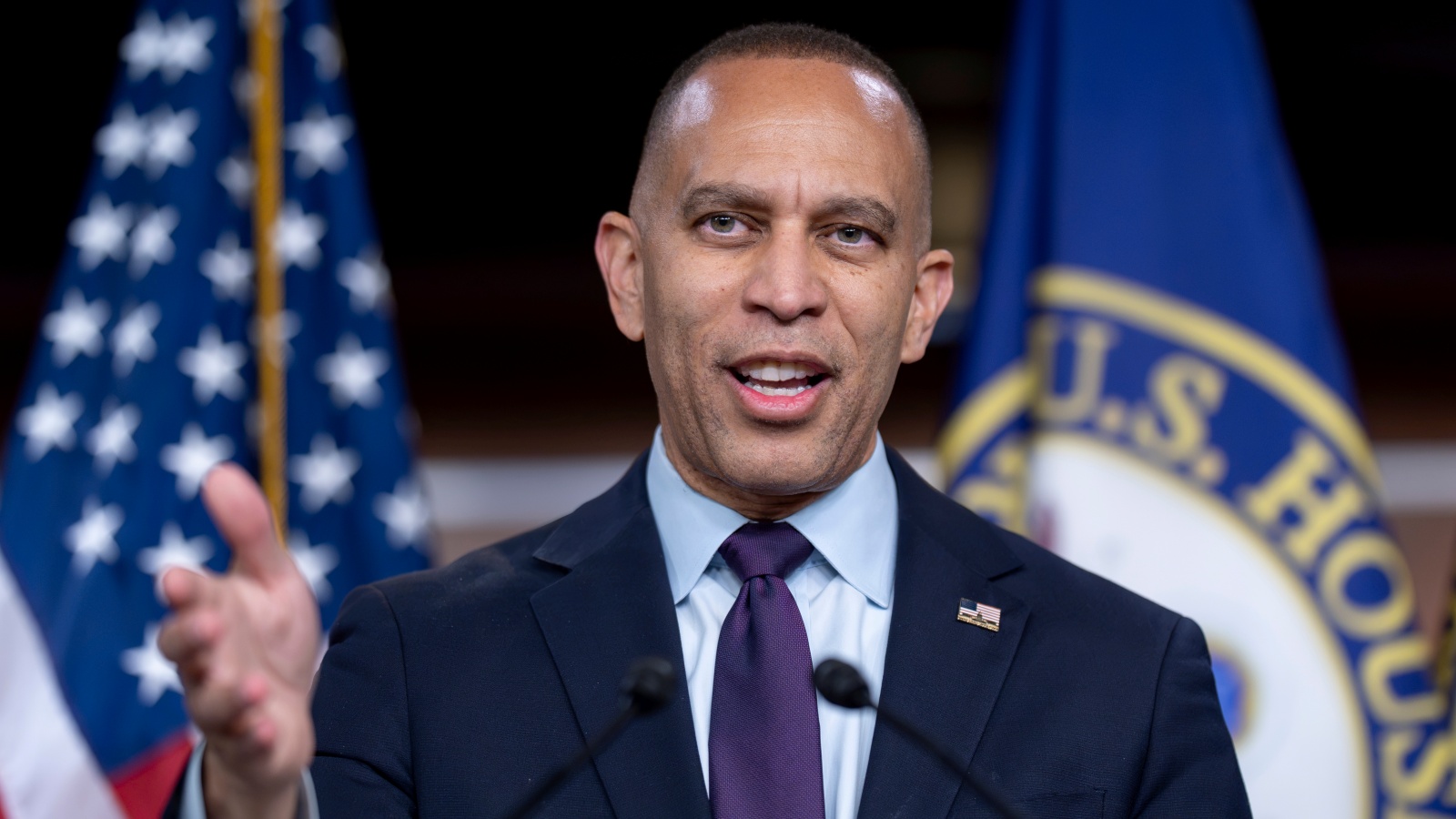
Every legacy media outlet in Washington is running the exact same victory lap right now. They look at Hakeem Jeffries, freshly nominated by a 251-to-11 caucus vote to become the first Black Speaker of the House, and they see a tidy, triumphant storybook ending. Crown Heights kid. Son of social workers. Former Paul, Weiss litigator. Heir to Nancy Pelosi’s ironclad discipline. Second in line to the presidency.
Stop buying the press release.
The political establishment is celebrating the optics of a historic milestone while ignoring the structural reality of the job Jeffries just inherited. Becoming Speaker of the House in January 2027 isn’t a coronation. It is a high-wire act over an active volcano, and the very traits that got Jeffries the gavel—his cautious corporate instincts, his top-down caucus control, and his allergy to ideological warfare—are the exact vulnerabilities that could paralyze his speakership before his first 100 days are up.
The Myth of the "Unifier"
Standard biographical profiles love to paint Jeffries as a bridge-builder who effortlessly balances Brooklyn progressive roots with Wall Street pragmatism. That sounds great in a Sunday profile. In practice, it means both wings of his party view him with deep, calculated suspicion.
Look closely at that November 2026 leadership vote. Yes, 251 Democrats backed him. Mainstream commentators treated the 11 "no" votes—mostly from incoming Democratic Socialists of America-aligned members—as a rounding error. A minor speed bump.
I’ve spent fifteen years watching Capitol Hill leadership battles up close, and I can tell you that a recorded bloc of 11 ideological defectors on day one isn't a rounding error. It is a loaded gun sitting on the Speaker's rostrum.
Why did potential heavyweight challengers like Jamie Raskin or Ayanna Pressley stand down? Not because the left suddenly fell in love with Jeffries. They stood down because Pelosi taught Jeffries how to schedule a snap leadership vote before an insurgency can organize. He didn't win over the left; he outmaneuvered them procedurally.
Procedural wins don't pass legislation. When Democrats take control of the 120th Congress with roughly 257 or 258 seats, Jeffries will have a comfortable cushion on paper. Until you remember that nearly 40 of those seats belong to frontline moderates from purple districts who won by running away from national progressive branding, while an energized progressive flank demands aggressive oversight, tax hikes on corporations, and an immediate confrontation with the White House.
You cannot split the baby on a floor vote. Either a bill hits the floor or it doesn't.
Corporate Litigator vs. Street Fighter
To understand how Jeffries will govern, ignore his speeches and look at his résumé.
Before he ever held elected office, Jeffries spent years as a high-powered corporate litigator at Paul, Weiss, Rifkind, Wharton & Garrison, followed by a stint as in-house counsel for Viacom and CBS—where he literally helped defend the network against FCC fallout over Janet Jackson’s Super Bowl wardrobe malfunction.
Litigators do not take unnecessary risks. Litigators manage exposure, control discovery, and settle quietly out of court.
That explains why Jeffries has repeatedly clashed with the activist base of his own party. In 2021, he famously told The Atlantic that he would "never bend the knee to hard-left democratic socialism." In August 2026, he raised eyebrows across his own caucus by quietly taking a meeting with Jared Kushner. Even his legendary, record-breaking floor speech opposing the GOP tax bill in July 2025 was an exercise in endurance and controlled messaging rather than legislative disruption.
Compare that to Nancy Pelosi. Analysts lazily call Jeffries "Pelosi's handpicked successor," assuming he will wield the gavel the exact same way she did. They are fundamentally different political animals.
| Leadership Trait | Nancy Pelosi | Hakeem Jeffries |
|---|---|---|
| Core Instinct | Transactional power broker; comfortable with messy public brawls | Risk-averse corporate litigator; obsessed with message discipline |
| Caucus Management | Bought loyalty with committee assignments and fundraising muscle | Enforces unity through procedural speed and tightly scripted talking points |
| Ideological Posture | Fluid; shifted left or center depending on where the votes lived | Rigidly institutionalist; openly hostile to the socialist wing |
| Opposition Strategy | Asymmetric warfare (impeachments, shutdown brinkmanship) | Institutional counter-punching and bipartisan dealmaking on targeted bills |
Pelosi understood that sometimes you have to let your caucus bleed in public to force a legislative outcome. Jeffries treats public disagreement like a client PR crisis that needs to be contained immediately.
The Divided Government Illusion
Most voters searching for "Who is Hakeem Jeffries" want to know what he is actually going to pass once he takes the gavel on January 3, 2027.
Here is the brutal truth nobody in Democratic leadership will say out loud: almost none of his domestic economic agenda will become law in the next two years.
After winning the November 2026 midterms, Jeffries stepped up to the microphones and promised to lower the cost of groceries, gas, housing, and healthcare. It is great campaign rhetoric. It is also a legislative fantasy under divided government, with Donald Trump sitting in the Oval Office for the final two years of his presidency and a Senate map that remains brutally tight.
When a House Speaker promises tangible economic relief—cheaper groceries and lower rent—while lacking the Senate supermajority or presidential signature to deliver it, they create an expectation gap that destroys majorities.
Voters who swept Democrats back into the House in the biggest wave since 1992 didn't cast ballots for "message bills" that die in a Senate drawer. They voted for results. And if Jeffries spends 2027 cutting incremental, bipartisan compromises—much like his past work on the FIRST STEP Act or the Music Modernization Act—his base will accuse him of collaborating with an administration they elected him to stop. If he refuses to deal and turns the House into a nonstop subpoena machine, the swing-district voters who just handed him the majority will punish Democrats in 2028.
What People Get Wrong About His Rise
If you look at the standard questions swirling around Jeffries right now, almost every single one rests on a flawed premise.
Is Hakeem Jeffries a progressive or a moderate?
Wrong question. He is neither. He is an institutionalist. In Washington, ideology is about what you want government to do; institutionalism is about who controls the machinery. Jeffries spent six years in the New York State Assembly sponsoring 87 bills and climbing the ladder, then spent over a decade in Congress methodically capturing the Democratic Caucus chairmanship in 2018 before taking the minority leader spot in 2022. His primary ideology is the preservation of Democratic institutional order.
Will his historic nomination permanently realign Black voter turnout for Democrats?
Do not count on symbolism to do the work of policy. Breaking a 237-year racial barrier at the top of the House of Representatives is undeniably monumental. For a kid who grew up in Crown Heights attending Cornerstone Baptist Church and dreaming of being a hip-hop artist named "Kid Fresh," standing second in line to the presidency is an extraordinary American story. Yet recent election cycles have proved beyond doubt that demographic representation alone no longer guarantees bloc loyalty—especially among younger Black men who care far more about housing costs and wage growth than historic firsts on Capitol Hill.
Does a 258-seat majority make Jeffries untouchable?
Ask John Boehner or Kevin McCarthy how safe a House majority feels when your own flanks stop fearing you. Jeffries has a larger cushion than Republicans did during their chaotic 2023–2024 meltdowns, which insulates him from losing a floor vote over three or four rogue members. It does not insulate him from a primary wave backed by outside groups if he is seen as blocking progressive priorities from reaching the floor.
The Contrarian Case for Jeffries
Before you write off his speakership as doomed to gridlock, let’s be honest about the one massive advantage his corporate-litigator style actually gives him—and the glaring downside that comes with it.
In an era where congressional politics has devolved into cable-news performance art, Jeffries is immune to the bait. You will never see him get baited into an unforced rhetorical blunder on a Sunday morning talk show. His famously rehearsed, alliterative speeches—like his alphabetical roll call of "American values over autocracy, benevolence over bigotry"—drive political journalists crazy because they sound robotic.
They aren't meant for journalists. They are meant to keep 250+ egos on the exact same talking point so the press corps cannot manufacture a "Democrats in Disarray" headline.
There is real power in being boring when your opponent thrives on chaos. By refusing to match the White House tweet-for-tweet or insult-for-insult, Jeffries forces the political spotlight back onto kitchen-table economics.
Here is the catch: discipline without a daring offense eventually turns into stagnation. You cannot litigate your way out of a populist era. You cannot use courtroom decorum to beat a political movement that actively cheers when the rules are broken.
How to Watch the 120th Congress Like an Insider
If you want to know whether Hakeem Jeffries is actually succeeding in 2027, ignore the cable news panels praising his historic gavel handoff. Watch three specific pressure points instead:
- The Rules Committee Appointments: Look at who Jeffries puts on the House Rules Committee before January 3. That committee is the choke point of the entire chamber. If he packs it exclusively with loyalists and shuts out the Progressive Caucus, he is signaling two years of tight, defensive floor control.
- Must-Pass Spending Deadlines: Watch the first major government funding standoff. If Jeffries relies on Republican votes to bail out a clean continuing resolution while 30 or 40 Democrats vote "no" in protest, his "unifier" reputation is dead on arrival.
- Subpoena Velocity: Track how quickly House committee chairs launch aggressive investigations into the executive branch. If Jeffries slows down oversight to protect vulnerable swing-district Democrats, the progressive base will revolt before summer recess.
Hakeem Jeffries spent twenty-six years—ever since his first failed State Assembly bid in 2000—mastering every rule of the political establishment to reach the pinnacle of Congress. Now he has the gavel. He is about to find out whether playing by the rules still works when the entire building is on fire.