The water in a California creek during a late-August drought does not flow so much as it surrenders.
If you kneel on the sun-baked cobbles along a tributary of the Russian River or the Scott River in mid-summer, you can smell the decline before you see it. It smells like warm silt, drying algae, and stranded river moss. The water, stripped of its cold mountain momentum, sits in tepid, disconnected puddles. For a human hiker, it looks like a quiet, sleepy afternoon in wine country or timber territory.
For a juvenile Coho salmon, it is a locked room slowly filling with carbon monoxide.
Young salmon—parr, barely longer than your pinky finger, speckled with vertical bars that look like thumbprints in wet ink—require cold, oxygenated water to survive until the autumn rains open their path to the Pacific. When a creek slows down and spreads thin across a wide, flat channel, the California sun turns that water into a warm bath. Warm water holds less oxygen. The fish begin to pant at the surface, their gills flaring rapidly, burning through the tiny fat reserves they spent all spring building.
For decades, our response to this crisis looked like a frantic, exhausting triage operation. Biologists in chest waders would hike into shrinking creeks with buckets and aerators, scooping gasping fish out of dying pools and trucking them to hatcheries or deeper mainstems. It was heroic work. It was also like trying to bail out a sinking ship with a coffee mug while someone else kept drilling holes in the hull.
Then, a group of restoration ecologists, tribal stewards, and ranchers decided to stop acting like emergency room doctors and start acting like architects. Or, more accurately, they decided to imitate an animal we spent the last two hundred years trying to wipe off the map.
They built fake beaver dams. And in doing so, they just saved 7,000 young salmon from a brutal summer drought.
The Architecture of a Broken River
To understand why a pile of woven willow branches and mud is outperforming millions of dollars in concrete engineering, you have to understand what a California river is actually supposed to look like.
Most of us carry a mental postcard of a healthy river. We picture a single, clean, fast-moving channel winding neatly between grassy banks, bordered by tall trees. It looks tidy. It looks like a park.
That mental postcard is a lie. It is the picture of a sick, simplified river.
Before European trappers arrived in North America, an estimated 60 million to 400 million beavers lived across the continent, including tens of thousands across California’s watersheds. To put that in perspective, early fur traders in the Central Valley described waterways so choked with beaver dams that navigating them by canoe required hauling boats over woody barricades every few hundred yards.
We trapped them out for felt hats. Then, once the beavers were gone, we straightened the rivers to make room for farms, railroads, and subdivisions. We armored the banks with boulders. We cleared out fallen logs so floodwaters would flush straight to the ocean as fast as possible.
Consider what happens next when you turn a messy, multi-threaded wetland into a straight drainage ditch.
Think of a healthy river system like a giant kitchen sponge laid flat on a counter. When winter rain hits that sponge, the water spreads out, slows down, and soaks deep into the pores. Even if you turn off the faucet for six months, the sponge stays damp at the bottom, slowly weeping cool water out of its edges.
By removing beavers and straightening channels, we replaced the sponge with a rain gutter.
When winter storms hit California now, water rockets down the gutter at destructive speeds, scouring away the gravel beds where salmon lay their eggs, and dumps straight into the Pacific Ocean within days. By June, the gutter is bone-dry. The groundwater table—the invisible underground reservoir that keeps creeks alive in August—never got recharged.
I remember walking a stretch of dried-out creek bed in Northern California a few summers ago with a local watershed coordinator. He kicked at a patch of cracked, grey mud where water had flowed twenty years earlier. He told me the hardest part of his job wasn't watching the fish die; it was listening to landowners who genuinely believed the creek had always gone dry in July, simply because nobody alive remembered what the valley looked like when the beavers ran it. We had forgotten our own baseline.
Sticks, Mud, and Stubbornness
Enter the Beaver Dam Analog, or BDA.
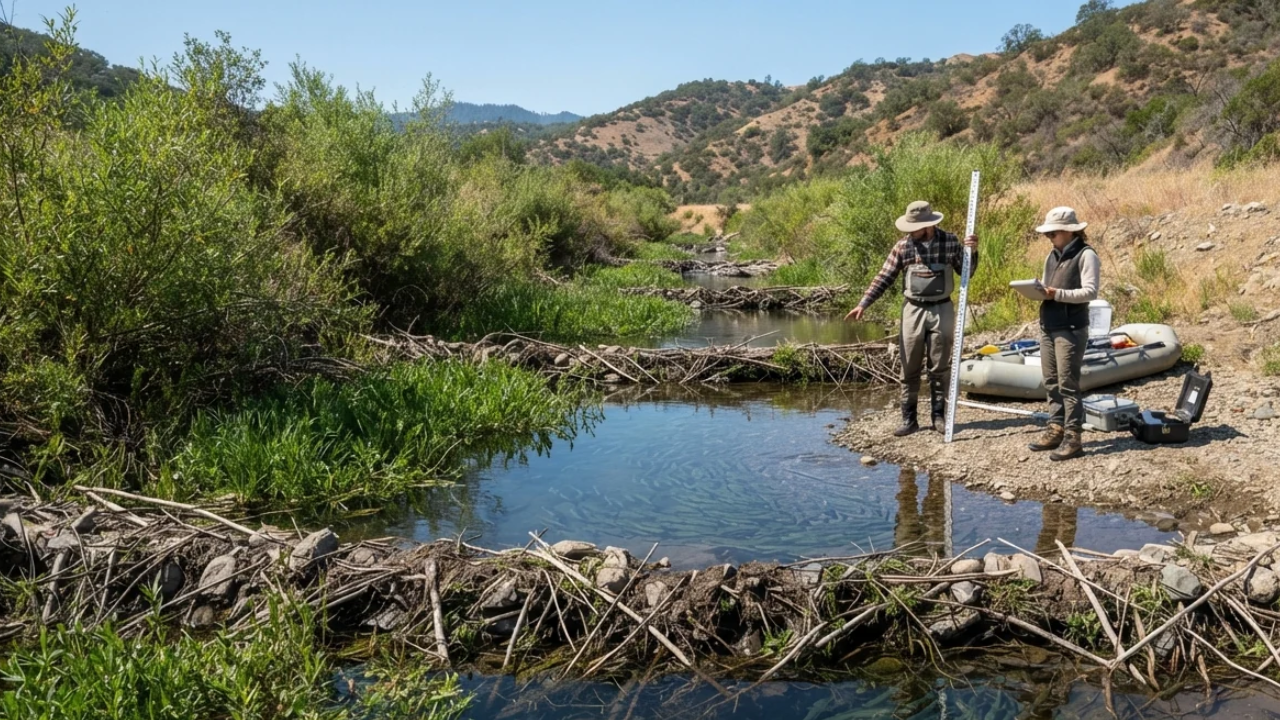
If you walked past one in the woods, you wouldn't mistake it for a grand infrastructure project. There is no poured concrete, no rebar, no heavy machinery tearing up the riparian corridor. A BDA is, quite literally, a human-built replica of a beaver dam.
Picture a crew of restoration workers standing knee-deep in a shrinking stream. They pound untreated wooden posts into the streambed in a staggered line from bank to bank, using a handheld hydraulic post-pounder that rattles your teeth when you operate it. Then comes the basket-weaving. They weave flexible branches of willow, alder, and cottonwood between the posts, packing the gaps with cobbles, sod, and river mud.
It looks primitive. Almost insultingly simple.
Yet the moment that woven wall rises eighteen inches above the streambed, the physics of the entire valley floor begins to shift.
Water hits the permeable wall of sticks and slows down. Because it slows down, it drops the heavy sediment it was carrying, which starts healing the deeply eroded, canyon-like banks that plague Western streams. The water backs up, forming a deep, shaded pond behind the structure.
And here is where the magic happens—the part you cannot see from the bank.
Because the water is pooled and pushed outward against the banks, gravity forces it down into the gravel bed. It enters what hydrologists call the hyporheic zone, the subterranean layer of rock and sand beneath the creek. Down there, insulated from the 100-degree California air, the water cools down. As more water enters the top of the pond, that chilled groundwater gets pushed out through the gravel downstream of the dam, emerging like natural air conditioning right where young salmon are hiding.
A study on California’s coastal streams—including critical Coho salmon habitats in watersheds like the Scott River and tributaries of the Russian River—tracked what happened when crews installed these low-tech structures ahead of severe drought conditions. The results weren't marginal. They were staggering.
In reaches treated with beaver dam analogs, water temperatures stayed measurably cooler, dissolved oxygen remained high, and side channels stayed wet long after untreated stretches turned into dust bowls. Across monitored restoration sites, roughly 7,000 juvenile salmon survived the dry season in habitats that, without those piles of sticks, would have cooked or dried up entirely.
Seven thousand fish might sound like a drop in the ocean until you understand salmon math. Coho salmon in California are listed as endangered or threatened across much of their range; in some coastal creeks, adult returns have dipped into the mere dozens in bad years. In a population hovering near local extinction, 7,000 surviving juveniles isn't a statistic. It is the difference between a lineage continuing for another ten thousand years and a river going permanently silent.
What Does a Beaver Know That We Don't?
To understand why these structures work so well for fish, it helps to imagine life from the perspective of a hypothetical three-inch Coho salmon named—let's call her Flicker, though she doesn't have a name, only an ancient, hardwired instinct to eat insects and avoid being eaten by herons.
In a straightened, dam-free creek, Flicker spends her entire summer fighting a losing energy equation. If she swims into the main current to catch a drifting mayfly, she burns calories just holding her position against the flow. If she hides near the bank, the water is shallow, warm, and exposed to kingfishers perched on overhanging branches. When the summer heatwave hits in July, her world shrinks to a stagnant puddle three feet wide.
Now put Flicker in a BDA complex.
Suddenly, she has an apartment building with climate control. Behind the dam, the deep pool gives her overhead cover from diving birds. Near the bottom of the pool, cold groundwater seeps up through the cobbles, creating a thermal refuge where her metabolism slows down and she doesn't burn through her fat stores. Just upstream, where the slowed water spills into flooded side-channels, submerged willow branches become nurseries for aquatic insects—a 24-hour buffet drifting right past her nose.
Even better, when winter storms finally arrive, the BDA doesn't act like a rigid concrete wall that blows out or blocks fish migration. Because it is built of woven branches, high water flows right over and through it, and adult salmon returning from the ocean to spawn can easily leap over the low crest or swim through side channels created by the pond.
And sometimes, the real architects show up to take over the lease.
In several California watersheds, wild beavers—animals that had been relegated to marginal habitats or treated as nuisance pests—discovered the human-built starter homes, inspected the workmanship, and moved in. Within weeks, actual beavers began patching leaks in the BDAs with fresh mud, expanding the ponds, and digging side canals. Humans had essentially hung a "For Rent" sign on a repaired ecosystem, and the original tenants came back to do the maintenance for free.
The Invisible Stakes of a Dry Creek
It is easy, if you live in an air-conditioned apartment in San Francisco or Los Angeles, to treat a story about 7,000 young salmon as a pleasant bit of environmental trivia. A nice thing to read while drinking coffee, right before scrolling to the next headline.
That distance is an illusion.
Salmon are what ecologists call a keystone species, though a better metaphor might be a massive biological delivery truck. Young salmon leave California’s rivers weighing a few ounces, spend two to three years feeding in the nutrient-rich North Pacific, and return weighing ten or fifteen pounds. When they spawn and die—or get dragged into the woods by bears, eagles, and river otters—they deposit marine nitrogen and phosphorus directly into the roots of coastal redwoods, firs, and oaks. Scientists can literally trace ocean-derived nitrogen inside the growth rings of ancient California trees miles inland from the coast.
When the salmon disappear, the forest starves.
And the water that keeps those salmon alive is the exact same water that keeps California’s agricultural valleys, wells, and rural communities from running dry. Every beaver dam analog that pushes water back into the underground aquifer acts as a natural savings account for the entire watershed. It raises the local water table. It keeps meadow grasses green later into the summer, which slows down wildfires—aerial photographs from recent Western megafires repeatedly show bright green, unburned ribbons of beaver-dammed wetlands cutting straight through blackened, incinerated forests.
For generations, rural landowners and conservationists fought bitter, exhausting battles over every drop of water in California. If a farmer pumped water to irrigate alfalfa or vineyards, a creek dried up and salmon died. If regulators shut off the pumps to save the fish, farms went under and families lost their livelihoods. It was treated as a zero-sum game, a mathematical trap with no exit.
What makes low-tech, process-based restoration so radical is that it breaks the math. It doesn't fight over how to divide a shrinking pie; it makes the pie bigger by keeping winter water in the landscape instead of letting it flush straight out to sea.
Still, we shouldn't pretend this is a fairy tale without friction.
Working with nature’s messiness makes modern humans deeply uncomfortable. Flooded meadows mean mosquitoes. Raised water tables can seep into low-lying pastureland or threaten poorly placed culverts under rural roads. And real beavers, if they move in, do not read property lines or respect prize orchard trees unless landowners install simple wire cages around trunks or pond-levelers—flexible pipes that keep beaver ponds from flooding nearby roads.
For a long time, California law itself treated beavers largely as pests to be killed under depredation permits, even while another branch of the state spent millions trying to recover the salmon that depend on beaver wetlands. Only recently did California launch its formal Beaver Restoration Program, shifting policy to allow live relocation of nuisance beavers into high-priority watersheds where their engineering skills are desperately needed.
Mud Under the Fingernails
There is a humbling lesson baked into every post pounded into those streambeds.
For over a century, our instinct whenever an ecosystem broke was to bring in bigger machines. We built taller concrete dams, lined miles of riverbanks with imported quarry rock, and constructed multi-million-dollar fish hatcheries to manufacture salmon in concrete raceways because the wild rivers could no longer support them. We treated rivers like plumbing systems that just needed tighter valves.
It turns out you cannot fix a living system with dead concrete.
When you watch a crew build a beaver dam analog, what strikes you most isn't the technology. It's the posture. People are bent over in the mud, weaving willow twigs by hand, listening to the sound of water shifting from a thin, hurried trickle to a deep, resonant swirl. It requires admitting that we don't know more about hydrology than an eighty-pound rodent with flat teeth and a paddle tail.
Out in those coastal creeks right now, beneath the shade of newly greening willows, seven thousand silver-flanked fish are hovering in pockets of cold, spring-fed water. They are waiting for the first heavy storms of autumn to swell the creeks, breach the gravel bars at the river mouths, and carry them out into the open Pacific.
All it took to keep them alive was giving the river back its memory.