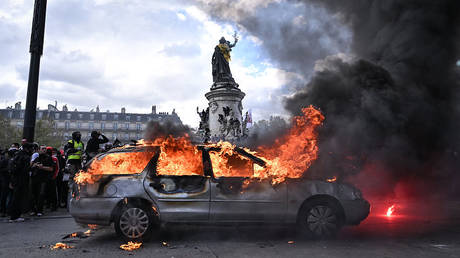
Sirens do not sound like music when you are standing behind a shop counter watching a stranger weigh whether your glass window is worth breaking. They sound like metal teeth grinding against a nerve.
I have stood in rooms in Paris, Lyon, and smaller towns across the hexagon when the air outside smelled sharp—like burnt rubber, tear gas, and wet ash—and felt that sudden, hollow drop in the stomach that hits when a routine evening turns unpredictable. You hear a shout two streets over. You watch people walk briskly instead of strolling. Shopkeepers pull down corrugated shutters with a heavy rattle that carries more weight than a speech from a podium.
When unrest breaks out across French cities, headlines often reduce the moment to a single accusation: leadership failed, incompetence lit the match, opposition politicians pointed the finger. That framing is tidy. It fits nicely onto a screen. Yet it leaves out the hardest truth about civil unrest in France: a spark only starts a fire when the wood is already dry, and politicians on every side rarely agree on who stacked the timber.
To understand what opposition leaders mean when they call President Emmanuel Macron’s handling of riots incompetent—and why that charge resonates with some citizens while sounding opportunistic to others—we have to look past the shouting matches in parliament and trace how tension builds from a single flashpoint to burned bus shelters, shattered storefronts, and exhausted emergency crews.
The Anatomy of a Flashpoint
Smoke.
It rises first from a specific grievance, a fatal encounter, an unpopular reform, or a policy decision that lands like a slap on an already bruised cheek, and suddenly a local anger becomes a national spectacle.
When riots erupt in France, the immediate catalyst rarely comes out of nowhere. Over recent years, the country has experienced waves of street mobilization and urban unrest driven by overlapping pressures: frustration over policing and trust in institutions, deep economic strain in outer neighborhoods and working-class towns, anger over cost-of-living pressures, and fierce political polarization over how the state governs. Whenever a flashpoint occurs, opposition figures—from the hard left to the traditional right and the far right—move quickly to frame the crisis around executive failure.
Critics argue that the presidency relies too heavily on top-down decision-making, technocratic confidence, or delayed communication when tempers flare. From their vantage point, waiting too long to speak, shifting tone between firmness and conciliation, or pushing contested policies without broad consensus convinces people on the streets that nobody at the top is actually listening until windows break.
That is the core of the "incompetence" charge. In political language, "incompetence" rarely means a single clerk misplaced a form. It is a verdict on judgment: the accusation that leaders misread the mood of the country, underestimated how quickly frustration could spill over, and responded reactively rather than preventing the boil-over.
But let’s be honest with ourselves. Watching a crisis unfold in real time is messy, and blaming one man for every brick thrown in every district is often too simple—even when the leader holds real responsibility for tone, timing, and public trust.
Two Sides of the Same Shutter
To see why this debate cuts so deep, consider a hypothetical scenario grounded in everyday French urban life. This scenario is invented to illustrate competing perspectives, not drawn from a single real person.
Imagine Nadia, who runs a small bakery near a transit hub outside a major city. At 5:30 a.m., dough is rising, ovens are warming, and the neighborhood is quiet except for early commuters. During periods of unrest, Nadia’s routine warps. Delivery vans reroute. Evening hours shrink because nobody wants to be caught out if a protest turns into running clashes with riot police. When a nearby bus stop is smashed or a municipal building is targeted, Nadia loses two days of revenue—and feels caught between anger at the rioters destroying shared neighborhood spaces and anger at a government that seems perennially surprised by social fury.
A few streets away, imagine Tariq, a young warehouse worker in his early twenties who has never thrown a stone in his life, yet watches friends get stopped repeatedly for identity checks and feels as though his neighborhood only enters national news when something burns. When politicians in Paris trade barbs on television, Tariq does not hear a plan for his future. He hears performers auditioning for the next election.
Both Nadia and Tariq carry real stakes. Nadia’s livelihood depends on order, predictability, and local commerce. Tariq’s sense of belonging depends on fairness, opportunity, and being treated as a full citizen rather than a recurring headline.
Opposition leaders speak directly to people like Nadia when they say the state failed to keep order swiftly and decisively. Left-wing critics often speak to people like Tariq when they argue that social neglect, housing strain, and tense policing create the conditions for explosions that heavy-handed responses only worsen. Meanwhile, Macron and his defenders argue that governing a divided country under constant pressure requires holding the line on law and order while pursuing structural reforms that easy slogans ignore.
None of these viewpoints exists in a vacuum. Each latches onto a piece of reality that the others find inconvenient.
Why Opposition Accusations Hit So Hard
In French politics, sharp conflict is not an exception; it is part of the ecosystem. From the strikes and street protests that have shaped modern French history to today’s fragmented National Assembly, taking to the streets—and denouncing the government from the opposition benches—has long been a central lever of pressure.
When opposition leaders call a president incompetent during riots, they are doing two things at once. First, they are voicing genuine outrage from voters who feel unsafe, unheard, or economically squeezed. Second, they are contesting legitimacy. In a system where executive power is strong and parliamentary majorities can be fragile or contested, framing riots as proof of presidential misrule is a way to argue that the government has lost its moral or practical compass.
Critics of the administration point to familiar flashpoints in governing style:
- Perception of distance: Opponents frequently portray the Élysée as overly centralized and detached from daily realities in struggling suburbs and rural towns.
- Messaging whiplash: When official statements shift rapidly—condemning violence one hour, calling for calm or dialogue the next—detractors call it hesitation or confusion rather than nuance.
- Unresolved root causes: Critics across the spectrum argue that deploying security forces treats symptoms after the match is struck, while deeper issues around youth employment, urban segregation, public services, and trust in institutions remain stubbornly unresolved.
Yet defenders push back just as fiercely. They note that modern unrest spreads at digital speed through social media rumors, copycat dynamics, and opportunistic vandalism that no single decree can instantly switch off. From that perspective, calling complex social and policing challenges mere "incompetence" oversimplifies a problem that has challenged successive French governments across decades and party lines.
The Invisible Stakes Beneath the Headlines
If you read only quick wire summaries, you might think a riot is just a clash between protesters and police. On the ground, the real toll is quieter and longer-lasting.
It sits in the insurance premiums a small shop owner has to pay next year. It sits in the nervous energy of teachers, paramedics, bus drivers, and municipal workers trying to keep basic services running when tensions spike. It sits in the widening gap between citizens who feel the state is too weak to protect property and order, and citizens who feel the state is too heavy-handed or indifferent to their daily struggles.
As a metaphor, think of a pressure cooker with a faulty valve. You can argue endlessly about who turned up the stove, and you can argue about whether the lid was screwed on too tight or too loose. What matters when steam begins to hiss through the cracks is whether anyone is addressing the pressure building inside—or just yelling about who is standing closest to the kitchen counter.
That is where uncertainty creeps in for anyone trying to make sense of French unrest from afar or up close. Even seasoned observers sometimes disagree on cause and effect. Did a specific policy or political misstep inflame anger, or did deep-seated grievances find a trigger and pull every political actor into a predictable script? Often, the uncomfortable answer is both.
What Happens When the Smoke Clears
Tear gas eventually dissipates. Broken glass gets swept into plastic bins. Political commentators move from emergency panels to polling analyses.
Yet the memory of a volatile night lingers in ways numbers rarely capture. It lingers in the way a resident checks the street before locking up, in the skepticism of a young person who feels written off before they have even begun, and in the bitter conviction among rivals that the people in charge missed the warning signs once again.
Calling unrest the result of incompetence offers a villain and a simple moral. Understanding why France keeps arriving at these boiling points demands something harder: looking squarely at the fractures beneath the pavement, long before the first siren wails.
A single match can blacken a room in seconds, but it takes years of neglect to leave the timber that dry.


