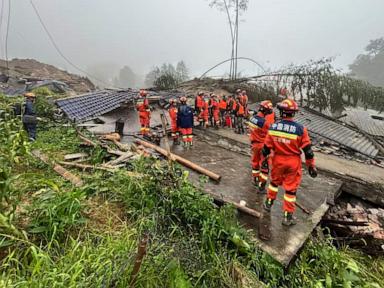
Sixteen lives. That is the grim milestone reached in Jiangxi province after relentless rains triggered catastrophic mudslides and landslides across multiple towns.
When search and rescue teams pulled another body from the debris in Suichuan County, the confirmed death toll climbed. It is a devastating repeat of a familiar crisis. Typhoon systems slam into China's southeastern coast, drop historic volumes of water in a matter of hours, and turn saturated hillsides into moving walls of earth.
Understanding the Suichuan County Disaster
Typhoon Saudel set the stage for this tragedy. After making landfall across Zhejiang and Fujian provinces, the storm system stalled over inland areas. It dumped relentless sheets of rain onto Suichuan County for days.
The geography of the region makes it uniquely vulnerable. Steep terrain, loose topsoil, and heavy deforestation or agricultural terracing create a recipe for disaster when extreme weather hits. State media reports indicate that towns like Gaoping bore the brunt of the destruction, alongside Zuo and Tanghu. A single mudslide in Gaoping claimed 13 lives on its own.
Local authorities didn't wait for total devastation to act. More than 18,000 residents were evacuated from Suichuan County as rivers swelled and slopes began to give way. Even with mass evacuations, fast-moving debris flows leave little margin for error.
The Broader Impact Across the Region
Jiangxi did not suffer alone. The same weather system stretched its deadly arms into neighboring Hunan province, claiming at least two additional lives.
When typhoons interact with regional mountain ranges, the atmospheric mechanics create localized cloudbursts. Standard weather forecasting can predict where a typhoon will cross the coast, but pinpointing which specific mountain valley will experience a catastrophic slope failure remains an imprecise science. Emergency response teams are routinely forced into reactive postures, racing against rising floodwaters and unstable mud to find survivors.
Why Infrastructure and Early Warnings Are Failing Fast
You might wonder why modern early warning systems don't prevent these numbers. The reality on the ground is messier than corporate disaster plans suggest.
Mountainous rural communities in southeastern China often feature older housing stock built generations ago, long before modern engineering codes for landslide mitigation existed. When an entire hillside lets go, traditional stone and brick homes offer virtually no resistance.
Furthermore, evacuation compliance remains a constant hurdle. Farmers and older residents are frequently reluctant to leave livestock, land, and homes behind. Convincing a rural family to abandon everything for a storm that might miss their specific grid coordinate is tough. By the time the ground actually starts moving, escape routes are often cut off by secondary slides or flash flooding.
The Path Forward for High-Risk Zones
Governments cannot stop typhoons from forming or raining down on fragile topography. Mitigation has to happen long before a storm makes landfall.
Jiangxi and surrounding provinces face a massive engineering challenge. Reinforcing slopes with concrete retaining walls, wire mesh netting, and deep drainage channels costs billions and takes years. Authorities are increasingly relying on mandatory pre-emptive evacuation triggers tied directly to rainfall thresholds. If precipitation passes a specific millimeter limit per hour, evacuation orders become non-negotiable.
Until regional infrastructure catches up with shifting climate patterns, these heavy monsoon and typhoon seasons will continue to test the limits of emergency responders across southeastern China. Track local meteorological updates closely if you have family or operations in Jiangxi, Fujian, or Zhejiang, and treat mandatory evacuation notices as absolute final warnings.