The air in Orchard Park does not merely drop in temperature; it hardens. By late December, the wind off Lake Erie carries a knife edge, sweeping across the concrete bowl of the stadium with a low, predatory moan. Breath rises in thick, white plumes from seventy thousand throats, merging into a single, breathing cloud that hangs beneath the stadium lights.
Down on the turf, the rubber pellets are frozen solid, crunching like glass beneath heavy cleats. This is not just a football game. It is a crucible.
On one sideline stand the Los Angeles Chargers, a franchise forged in the relentless sunshine and Pacific salt air of Southern California, now thrust into an alien landscape of sub-zero wind chills and hostile noise. On the other sideline wait the Buffalo Bills, an army draped in royal blue and red, fueled by a collective, generational hunger that has defined the city for decades. Between them lies eighty yards of frozen green and white, and the invisible, crushing weight of expectations.
To understand why this collision matters so intensely, you have to look past the sterile numbers blinking on the scoreboard or the point spreads flashing across morning television screens. You have to look at the human cost of ambition.
Consider Marcus, a fictional thirty-four-year-old season-ticket holder in Section 314. For Marcus, the Bills are not a Sunday diversion; they are a pulse. He inherited his seats from his father, who bought them during the turbulent glory years of the early nineties. Marcus remembers the heartbreak of wide right, the sting of consecutive February disappointments, and the long, freezing winter decades when Sunday afternoon was just an exercise in endurance. When the Bills take the field, Marcus feels every ache in his knees and every surge of adrenaline in his chest. He represents thousands in Western New York who treat football as a secular religion—a weekly ritual of hope handed down through blood and frost.
Across the country, in sleek apartments overlooking the Pacific, fans in light blue jerseys watch the temperature drop on their screens with a quiet dread. They root for a team of immense talent that has spent years searching for its definitive soul. They want to believe that talent alone can conquer adversity, that an arm blessed with angelic precision can pierce the heaviest blizzard.
At the center of this storm stand two extraordinary men who carry the burden of their respective worlds: Justin Herbert and Josh Allen.
Allen is a physical manifestation of the region he plays for. He is large, bruised, and relentlessly aggressive, a quarterback who runs toward contact rather than away from it. When he scrambles, his body absorbs the shock of crashing linebackers with a violence that makes trainers wince. He plays with the desperate, joyous abandon of a backyard competitor who refuses to lose. Every throw is an act of sheer willpower, a manifestation of a city that has learned to build strength out of harsh winters.
Herbert is a study in contrasting elegance. Quiet, analytical, and possessing a right arm capable of throwing a football seventy yards with effortless velocity, he plays with the icy calm of a chess grandmaster. Yet beneath that placid exterior lies a burning urgency. He has spent his professional life shouldering high expectations, carrying a roster battered by injuries and shaken by shifting coaching philosophies. He enters this hostile stadium knowing that greatness is not given; it is extracted through pain.
When the referee’s whistle blows to signal kickoff, the abstract theories of sports analysts dissolve into pure chaos.
The first quarter is a war of attrition. The football, slick and hardened by the cold, slips from grasp with the fickleness of river stone. Pass protection breaks down not because schemes fail, but because linemen are fighting a losing battle against traction and frozen muscles. Every collision sounds like dry timber snapping.
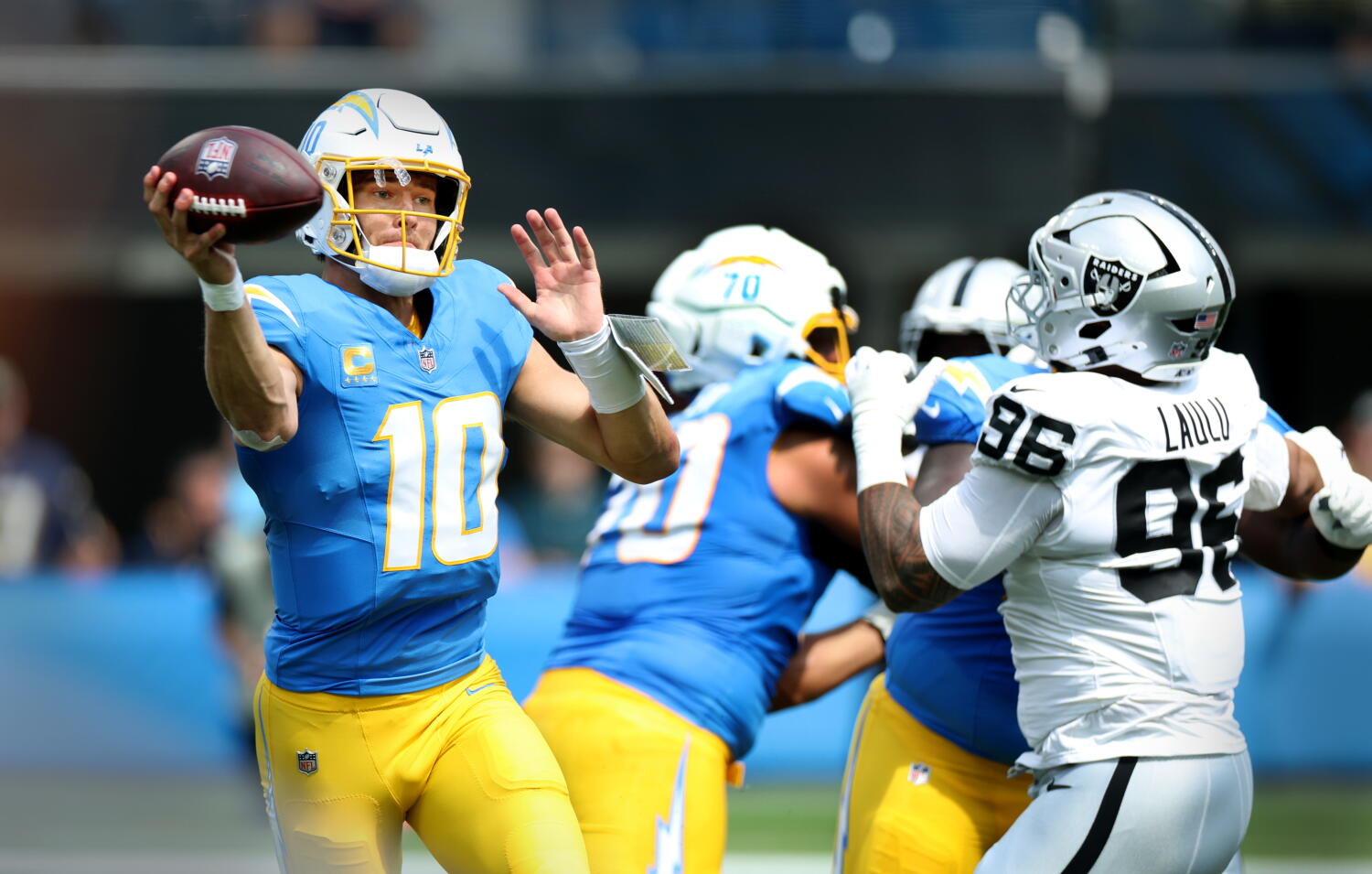
On the Chargers' second possession, Herbert drops back. The pocket collapses instantly. A six-foot-four defensive end breaks free from the edge, his breath clouding his face mask as he closes in with bad intentions. Herbert does not flinch. His eyes remain locked downfield, scanning through a forest of churning limbs. With a defender milliseconds away from driving him into the frozen turf, Herbert looses a laser into a tight window fifteen yards downfield. Completion. First down.
It is a play of immense bravery. No statistic can fully capture the courage required to stand tall while an oncoming freight train of muscle and momentum bears down on you.
Minutes later, Allen answers. Scrambling to his left under heavy pursuit, he recognizes that the secondary has locked down every receiver. Instead of throwing the ball away, he tucks it and charges up the sideline. A defender hits him flush at the waist. Allen bounces off the tackle, absorbs a second glancing blow, and dives headfirst across the marker, helmet scraping the frozen turf in a shower of rubber pellets. The crowd erupts, a sound so violent and unified that it rattles the press box high above the field.
This is the hidden cost of the game. It is not just about X's and O's, or clever play-calling designed by coordinators working in warm rooms during the week. It is about how much physical punishment a human body can endure before the mind starts whispering warnings of self-preservation. In professional football, the winner is rarely the smartest team. It is the team that manages to silence those internal whispers the longest.
As the second quarter bleeds into halftime, the score remains tight, a defensive struggle where every inch is earned through blood, sweat, and frozen turf. In the locker rooms, heaters roar, but the true warmth comes from adrenaline and blunt coaching. Tape is ripped off and reapplied. Sprains are iced and ignored. Coaches draw frantic adjustments on whiteboards, shouting over the din of exhausted men breathing heavily.
The second half unfolds like a thriller novel written in real-time.
The Chargers adjust by quickening their tempo, neutralizing the fierce Buffalo pass rush with rapid three-step drops. Herbert begins finding his rhythm, threading passes into tiny seams between linebackers and safeties. The sideline energy shifts. The visitors realize they can survive this frozen nightmare; they can conquer it.
Yet Buffalo refuses to break. The Bills defense, fueled by the relentless roar of the home crowd, tightens in the red zone. On a crucial third-and-goal from the four-yard line, the stadium becomes so loud that communication collapses. The center has to snap the ball based purely on visual cues, sensing the cadence rather than hearing it.
Allen takes the snap, rolls right, and sees his primary target blanketed. The pocket dissolves. He tucks the ball and leaps over a diving linebacker, stretching his arm across the goal line just as a safety meets him in mid-air. Touchdown. The stadium shakes so violently that old-timers swear they can feel the concrete shift beneath their boots.
It is moments like this that strip away the commercial sheen of modern sports and reveal its primal core. We watch these games not for the final score, but to witness human beings test the absolute limits of their capacity. We see ourselves in their struggle. When we watch a player pick himself up off the turf after a punishing hit, we are watching a metaphor for our own daily battles against adversity, fatigue, and doubt.
The clock winds down into the final two minutes. The score is razor-thin. One team will walk off this field with their championship dreams intact; the other will face the long, quiet flight home, carrying the heavy grief of a season that fell just short.
Herbert takes the field for what might be the final drive of the game. There are no timeouts left. Ninety-four yards separate him from immortality.
He completes an out-route to the sideline, stopping the clock with four seconds remaining. The next play is a deep crossing route. The defense brings a blitz, flooding every passing lane. Herbert steps up into the shrinking pocket, absorbs a massive blow to his ribs, and releases the ball deep into the twilight sky.
For a suspended heartbeat, time stops. Seventy thousand people hold their breath. The white leather sphere cuts through the freezing air, spinning in slow motion against the floodlights.
Gravity takes hold.
The final whistle blows, echoing across the empty parking lots long after the stadium lights begin to power down, leaving only the quiet snow falling gently over the yard lines.