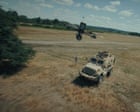
The buzz is the first thing that gets you. It isn't the roar of a jet engine or the rhythmic thumping of a helicopter blade. It is a high-pitched, mosquito-like whine—the sound of a toy, or a garden tool, or a nightmare. In the mud-slicked trenches of eastern Ukraine, that sound doesn't mean a hobbyist is taking photos. It means someone, somewhere, is looking at a screen, adjusting a joystick, and deciding you have lived long enough.
Warfare used to be about the horizon. You looked for the silhouettes of tanks or the flash of muzzle fire from a distant treeline. Now, the horizon has tilted ninety degrees. The danger is vertical.
This shift in the very nature of human conflict is the beating heart of The Wingman, a new Ukrainian action thriller that is already being whispered about as the Saving Private Ryan of the 180-degree era. But where Spielberg used the chaos of the Normandy surf to ground us in the sheer scale of industrial slaughter, The Wingman shrinks the battlefield down to the size of a handheld remote. It is intimate. It is claustrophobic. It is terrifyingly current.
The Ghost in the Machine
Consider a young soldier named Mykola. He isn't a career officer. Two years ago, he was probably a graphic designer in Kyiv or a barista in Lviv. Now, he sits in a damp basement, his face illuminated by the blue light of a tablet. He isn't holding a rifle. He is holding a controller.
In the film, we see this duality play out with a visceral intensity that traditional war movies can’t touch. The protagonist isn't just fighting an enemy; he is navigating a psychological disconnect. One moment, he is watching a high-definition feed of a Russian dugout, noticing the way a soldier smokes a cigarette or adjusts a boot. He sees their humanity in 4K. The next moment, he pulls a trigger, and that humanity is extinguished in a pixelated plume of grey smoke.
This is the "invisible stake" of the drone age. We often talk about these machines as if they make war easier because they keep our soldiers out of harm's way. The reality is more complex. While the body might be safe in a bunker, the mind is forced into a strange, god-like voyeurism. You are close enough to see the color of their eyes but far enough away that you can’t hear them scream.
The film captures this eerie silence. Most war movies rely on a wall of sound—artillery whistles, shouting, the clatter of treads. The Wingman leans into the quiet. It understands that in 2026, the most dangerous moment on a battlefield is the silence just before the hum begins.
The Democratization of the Kill
History books usually frame military evolution through the lens of massive budgets and state-sponsored research. The tank. The aircraft carrier. The nuclear sub. These were the toys of empires.
But the drone revolution is different. It is bottom-up. It is improvised. It is "MacGyvered" in garages and backrooms.
The Wingman doesn't shy away from the gritty, duct-tape reality of modern Ukrainian tech. We see soldiers soldering circuit boards by candlelight and 3D-printing stabilizers for grenades. These aren't the sleek, multi-million dollar Predators used by the U.S. military in the Middle East. These are FPV (First-Person View) drones—racing quads built for speed and maneuverability, strapped with explosives and sent on one-way missions.
The math of this shift is brutal. A modern main battle tank can cost $10 million. A skilled drone pilot with a $500 kit and a well-placed thermobaric charge can turn that tank into a charred husk in seconds.
This isn't just a change in tactics. It is a change in the social order of the front lines. The "hero" of this story isn't the muscle-bound commando charging a hill. It is the skinny kid with the glasses who knows how to bypass frequency jamming. The film repositioned the idea of bravery, placing it not in the act of physical dominance, but in the agonizing patience required to fly a fragile piece of plastic through a storm of electronic interference.
The Hunting Ground
The narrative follows a specialized unit tasked with a high-stakes rescue mission, a clear nod to the Spielbergian trope. But the obstacles aren't minefields or sniper nests in church steeples. The obstacles are "electronic domes"—invisible spheres of radio interference that drop drones out of the sky like dead birds.
The tension in the film builds through these invisible barriers. The characters have to move through a landscape where the very air is weaponized. If they use their radios, they are spotted. If they fly too high, they are intercepted. They are forced to play a lethal game of hide-and-seek with an enemy that is always watching from above.
There is a specific scene that mirrors the emotional core of the project. A drone pilot is trying to guide a wounded comrade back to safety through a forest. The pilot can see the enemy patrol closing in from the air, but the soldier on the ground is blind to them. The pilot has to "whisper" directions through a headset, acting as a guardian angel made of lithium-ion batteries and carbon fiber.
It is a beautiful, tragic metaphor for the modern condition. We have more information than ever before. We can see everything. And yet, we are often powerless to change the outcome.
The Ethical Shrapnel
We like to think of technology as a tool that solves problems. In war, technology just changes the shape of the tragedy.
The film's director, who spent time embedded with actual drone units, refuses to paint this as a clean, clinical way to fight. There is a messiness to it. There is the "latency"—the split-second delay between a command and an action. There is the "grain"—the static that eats the screen just as the drone makes its final dive.
Most importantly, there is the aftermath.
In Saving Private Ryan, the horror was the proximity. The blood on the lens. The feeling of being buried in the sand. The Wingman finds its horror in the detachment. It asks the viewer to consider what happens to a culture when its young people spend their days playing a real-life version of a video game where the "Game Over" screen means a real person has died.
The film doesn't offer easy answers. It doesn't tell us if this is "better" or "worse" than the old way of dying. It simply shows us that the genie is out of the bottle. The sky is no longer a neutral space. It is a predatory one.
The Hum in the Head
By the time the credits roll, you aren't thinking about the political borders or the geopolitical ramifications. You are thinking about the sound.
You find yourself looking up. You see a bird or a kite, and for a fleeting second, your heart rate spikes. That is the triumph of this narrative. it successfully translates the specific, localized trauma of the Ukrainian front into a universal anxiety. It reminds us that technology doesn't just change how we kill; it changes how we live.
We are all under the eye now.
The final shot of the film isn't a flag waving or a soldier returning home. It is a wide, sweeping view of a beautiful, sun-drenched field. It looks peaceful. It looks like a painting. But then, faintly, right at the edge of hearing, the buzzing starts again.
And you realize that in the drone age, there is no such thing as being alone.