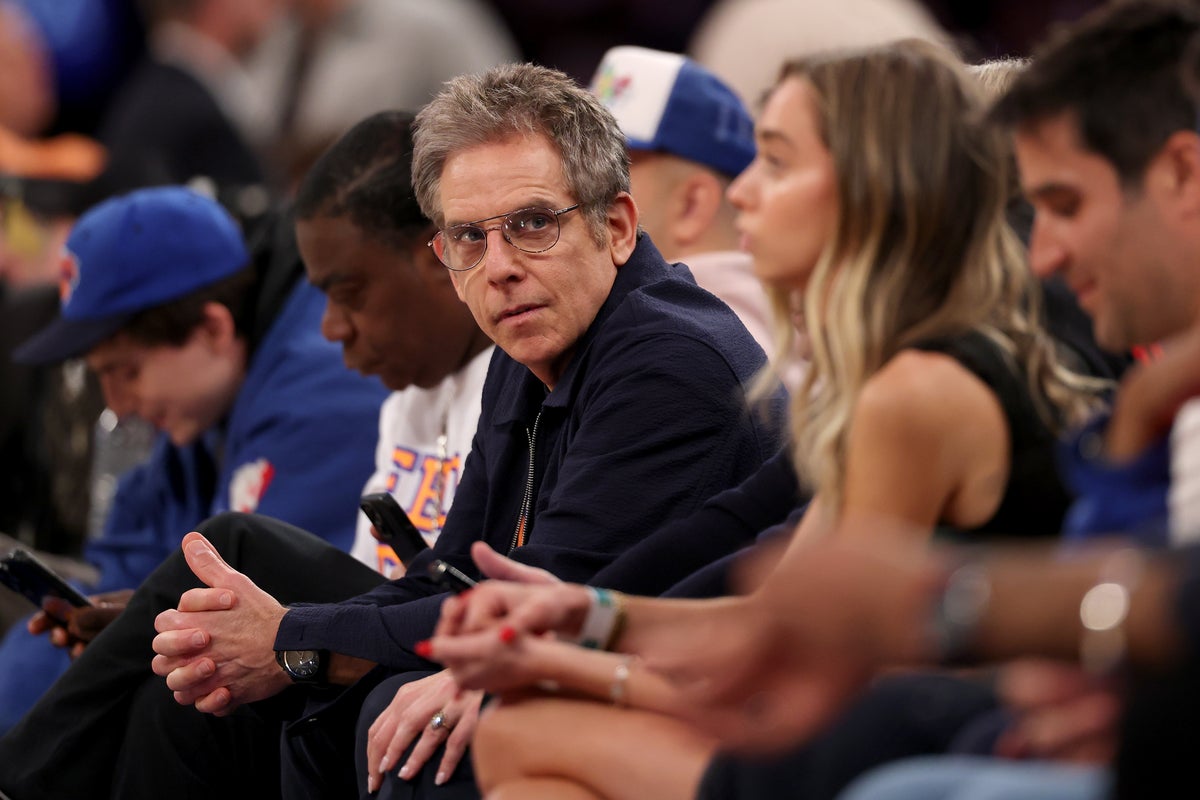
The blue light of the smartphone is a judge that never sleeps. It waits for a slip, a stutter, or—in the case of Ben Stiller—a simple expression of hometown pride that collided with the worst possible timing.
It was a Saturday night in New York. For anyone who has ever felt the electric, vibrating floorboards of Madison Square Garden during a playoff run, you know the feeling. The Knicks had just secured a hard-fought victory against the Philadelphia 76ers. It was the kind of win that makes a fan want to shout into the digital void, just to hear the echo of a thousand other orange-and-blue hearts. Stiller, a lifelong fixture in the front row, did exactly that.
"Got it done," he posted to X, formerly Twitter.
Three words. A celebratory sigh. But while Stiller was watching Jalen Brunson navigate a high-screen pick-and-roll, the rest of the world’s eyes were fixed on a different screen entirely.
The Collision of Two Realities
At the exact moment Stiller’s thumbs hit "post," the White House Correspondents' Association dinner was unfolding in Washington, D.C. Outside the glittering Hilton, the air was thick with the scent of exhaust and the sound of chanting. Protesters had gathered to voice their fury over the conflict in Gaza. It was a scene of high tension, raw emotion, and political friction.
Then, the internet did what it does best: it lost the thread.
Within minutes, the celebratory "Got it done" was ripped from the context of a basketball hardwood and dropped into the middle of a geopolitical firestorm. To a scrolling stranger who had just seen footage of police lines or heard rumors of unrest, Stiller’s tweet didn't look like sports commentary. It looked like a cold, heartless endorsement of a crackdown.
The transformation was instantaneous.
Aggrieved users began flooding his mentions. They didn't see the actor who played Derek Zoolander or the director of Severance. They saw a wealthy celebrity allegedly gloating over the suppression of a protest. The comments ranged from bewildered disappointment to vitriolic rage. People accused him of being "out of touch" or, worse, "complicit."
The digital mob doesn't ask for clarification. It asks for blood.
The Invisible Stakes of Context
We live in an era where the "Main Character of the Day" is often chosen by a glitch in the collective perception. Consider the hypothetical user, let's call her Sarah, sitting in a coffee shop in Seattle. She opens her feed. She sees a video of a journalist being shoved by a security guard at the D.C. event. Directly beneath that video, she sees Ben Stiller saying, "Got it done."
Sarah doesn't know the Knicks played at 6:00 PM. She doesn't care about the Eastern Conference standings. To her, the proximity of the two posts creates a narrative link that is impossible to ignore. Her brain fills in the gaps. She feels a surge of righteous indignation. She taps out a scathing reply.
This is the psychological trap of the modern feed. It is a flat plane where a box score and a human rights crisis occupy the same visual real estate. There is no depth of field. There is only the "now."
Stiller found himself caught in this flattening of reality. He wasn't tweeting about the dinner. He wasn't tweeting about the protesters. He was, quite literally, just a guy happy that his team didn't blow a lead in the fourth quarter.
But the truth is often a secondary casualty in the war for engagement.
The Anatomy of a Misunderstanding
When the backlash reached a fever pitch, the confusion became a feedback loop. Others, seeing the angry replies, assumed they had missed the original "offense" and joined in. This is the wildfire effect of social media. It doesn't require a spark of malice; it only requires a dry forest of fragmented information.
Stiller eventually had to do what no one should have to do after a sports win: explain his own joy.
"I was talking about the Knicks game," he clarified in a follow-up, his digital voice sounding weary even through the screen.
The fever broke, but the sweat remained. The incident serves as a chilling reminder of how fragile our public identities have become. We are all one poorly timed sentence away from being cast as the villain in a story we didn't even know we were writing.
There is a specific kind of exhaustion that comes with modern fame. It isn't just the paparazzi or the long hours on set. It is the constant, low-grade fever of knowing that every word you utter is being filtered through a billion different lenses, most of which are out of focus. Stiller wasn't being political. He was being human. He was being a fan.
But in the arena of the internet, being human is a dangerous game.
The Cost of the Instant Reaction
Why does this matter beyond a celebrity’s bad weekend?
It matters because it highlights the erosion of our ability to give each other the benefit of the doubt. We have traded nuance for speed. We have replaced conversation with "gotcha" moments. When we see something that upsets us, our first instinct is to strike, not to seek the source.
The Ben Stiller "scandal" wasn't a scandal at all. It was a ghost. It was a phantom limb of a conversation that didn't exist, felt by thousands of people who were looking for a place to put their anger.
Imagine the mental load of having to cross-reference the entire globe's current events before celebrating a personal win. Did a tragedy happen in a time zone eight hours away? Is there a sensitive anniversary today? Is a major political event happening simultaneously? If we require this level of vetting for a three-word tweet, we have effectively killed the spontaneity of human connection.
Stiller’s mistake wasn't what he said. His mistake was assuming that the person on the other side of the screen was seeing the same world he was.
The Quiet After the Storm
By the next morning, the "controversy" had largely evaporated. The Knicks were preparing for the next round. The protesters in D.C. had moved on to the next day's struggle. The angry commenters had found a new target, a new phrase to dissect, a new reason to feel aggrieved.
But for Stiller, and for anyone watching closely, the lesson was clear. The internet is not a town square. It is a hall of mirrors where the reflections are distorted, stretched, and often unrecognizable.
We are living in a time of unprecedented noise. To find the signal, we have to be willing to pause. We have to be willing to ask, "What else could this mean?" before we hit the "send" button on our fury.
Next time the Knicks win, Ben Stiller might think twice before he tweets. He might wait an hour. He might check the news. He might look at the world outside his window and wonder if his happiness will be misinterpreted as someone else's pain.
That hesitation is the hidden tax of the digital age. It is a quiet, creeping censorship born not of law, but of the fear that our simplest joys will be weaponized against us.
The blue light flickers. The judge waits. The game goes on, but the cheers are becoming much more careful.


:max_bytes(150000):strip_icc():focal(999x0:1001x2)/hemsworth-parents-craig-leonie-8-0ce1804e412f4972a0b7610a0bbe12c1.jpg)