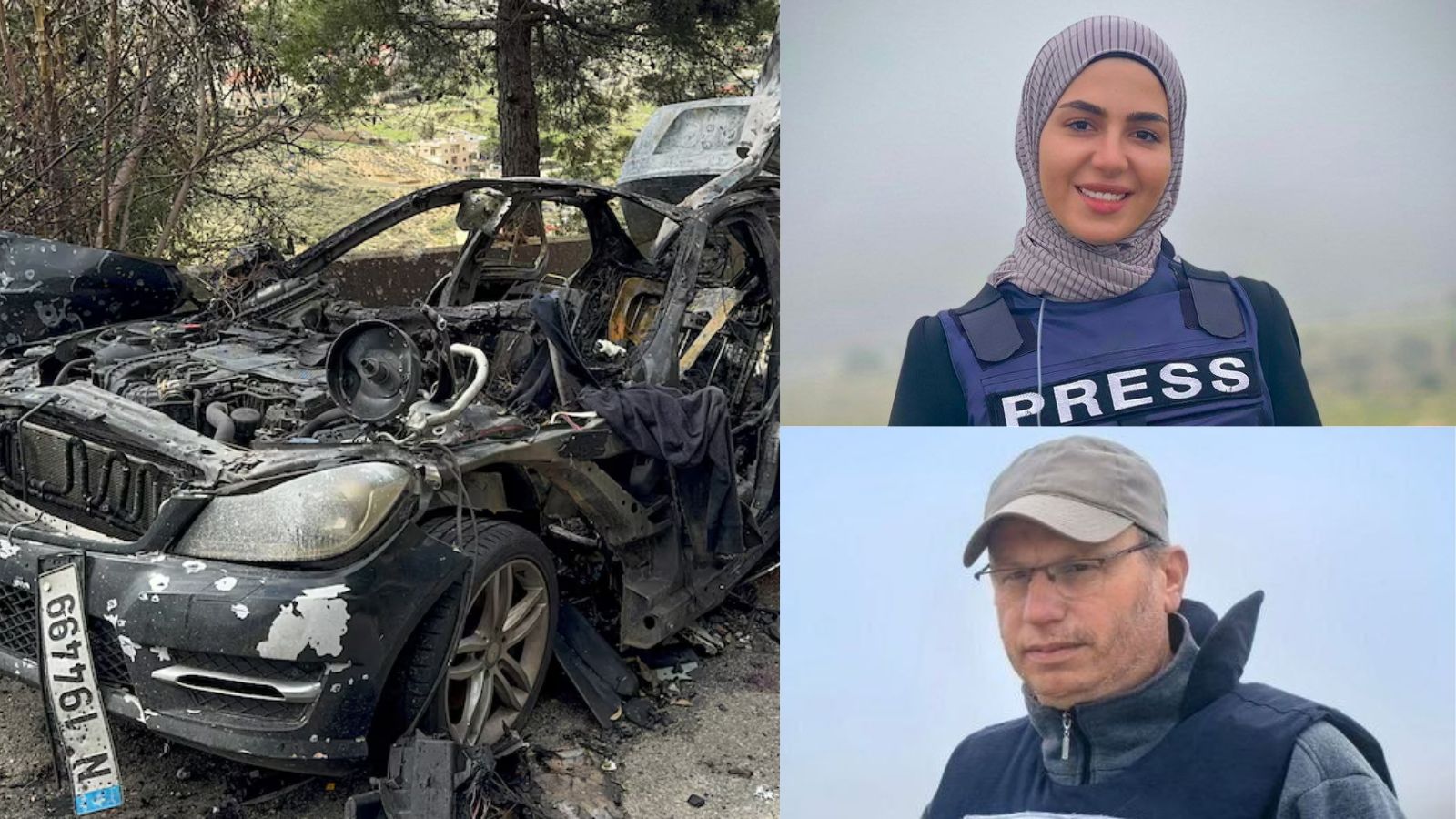
The lens of a camera is a strange, transparent barrier. To the person behind it, the glass provides a deceptive sense of distance, a feeling that they are merely observers of history rather than participants in its violence. But in the borderlands of South Lebanon, that barrier has shattered. When the metal of a drone or the heat of a missile finds its mark, the "Press" vest—bright blue, supposed to be a shield of international law—becomes nothing more than a target.
Last night, the air in Beirut didn't just carry the scent of exhaust and sea salt. It carried the electricity of a breaking point.
The Weight of a Broken Lens
Imagine a small apartment in the heart of Beirut. A young man sits at a kitchen table, his phone glowing with a grainy video feed from the south. He isn't looking for military movements or political grandstanding. He is looking for a blue vest. He is looking for his sister, or his friend, or the colleague who taught him how to white-balance a shot under the midday sun.
When the news broke that journalists had been killed in a targeted strike, that glow on the phone didn't represent information anymore. It represented an inheritance of grief.
Abbas Araghchi, Iran’s Foreign Minister, stood before the microphones and called it a "wake-up call." It is a phrase often used in the sterile hallways of diplomacy, but on the streets of Lebanon, the wake-up call was the sound of a funeral procession. The words from Tehran weren't just a political condemnation; they were an acknowledgment of a shifting reality where the messengers are being hunted with the same precision as the soldiers.
The Vanishing Middle Ground
Diplomacy is often a game of shadows and mirrors. To understand the "wake-up call" Araghchi described, you have to understand the fragile ecology of information in a war zone. When journalists are killed, it isn't just lives that are lost. The middle ground vanishes. The bridge between a bombed-out village in the south and a television screen in London or New York or Tehran is burned.
In Beirut, the streets didn't wait for a formal statement.
Protests erupted. Not the choreographed rallies of political parties, but a raw, jagged outpouring of rage from people who know exactly what happens when the cameras stop rolling. They know that when the witnesses are gone, the violence can grow in the dark.
Consider the "Press" vest itself. It is meant to be a universal language. It is a neon sign that says: I am here to see, not to kill. But the rules of the game have been rewritten by those who see the camera as a weapon more dangerous than a rifle. To those in power, a recorded image can be a indictment, a piece of evidence, a spark for a global outcry.
The Cost of the Image
Think about the physical reality of a journalist in South Lebanon. They aren't in bunkers. They are on rooftops, in the mud of a olive grove, or in the front seat of a beat-up SUV with a "TV" sign taped to the roof in masking tape. They carry batteries, water, and the crushing weight of knowing that their presence is the only thing keeping a story alive.
When those journalists are struck down, the "wake-up call" isn't a metaphorical alarm. It is a literal silence. It is the static on a screen when a live feed cuts out.
Araghchi’s statement from Tehran serves a political purpose, certainly. It frames the conflict in a way that highlights the vulnerability of those telling the story. But for the people in Beirut, the politics are secondary to the visceral reality of a colleague’s blood on the pavement. The protests weren't just about a foreign policy shift or a new alliance; they were about the fundamental right to exist while bearing witness.
A New Geography of Danger
The geography of Lebanon has always been defined by its borders, but now it is being defined by its visibility. There are areas where you can still buy a coffee and walk to a movie theater, and there are areas—just a few hours south—where the very act of holding a microphone is a death sentence.
This is the "wake-up call" for the international community. If the people tasked with reporting the truth are no longer safe, then no one is. The rules that have governed conflict for a century are being systematically dismantled, piece by piece, lens by lens.
In the protests that surged through Beirut, you could see the faces of people who have lived through decades of this. They are tired. They are angry. But they are also deeply aware that if they don't scream now, the silence will become permanent.
The Iranian FM's words ripple through the diplomatic circles, but they find their true resonance in the silence of the newsroom. In the empty chair where a reporter used to sit. In the hard drive that contains the final, unedited footage of a world on fire.
The "wake-up call" has been delivered. The question is whether anyone is actually listening, or if we have all become too used to the sound of the alarm.
A lone journalist in a blue vest stands on a hill overlooking the border. They check their focus. They check their audio. They know the risk. They know that the next sound they hear might not be the wind, but the whistle of something much faster, much hotter, and much more final. They press "record" anyway.
The red light on the camera is a small, defiant sun in the gathering dark.