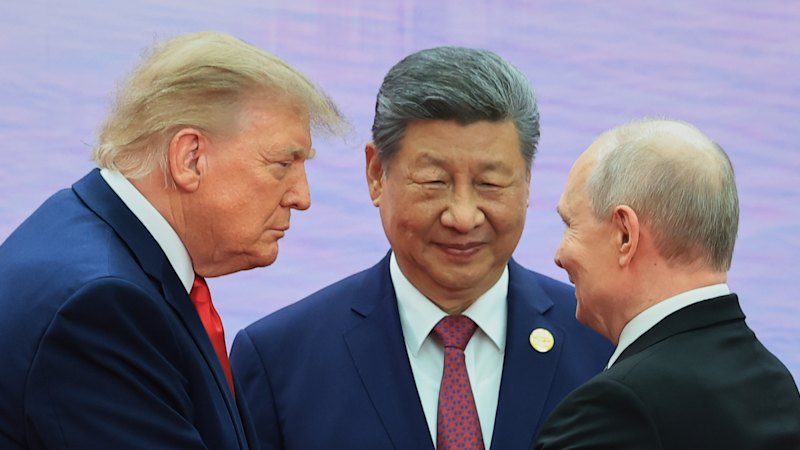
The convergence of Donald Trump, Xi Jinping, and Vladimir Putin in Shenzhen for the 2026 Asia-Pacific Economic Cooperation (APEC) summit represents a structural collision between economic interdependence and national security maximalism. Standard coverage treats this gathering as a series of isolated bilateral photo opportunities centered on artificial intelligence and Taiwan. That framing misses the underlying operational reality. When the leaders of the United States, China, and Russia occupy the same physical venue, the diplomatic mechanism shifts from multilateral trade facilitation to a three-body deterrence problem where every concession on one front creates immediate vulnerability on another.
To evaluate what actually happens behind closed doors in Shenzhen, observers must separate the public communiqué theater from the hard constraints governing each leader's domestic and strategic calculus. APEC was designed in 1989 as a non-binding forum to reduce tariff barriers and harmonize regulatory standards across the Pacific Rim. By hosting the 2026 iteration in Shenzhen—China’s hardware manufacturing and artificial intelligence epicenter—Beijing has deliberately converted a consensus-based trade venue into a live demonstration of technological self-reliance.
The Structural Architecture of the Three-Body Negotiation
Conventional diplomatic analysis relies on bilateral game theory, modeling Washington versus Beijing or Washington versus Moscow as discrete two-player games. In Shenzhen, those boundaries collapse. The simultaneous presence of Trump, Xi, and Putin introduces a triadic dynamic where third-party externalities dictate the ceiling of any bilateral agreement.
The Washington-Beijing Axis (Compute and Deterrence)
The primary friction point between the United States and China is no longer conventional trade deficits in consumer goods; it is the control of frontier compute infrastructure and the sovereignty of Taiwan. Washington’s objective is to maintain an asymmetric lead in advanced semiconductor fabrication and frontier AI model weights while preventing a kinetic blockade or invasion of Taiwan. Beijing’s objective is to neutralize U.S. export controls, secure unrestricted access to global markets for its overcapacity in green technology and industrial hardware, and establish diplomatic recognition of its sovereignty claims over the Taiwan Strait.The Beijing-Moscow Axis (Resource Security and Sanctions Evasion)
For Xi Jinping, Vladimir Putin’s presence serves as both a strategic backstop and a diplomatic liability. Russia provides China with discounted hydrocarbons, raw commodities, and military-industrial cooperation that insulate Beijing from potential maritime blockades in the Strait of Malacca. However, overt alignment with Moscow complicates Xi’s efforts to persuade European and middle-power APEC economies—such as South Korea, Japan, and Australia—to resist Washington’s decoupling mandates.The Washington-Moscow Axis (Transactional Linkage)
Donald Trump’s diplomatic methodology favors bilateral, transactional deal-making over multilateral consensus. Engaging Putin on the sidelines of an Asian trade summit allows Washington to test whether concessions on European security architecture or sanctions relief can be traded for Russian neutrality—or active pressure—regarding Sino-American friction points, energy pricing, and nuclear arms control.
This triadic structure creates an immediate operational bottleneck. Any move by Washington to tighten semiconductor restrictions on Shenzhen’s technology sector drives Beijing closer to Moscow’s defense-industrial base. Conversely, any U.S. overture to Moscow designed to drive a wedge between Russia and China alarms U.S. treaty allies in the Indo-Pacific, weakening the exact coalition Washington needs to deter Chinese action in the Taiwan Strait.
The Artificial Intelligence Governance Paradox
Placing artificial intelligence on the APEC agenda in Shenzhen exposes a fundamental contradiction between commercial interoperability and national security. APEC’s core institutional mandate is to lower transaction costs across borders through shared technical standards. Yet frontier AI development operates under zero-sum security logic.
Compute Asymmetry vs. Algorithmic Diffusion
To understand the negotiations over AI, one must distinguish between the physical layer and the algorithmic layer of the technology stack.
- The Physical Layer (Hardware and Energy): Training frontier models requires massive clusters of specialized accelerators, advanced packaging technologies, high-bandwidth memory, and gigawatt-scale electrical grid capacity. The United States and its allies—specifically the Netherlands, Japan, South Korea, and Taiwan—control the chokepoints in extreme ultraviolet (EUV) lithography and advanced logic fabrication. China possesses superior electrical grid expansion speed and domestic hardware scaling, but remains constrained by lithography bottlenecks.
- The Algorithmic Layer (Weights and Standards): Open-weight models and algorithmic efficiency gains diffuse rapidly across borders regardless of export controls.
In Shenzhen, the negotiation is not about creating a unified global AI safety treaty. Neither Washington nor Beijing will accept binding international inspections of their sovereign compute clusters, as doing so would expose military targeting and cyber-offense capabilities. Instead, the realistic scope of AI diplomacy at APEC 2026 is limited to narrow risk-mitigation protocols:
- Kinetic Command-and-Control Firewalls: Establishing bilateral assurances between Washington, Beijing, and Moscow that autonomous AI systems will not be integrated into nuclear launch authorization architectures without human-in-the-loop verification.
- Synthetic Media and Election Interference Guardrails: Technical watermarking standards for generative audio and video to prevent automated destabilization campaigns during domestic political cycles.
- Commercial Liability and Intellectual Property: Harmonizing basic cross-border rules for enterprise AI deployment across non-sensitive sectors like logistics, agriculture, and retail within APEC member economies.
The limitation of these agreements is enforcement. Without intrusive verification mechanisms—which all three powers reject on sovereignty grounds—AI governance accords at APEC function strictly as confidence-building measures rather than verifiable constraints.
The Taiwan Strait as an Economic Circuit Breaker
Media narratives frequently treat Taiwan as a purely ideological or territorial dispute. From a macro-operational perspective, Taiwan is the single point of failure for the global economy. The Taiwan Strait handles roughly half of the world’s container fleet tonnage, and Taiwan’s semiconductor foundries manufacture the vast majority of the world’s sub-5-nanometer logic chips.
When Trump and Xi address Taiwan in Shenzhen, they are negotiating the stability of the global capital markets. A kinetic conflict or a sustained maritime quarantine around Taiwan would trigger an immediate supply shock orders of magnitude worse than the 2020 pandemic disruptions or the 2022 European energy crisis. Global GDP would contract sharply due to the instant halt of automotive, aerospace, telecommunications, and data center hardware assembly.
The Mechanics of Deterrence Signaling
Both leaders face severe domestic constraints that narrow their room for maneuver:
- Washington’s Strategic Ambiguity vs. Operational Clarity: The United States maintains a policy of strategic ambiguity to deter both a unilateral declaration of independence by Taipei and an unprovoked invasion by Beijing. Under a transactional U.S. administration, Washington seeks to extract maximum economic investment from Taiwanese semiconductor firms into U.S. domestic fabs while demanding higher defense spending from Taipei, using U.S. security guarantees as the primary bargaining chip.
- Beijing’s Coercive Incrementalism: Xi Jinping cannot afford to appear weak on national reunification, which sits at the core of his political legitimacy. Yet initiating a high-intensity war against a U.S.-backed island risks catastrophic economic collapse and domestic unrest if the campaign stalls. Therefore, Beijing uses gray-zone pressure—naval blockades, air defense identification zone incursions, and cyber operations—to alter the status quo without crossing the threshold that triggers direct U.S. military intervention.
- Moscow’s Opportunistic Leverage: Putin benefits directly from heightened tension in the Taiwan Strait. Every U.S. naval carrier strike group, intelligence asset, and air defense interceptor deployed to the Western Pacific is an asset unavailable for deployment in Europe or the Middle East. Moscow’s optimal outcome in Shenzhen is a prolonged, unresolved standoff between Washington and Beijing that permanently divides American strategic bandwidth.
The Geoeconomic Weaponization of Shenzhen
Hosting the 2026 summit in Shenzhen is a deliberate exercise in spatial signaling. Forty-six years ago, Shenzhen was a fishing village of 30,000 people; today, it is a sprawling metropolis of over 17 million and the nerve center of China’s hardware ecosystem. By bringing Trump, Putin, and twenty other Asia-Pacific leaders to the headquarters of companies like Huawei, Tencent, and BYD, Beijing is making an empirical argument about the failure of Western containment.
The Supply Chain Reality Check
APEC’s smaller and middle-power members—including Vietnam, Indonesia, Malaysia, Thailand, Mexico, and Chile—attend the summit caught between two competing gravitational pulls. They rely on the U.S. consumer market for export demand and on the U.S. military for maritime security, yet their domestic manufacturing sectors are deeply integrated into Chinese supply chains.
When Washington imposes sweeping tariffs or secondary sanctions on components manufactured in China, middle-power economies experience immediate input cost inflation. They cannot simply replicate Shenzhen’s dense network of component suppliers, tooling engineers, and logistics ports overnight. This creates a structural divergence within APEC:
- The Security-First Bloc (U.S., Japan, Australia): Prioritizes supply chain resilience, friend-shoring, and technological denial, accepting higher short-term consumer prices and capital expenditure inefficiencies as the cost of national security.
- The Growth-First Bloc (ASEAN nations, Latin American members): Prioritizes capital inflows, infrastructure financing, and cheap intermediate goods, resisting any APEC declaration that forces a binary choice between Washington and Beijing.
Xi Jinping leverages this divergence by positioning China as the defender of open trade and globalization, effectively inverting the historical roles of the United States and China within the APEC framework. Meanwhile, Trump’s bilateral tariff threats force each APEC member to negotiate individual exemptions, eroding the collective bargaining power of the multilateral bloc.
Analytical Limitations and Blind Spots
Forecasting summit outcomes based solely on leader personalities or opening statements introduces severe analytical error. Three structural blind spots regularly distort assessments of high-level trilateral encounters:
- The Implementation Gap: Leaders frequently announce framework agreements or working groups in summit communiqués to project diplomatic momentum. In practice, bureaucratic inertia and domestic regulatory agencies routinely stall implementation. An agreement between Trump and Xi to ease specific agricultural or industrial tariffs can be neutralized within weeks by national security reviews from the U.S. Department of Commerce or retaliatory anti-monopoly investigations by Chinese regulators.
- Domestic Political Cycles: All three leaders operate under distinct domestic pressures that override international commitments. Economic stagnation, deflationary pressures in China’s property sector, inflationary sensitivity among U.S. voters, and wartime resource exhaustion in Russia dictate what concessions are politically survivable at home. If a concession looks like capitulation to domestic audiences, it will be walked back immediately after the cameras leave Shenzhen.
- Black Swan Escalation: High-density military deployments in the South China Sea and the Taiwan Strait create persistent collision risks. An unintended tactical incident—such as a mid-air collision between reconnaissance aircraft or a maritime ramming incident—can instantly invalidate months of careful diplomatic choreography, forcing leaders into escalatory spirals regardless of their summit intentions.
Strategic Positioning for Enterprises and Policymakers
The 2026 APEC summit in Shenzhen will not produce a grand bargain that resolves Sino-American rivalry, halts the Russo-Ukrainian conflict, or establishes a unified global AI regime. The structural incentives of the three major powers are fundamentally misaligned. Instead, the summit establishes the operational parameters for a bifurcated global economy where trade, technology, and security operate under competing rulebooks.
Organizations operating across the Asia-Pacific must abandon the assumption of a return to frictionless globalization and execute a dual-track operational architecture immediately:
- Decouple Data and Compute Stacks: Enterprises deploying AI models across both Western and Chinese markets must maintain physically and logically separated training pipelines, cloud infrastructure, and model weights. Cross-border data flows involving enterprise telemetry or consumer analytics will face escalating national security blocks from both Washington and Beijing regardless of summit rhetoric.
- Map Tier-2 and Tier-3 Supply Chain Exposure: Relocating final assembly from China to Southeast Asia or Mexico is no longer sufficient to bypass U.S. tariff walls or export controls. Companies must audit their sub-tier suppliers to identify Chinese-origin components, raw materials, and software dependencies, building parallel sourcing capacity for critical hardware inputs before punitive origin-tracing rules take effect.
- Price Geopolitical Volatility into Capital Allocation: Treat the Taiwan Strait and South China Sea as active risk zones rather than low-probability tail risks. Maintain higher inventory buffers for sub-7nm semiconductors and specialized industrial electronics, and establish pre-vetted alternative logistics corridors that bypass contested maritime chokepoints.