Ukraine is rewriting the rules of global military trade by legalizing the export of its advanced domestic drone technology while fighting an active war for survival. President Volodymyr Zelenskyy recently approved the "Drone Deal" legal framework, authorizing the sale of verified surplus defense hardware to foreign partners. This policy allows Kyiv to export long-range strike platforms, interceptor drones, battlespace management software, and electronic warfare integration services to select buyers in Europe, the United States, and the Gulf region. The primary objective is to monetize a massive domestic defense manufacturing capacity that now vastly outstrips the state's capacity to pay for it. Kyiv expects its overall defense production capacity to reach 55 billion dollars, yet the national budget can only afford to contract a third of that output. By selling weapons internationally, Ukraine is financing its own survival, securing foreign capital to keep production lines running, and embedding its defense ecosystem into Western security alliances.
The Fatal Funding Gap inside the Domestic Manufacturing Boom
The scale of the expansion is unprecedented. Since the start of the full-scale invasion, Ukraine has grown its defense manufacturing sector thirty-five fold. Private tech startups and state enterprises have scaled production to a level where they can produce millions of low-cost first-person-view (FPV) drones annually.
A stark financial reality limits this industrial achievement.
"The capacity is there, but the money is not," notes a veteran Kyiv defense procurement official. "We have factories capable of producing thousands of long-range strike units a month, but our national treasury can only purchase a fraction of that. Without foreign buyers, these factories will lay off workers or shut down completely."
The newly minted Drone Deal framework resolves this contradiction by splitting production into two distinct streams. The Ukrainian Armed Forces retain an absolute right of first refusal, absorbing every piece of hardware required for front-line operations. Anything produced beyond that verified baseline is officially designated as surplus and cleared for international export. This mechanism keeps assembly lines operational at maximum capacity, driving down unit costs through economies of scale while generating revenue that is immediately plowed back into local defense research and development.
Breaking the Major Power Monopoly on Military Influence
For decades, military statecraft followed a predictable, one-way trajectory. Wealthy industrial nations used advanced arms exports and technology transfers to secure the loyalty of smaller, developing states. Ukraine has reversed this dynamic completely. A nation relying heavily on foreign financial assistance is now teaching the world's most advanced militaries how to fight cheap, attritional, high-tech wars.
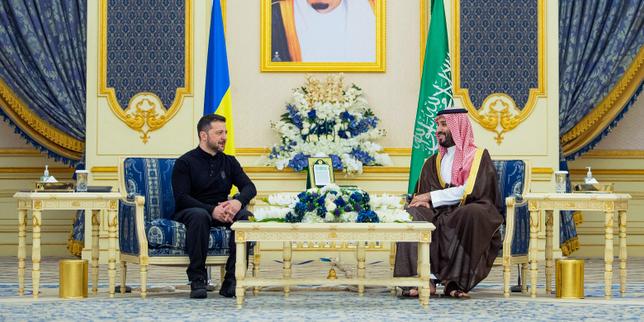
The pivot toward the Gulf states highlights this geopolitical realignment. In early spring, Zelenskyy secured a series of bilateral security and technology partnerships with Saudi Arabia, Qatar, and the United Arab Emirates. These are not symbolic diplomatic gestures. Rich in capital but vulnerable to asymmetric aerial threats, the Gulf nations are actively investing in Ukrainian defense tech hubs. They are acquiring proven counter-drone expertise and interceptor platforms designed specifically to bring down Iranian-designed Shahed loitering munitions—the exact hardware currently threatening both Eastern Europe and Middle Eastern energy infrastructure.
The strategic trade-offs are concrete:
- Capital Infusions: Gulf sovereign wealth funds provide non-dilutive capital directly to Ukrainian drone manufacturers.
- Supply Chain Diversification: In exchange for technological blueprints, Kyiv secures stable energy commitments and access to global components markets.
- Geopolitical Leverage: By rendering themselves indispensable to Gulf security, Ukrainian diplomats break out of a single axis of Western dependence.
The Race for Institutional Integration over Western Hesitation
While the business case for arms exports is clear, the broader geopolitical objective is structural integration into Western defense networks before the current window closes. Ukrainian drone companies are establishing joint production hubs across Europe through the "Build with Ukraine" initiative. Backed by a 500 million Danish kroner fund, manufacturers like SkyFall—famed for its heavy Vampire night-bomber platforms—are opening factories in Denmark, Britain, and Germany.
The European Union Bureaucratic Lag
The European Commission recently launched the EU-Ukraine Drone Alliance to bring together Western industrial scale and Ukrainian combat experience. Yet, a fundamental timeline mismatch threatens this cooperation. The EU's collective defense plan, outlined in its Defense Readiness Roadmap, aims to fully establish an automated aerial defense shield across Eastern Europe by 2028. NATO commanders openly warn that regional security threats could escalate significantly faster than that institutional timeline allows.
The bottleneck is not technological; it is bureaucratic. Ukraine has already built and field-tested DELTA, a highly sophisticated digital battlespace management system that integrates real-time drone reconnaissance, satellite telemetry, and predictive algorithms into a unified command layer. While NATO forces still rely on multimillion-dollar air defense batteries to intercept cheap loitering munitions, Ukraine routinely downs identical threats using automated machine-gun networks and low-cost interceptor drones coordinated via DELTA. Kyiv is pushing to fast-track this software as the foundational command architecture for Europe's upcoming border defense infrastructure, but Western regulatory bodies continue to treat the platform as an experimental third-party tool rather than a proven solution.
The Automated Permit Framework
To navigate these international hurdles, Ukraine has stripped away its own notorious state bureaucracy. The export framework introduces three separate legal channels designed to bypass traditional cabinet-level delays:
| Export Route | Processing Time | Primary Function |
|---|---|---|
| Defense City Permits | 15 Days | Accelerated clearance skipping cabinet designation for trusted allies. |
| Independent Licensing | Standard Regulatory | Direct commercial sales via the State Export Control Service. |
| State Arms-Trade Channels | Regulated Brokering | Handled via specialized state entities for sensitive government-to-government transfers. |
Managing Intellectual Property and the Threat of Counter-Espionage
Exporting advanced military technology while actively targeted by a hostile foreign intelligence apparatus carries immense structural risk. The technology cycle in modern drone warfare is brutally short, measured in weeks rather than years. A radio frequency profile or an electronic warfare countermeasure that works flawlessly today can be rendered completely obsolete next month by a software patch implemented across the line of contact.
To mitigate this risk, the Ministry of Foreign Affairs, alongside state intelligence services, maintains a strict, non-negotiable blacklist. Countries maintaining economic, political, or military cooperation with Moscow are barred from acquiring Ukrainian defense hardware.
Furthermore, the legal agreements drafted with Western partners—including a recent landmark procurement memorandum between Ukrainian Ambassador Olha Stefanishyna and the U.S. State Department—focus heavily on joint ventures built on foreign soil. By manufacturing Ukrainian-designed platforms within American or European facilities, Kyiv protects its core intellectual property from physical frontline capture and Russian airstrikes, while utilizing Western industrial capacity to out-produce its adversaries.
The value of Ukraine's battlefield data will inevitably decline as global defense conglomerates adapt and catch up. The current export drive is a high-stakes race to lock in long-term institutional dependencies while Western militaries still lack the practical experience to build these ecosystems on their own. Kyiv is gambling that by becoming the indispensable research lab and primary supplier for the future of automated warfare, it can secure its place in Western security alliances regardless of changing political tides.