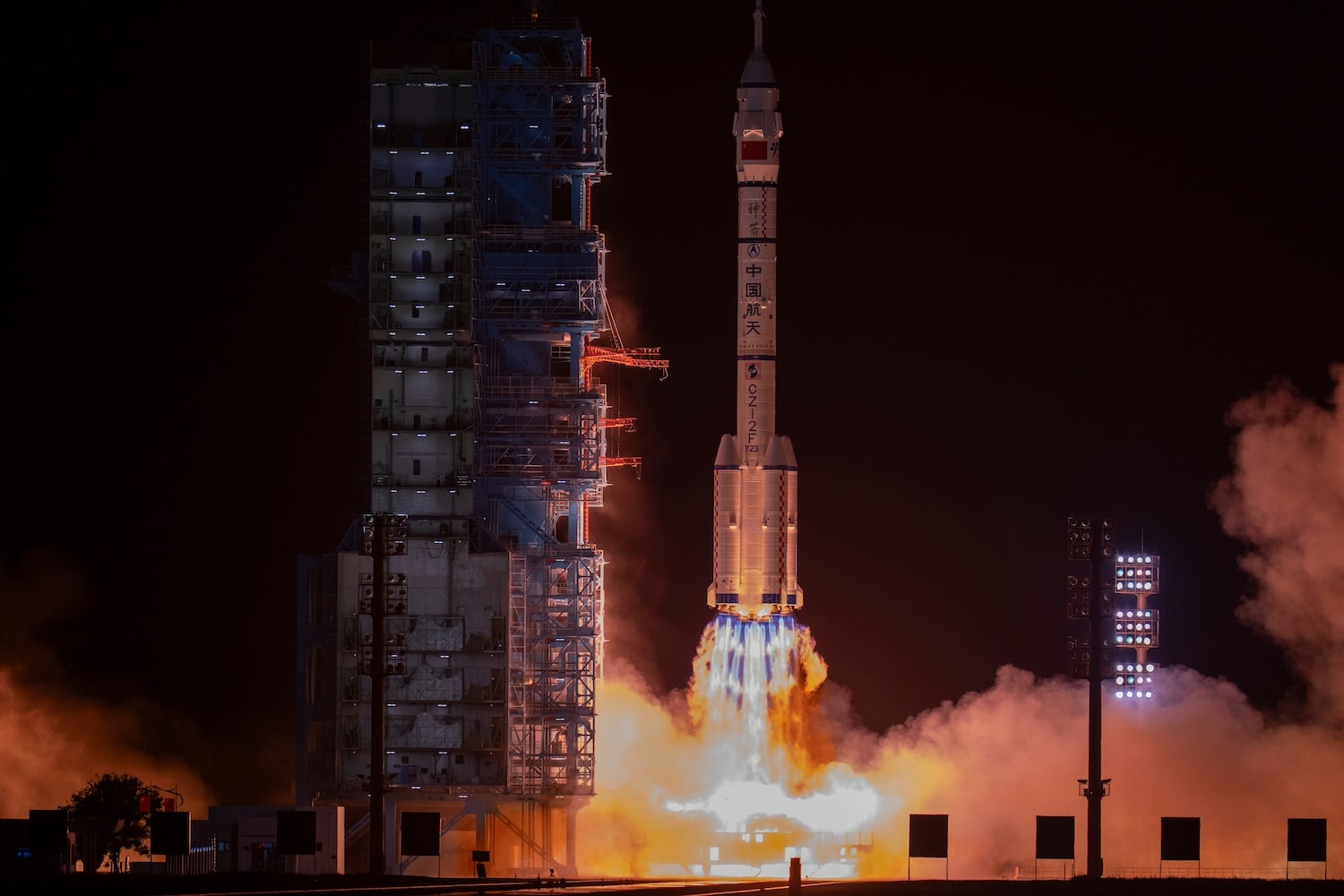
The media is collectively hyperventilating over China’s latest long-duration orbital mission. Mainstream defense analysts and aerospace commentators are churning out predictable copy, viewing a year-long stay in low Earth orbit purely as a stepping stone for Chinese boots on the Moon. They see a linear progression: track the days in orbit, count the launch cadences, and declare who is winning the new Apollo era.
They are missing the point entirely.
The lazy consensus treats space exploration like a 1960s track meet. In that outdated view, long-duration orbital stays are just endurance training for deep space. But treating low Earth orbit as merely a gym for lunar astronauts ignores the actual geopolitical and economic reality of modern aerospace. China is not just training bodies for a flag-and-footprints mission to the Moon; they are mastering the boring, industrial mechanics of orbital persistence that the West is actively at risk of losing.
While Western commentators fixate on the romantic optics of a lunar landing, the real value is being captured in the unglamorous work of sustaining infrastructure in zero gravity. The next decade will not be decided by who plants a flag on lunar regolith first. It will be decided by who controls the industrial baseline of low Earth orbit.
The Endurance Myth: Why Days in Orbit Aren't What They Seem
Public analysis of long-duration missions always falls into the same trap. Commentators look at a 365-day mission timeline and assume the primary goal is biological data—studying bone density loss, radiation exposure, and muscular atrophy.
I have spent years analyzing aerospace supply chains and defense procurement. Let me tell you a truth that civilian analysts hate to admit: the biological hurdles of long-duration spaceflight are already largely understood. The Soviet Union ran year-long missions on Mir decades ago. Valery Polyakov spent 437 consecutive days in space in the mid-1990s. If the goal were simply proving humans can survive a transit to Mars or the Moon, the data ambiently exists.
The real challenge of a year-long mission is not biological. It is logistical.
The True Bottleneck: Environmental Control and Life Support Systems (ECLSS)
When an aerospace program extends a mission from six months to a year, they are testing machine reliability, not human willpower.
- Loop Closure Efficiency: Surviving in space requires recycling everything. Air, water, urine. The International Space Station (ISS) achieves high water recovery rates, but maintaining those systems requires a constant influx of replacement parts from Earth.
- Component Degradation: Pumps fail. Filters clog. Valves seize. A year-long mission without scheduled cargo resupply tests the true mean time between failures (MTBF) of critical life support hardware.
- Orbital Maintenance Overhead: On the ISS, astronauts spend an immense percentage of their working hours simply fixing the toilet, repairing the oxygen generation systems, and managing inventory.
When China pushes orbital durations, they are stress-testing their domestic ECLSS architecture. They are learning how to build closed-loop life support systems that do not rely on a hyper-frequent cadence of supply rockets. If you cannot run a space station for a year without emergency part deliveries from the ground, you cannot support a base on the Moon. Period. The mainstream press focuses on the astronauts’ smiles; insiders are looking at the telemetry of the water recycling loops.
Dismantling the "People Also Ask" Illusions
The public search intent around these missions reveals just how warped the general understanding of space technology has become. Let us address the flawed premises driving the conversation.
Is China winning the space race?
The question itself is broken. It assumes a single finish line. If the finish line is a highly subsidized, economically unviable footprint on lunar dust, then the race is a race to spend money. If the finish line is the creation of a self-sustaining orbital economy, the metric changes.
China is winning the race for structural integration. Their space program is centrally directed, tied explicitly to five-year industrial plans, and integrated with their broader geopolitical strategies. While the West relies on a delicate, politically volatile mix of government funding and private venture capital, Beijing views orbital infrastructure exactly like high-speed rail: a state-backed utility designed for long-term strategic dominance.
Why can't we just use the International Space Station?
The ISS is a technological marvel, but it is also an aging bureaucratic compromise approaching its end-of-life cycle. The structural fatigue on the ISS modules is real. Micro-fractures, air leaks, and obsolete data buses mean the station requires significant energy just to keep running safely.
More importantly, Western access to low Earth orbit is transitioning to a commercial model. While commercial space stations promise efficiency, they introduce a massive variable: profitability. A commercial station must justify its existence to shareholders or private clients. A state-backed station has no such constraints. China’s Tiangong architecture is built for national longevity, not quarterly returns.
The Vulnerability of the Western Playbook
To understand why the common analysis is so flawed, look at the downsides of the current Western strategy. The United States and its partners have bet heavily on commercialization. Companies are expected to build the next generation of orbital habitats, with NASA acting as an anchor tenant.
On paper, this lowers costs and drives innovation. In practice, it introduces structural fragility.
+------------------------------------+------------------------------------+
| State-Backed Infrastructure        | Venture-Backed Commercialization   |
+------------------------------------+------------------------------------+
| Decadal funding certainty          | Subject to market cycles & funding |
| Standardized, modular architecture | Fragmented proprietary designs     |
| Direct geopolitical alignment      | Commercial liability constraints   |
| High tolerance for economic loss   | Must achieve profitability early   |
+------------------------------------+------------------------------------+
Imagine a scenario where the macroeconomic climate sours, venture capital dries up, or a major commercial space provider suffers a catastrophic hardware failure on orbit. The commercial timeline slips. The transition from the ISS to private habitats becomes a gap.
China does not have to worry about a venture fund pulling its Series C round. They are executing a methodical, iterative engineering roadmap. They don't need to disrupt the industry; they just need to outlast it.
The Real Lunar Ambition is Manufacturing, Not Flag-Planting
Stop looking at the Moon as a trophy. The Moon is an industrial resource base.
The competitor narrative suggests that long-duration orbital missions are about proving astronauts can handle the journey to the lunar surface. The deeper reality is that these missions are about mastering the orbital mechanics required to assemble massive structures in space.
The Limits of Earth's Gravity Well
Launching a fully assembled lunar base from the surface of the Earth is an engineering impossibility. Everything built for deep space must be modular. It must be launched in pieces, rendezvous in orbit, and be assembled by autonomous systems or humans working in zero gravity.
- Precision Docking: Long missions allow for repeated, iterative testing of automated rendezvous and docking procedures under varying thermal and orbital conditions.
- On-Orbit Manufacturing: True deep-space capability requires manufacturing components in situ. This means testing 3D printing with polymers and metals in microgravity over extended durations to see how material crystallization behaves over months, not days.
- Propellant Transfer: You cannot get to the Moon with heavy payloads without refueling in orbit. Managing cryogenics—keeping liquid oxygen and hydrogen cold enough to prevent boil-off over a year—is an unsolved industrial challenge.
China’s orbital station is an experimental laboratory for these exact capabilities. Every day their station remains occupied, they collect data on how lubricants degrade in vacuum, how seals hold up against solar radiation, and how autonomous arms perform micro-adjustments after thousands of cycles.
While the public watches videos of astronauts doing Tai Chi in microgravity, the real victory is the telemetry showing zero pressure drops across module bulkheads over 365 days of continuous operation.
Shift the Metric of Success
If you want to accurately assess the geopolitical balance of aerospace power, stop reading the celebratory press releases about planned lunar landing dates. Start tracking the unsexy metrics.
Track the number of successful automated dockings per year. Track the efficiency of the life support loops. Track the hours spent on preventative maintenance versus unscheduled repairs. Look at the orbital inclination choices and the integration of satellite servicing capabilities into the main station architecture.
The nation that masters the tedious, grinding reality of long-term orbital industrialization will inherently inherit the cis-lunar pathway. They won't just visit the Moon; they will dictate the terms of its utilization.
Stop looking at the sky expecting a rerun of 1969. The era of the space race as a PR stunt is dead. The era of the orbital factory has begun.