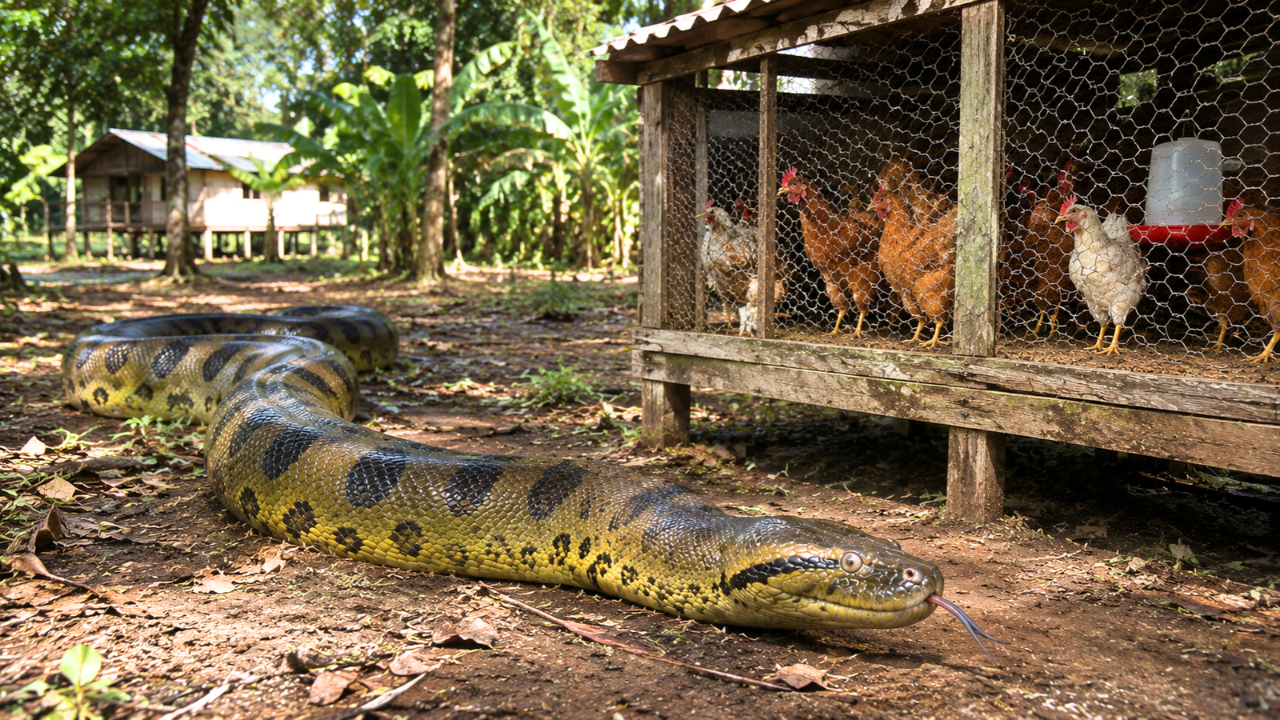
In the floodplains of the Amazon basin, a green anaconda sliding beneath a raised wooden house is rarely viewed as a conservation priority. To the families living along the riverbanks, that massive snake represents an immediate threat to their household economy, and they frequently kill it on sight to protect their chickens. Conservation biologists have responded with a straightforward recommendation—build stronger, predator-proof chicken coops. While reinforced enclosures reduce livestock losses, treating this conflict as a simple carpentry problem misses the deeper ecological, economic, and cultural realities driving villagers to reach for their machetes.
The friction between subsistence farmers and giant constrictors is an old story with worsening modern pressures. When a single green anaconda (Eunectes murinus) can exceed twenty feet in length and weigh more than two hundred pounds, its presence near a settlement triggers a visceral survival calculation. Chickens are not merely pets or casual backyard hobbies in rural Amazonia. They are liquid assets, primary protein sources, and an informal savings account that can be sold or traded when a child gets sick or fuel runs low. Losing five or six birds in a single night to a constrictor is a severe financial blow.
The Economics of a Backyard Flock
To understand why villagers kill anacondas rather than shooing them back into the river, you have to look at household margins. In remote riverine communities across Brazil, Peru, and Ecuador, cash flow is irregular and supply chains are fragile. Transporting frozen meat or commercial eggs up winding tributaries is expensive, making locally raised poultry indispensable.
A single laying hen produces steady nutrition. When an anaconda breaches a flimsy wire fence or slips through the floorboards of an elevated coop, it does not just take one bird and leave. Heavy-bodied constrictors have slow metabolisms, yet an opportunistic feeder surrounded by trapped, flightless prey will often kill multiple birds or gorge itself to the point of immobility right inside the pen.
Imagine a hypothetical river family managing a flock of fifteen chickens. If a ten-foot anaconda enters their coop overnight, kills four hens, and remains coiled in the corner at dawn, the family faces two immediate realities. First, a quarter of their protein capital is gone. Second, the predator is still there, heavy and slow, presenting a clear target. Letting the snake slither away means accepting the high probability that it will return in three or four weeks when its digestive cycle finishes.
For a family living close to the economic edge, tolerance is an expensive luxury. Conservationists flying in from urban universities often preach the long-term ecological value of apex predators, but those researchers do not absorb the immediate cost of a wiped-out flock.
Why Standard Chicken Coops Fail in the Floodplain
The scientific consensus around human-wildlife conflict consistently points toward non-lethal mitigation. In the case of Amazonian poultry, wildlife biologists advocate for elevated, tightly sealed coops constructed with small-gauge welded wire mesh rather than loose chicken wire. On paper, the logic is sound. Anacondas are ambush predators, not agile climbers like smaller arboreal boas, and they lack the limbs needed to pry open secure latches.
In practice, building a truly anaconda-proof structure in the Amazon is harder than it sounds.
The Material Cost Barrier
Standard hexagonal chicken wire—the cheapest and most widely available fencing material in rural hardware stores—is notoriously weak. A heavy anaconda pressing its muscular body against thin galvanized wire can easily stretch the openings, tear staples out of soft tropical wood, or push underneath an unburied perimeter.
Upgrading to heavy-duty hardware cloth, concrete footings, or rot-resistant hardwood planks requires upfront capital that many subsistence households simply do not have. When a biologist suggests better coop design without funding the materials, the advice lands as detached theory.
Seasonal Flooding and Shifting Terrain
The Amazon is not a static landscape; it breathes with the flood pulse. Water levels in major tributaries can rise and fall by thirty feet or more between the dry and wet seasons. Villages built along riverbanks are constantly adapting to mud, erosion, and inundated ground.
A coop built on dry earth in August may be standing in four feet of murky water by March. As the water rises, anacondas expand their hunting grounds directly into the flooded backyards of human settlements. Floating platforms and stilted coops help, yet the constant cycle of moisture, rot, and shifting soil warps wooden frames. A gap of just two inches beneath a door frame or between floor planks is enough for a juvenile or sub-adult anaconda to squeeze through. Once inside, if it swallows a chicken, its expanded midsection traps it inside the coop—guaranteeing a fatal encounter when the owner opens the door in the morning.
Fear, Folklore, and the Asymmetry of Risk
Economic loss explains much of the killing, but ignoring human fear is a mistake. The green anaconda holds a powerful place in Amazonian folklore, often depicted as a supernatural river spirit or a monstrous man-eater capable of swallowing adults whole. While verified fatal attacks on adult humans by wild anacondas are extraordinarily rare, the sheer physical power of a large constrictor commands intense respect and dread.
Parents with small children playing near the water's edge do not evaluate risk using peer-reviewed herpetological statistics. They look at a snake thick enough to crush a capybara or a small caiman, and they see an unacceptable danger to their family.
There is also a stark asymmetry in how risk is perceived. If a villager kills an anaconda, the immediate threat disappears, and there is rarely any legal consequence. Although hunting and killing native wildlife is technically illegal in countries like Brazil and Peru, environmental enforcement in remote river basins is nearly nonexistent. Authorities struggle to stop illegal gold mining and industrial logging; they are not patrolling rural backyards to hand out citations over dead snakes.
Conversely, if a villager spares the snake, they carry all the ongoing risk—lost livestock, terrified children, and the lingering anxiety of a massive predator lurking under the floorboards. Until that risk calculus changes, lethal retaliation remains the default response.
The Ecological Ripple Effect Nobody Sees
Killing a few nuisance snakes around a village might seem harmless in a basin spanning millions of square miles, yet localized depletion creates quiet ecological disruptions. Green anacondas sit near the top of the aquatic food web. They regulate populations of medium-sized mammals and birds, including capybaras, agoutis, muscovy ducks, and wading birds.
More importantly, anacondas help keep rodent populations in check around the margins of human settlements. When villagers systematically eliminate large snakes from the immediate vicinity of their homes, they inadvertently remove a natural brake on pests that raid stored grain, cassava flour, and the very chicken feed families are trying to protect.
Large female anacondas are especially vulnerable. Because green anacondas exhibit extreme sexual dimorphism—females grow drastically larger than males—the massive snakes that attract the most fear and targeted killing are almost always breeding-age females. Removing a single fifteen-foot female eliminates decades of future reproductive potential, as these snakes grow slowly and reproduce infrequently, giving birth to live young only once every few years.
What Actually Works Beyond Carpentry
If telling villagers to build better coops is only half an answer, what does a realistic solution look like? Successful conservation initiatives across Latin America show that reducing retaliatory killings requires pairing physical barriers with tangible economic incentives and community-led enforcement.
Subsidized Hardware and Collective Builds
Programs that actually reduce livestock predation do not just hand out pamphlets; they provide the physical materials. In regions where conservation groups have partnered with rural communities to supply heavy-gauge welded mesh, steel latches, and treated timber, predation rates drop sharply.
Even better are community build days, where neighbors help construct standardized, elevated predator-proof coops for multiple households at once. Shared labor lowers the barrier to entry and turns coop construction into a collective community norm rather than an individual financial burden.
Guard Animals and Yard Management
Physical enclosures work best when combined with simple environmental modifications. Anacondas rely on cover to ambush prey and avoid detection. Clearing tall grass, brush piles, and stagnant debris within twenty yards of livestock pens removes the exact habitat snakes use to approach unnoticed.
Many rural farmers also rely on free-ranging dogs or geese as early warning systems. While a dog cannot fight off a giant constrictor in deep water, barking alerts families to an intrusion on land before the snake reaches the coop. Geese, notoriously territorial and loud, serve a similar alarm function around farmyards.
Turning Live Snakes Into Economic Assets
The most durable shift happens when a live anaconda becomes worth more to a village than a dead one. In parts of the Peruvian Amazon and the Pantanal wetlands, community-based ecotourism has altered local attitudes toward large reptiles. Travelers pay significant money for the chance to spot a giant anaconda in the wild, creating direct income for local boat drivers, guides, and lodge operators.
Where tourism is not viable due to isolation, alternative compensation schemes or micro-insurance funds for verified livestock losses can bridge the gap. If a family knows that reporting a snake raid—rather than killing the animal—unlocks rapid reimbursement or replacement chicks, the financial incentive to reach for a machete weakens.
The Limits of Top-Down Conservation
Wildlife scientists are right about the mechanics of exclusion: a properly built, elevated coop with quarter-inch welded wire mesh will stop an anaconda cold. The flaw lies in assuming that technical knowledge automatically translates into local action.
Rural Amazonians are pragmatic survivors navigating an unpredictable environment with limited resources. They do not hate anacondas out of malice; they kill them because, under their current economic and structural constraints, lethal force is the cheapest, fastest insurance policy available. Until conservation strategies address the cost of materials, the reality of seasonal flooding, and the financial vulnerability of smallholder families, the standoff between village chicken coops and the river's largest predator will continue unabated.