Silence.
That is the first thing you notice when you stand outside a zoo enclosure after the crowds go home, long after the cotton candy wrappers have been swept from the asphalt and the automated gates have clicked shut for the night, leaving only the hum of industrial filtration systems and the low, rhythmic swaying of a massive gray body shifting its weight from one bruised foot to another in the dark.
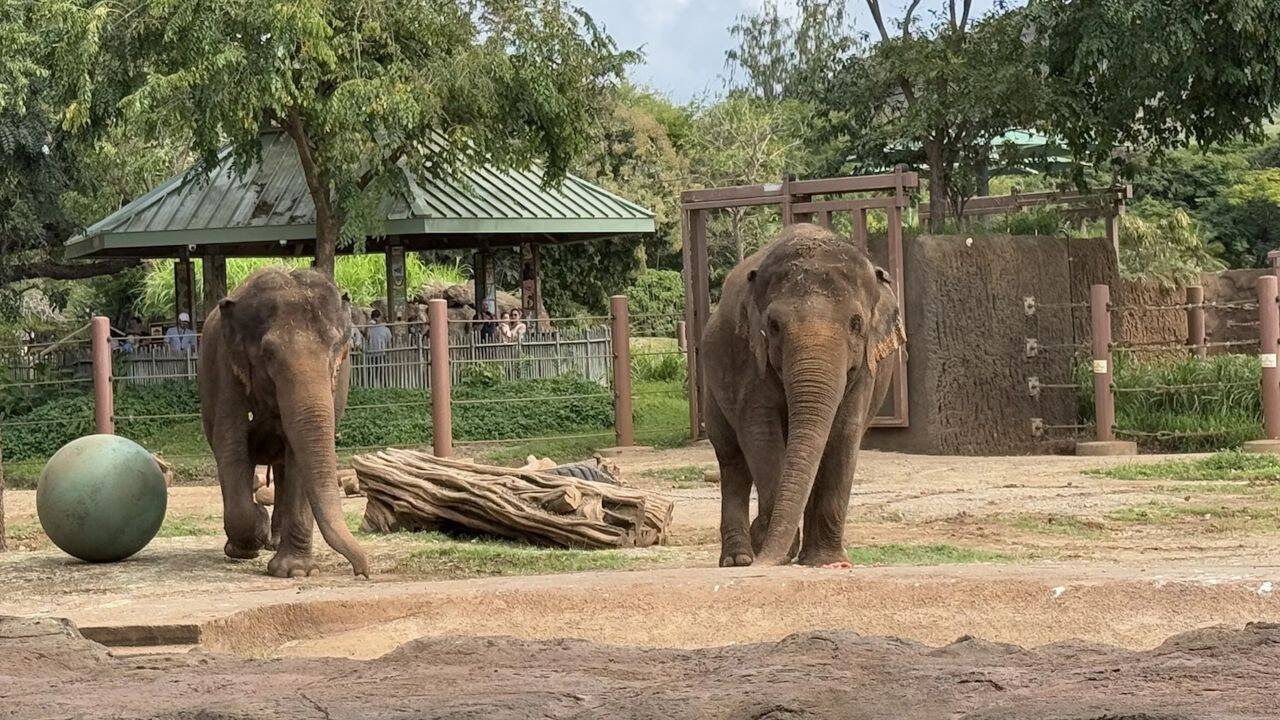
I remember the first time I stood beside a chain-link perimeter watching an aging Asian elephant rock back and forth in a space barely larger than a suburban cul-de-sac. You could smell the damp concrete, the faint tang of old hay, and something heavier—a thick, stagnant stillness that felt less like a habitat and more like a waiting room with no exit. Her name was Mari. For decades, she had lived at the Honolulu Zoo, isolated from her own kind, performing the slow, repetitive choreography of captivity while thousands of tourists snapped photos against the backdrop of Diamond Head.
Then, in early 2026, Mari died.
She died inside that enclosure before the courts ever finished arguing over whether she had a right to leave it.
Now, the Hawaii Supreme Court is preparing to hear a landmark habeas corpus petition that could change the legal architecture of the Pacific—and perhaps the nation. On the surface, it looks like a procedural dispute filed by animal rights attorneys from the Nonhuman Rights Project against the City and County of Honolulu. Look closer, and you realize it is an existential interrogation of what the law actually sees when it looks at a living, grieving, self-aware mind.
The Architecture of a Cage Without Bars
To understand why five justices in Honolulu are about to wrestle with a legal writ forged in thirteenth-century England, you have to strip away the comforting vocabulary of modern zoos. We love words like conservation, enrichment, and ambassador. They soften the edges of iron and concrete. They allow us to look at a solitary creature pacing a dirt yard and call it education.
Consider a hypothetical scenario to make the legal abstraction concrete. Imagine a human being—let’s call her Elena—who is kidnapped as a toddler, transported across an ocean, and placed inside a well-maintained, climate-controlled glass house. Her captors feed her organic meals, provide regular medical checkups, and occasionally give her puzzles to solve so she does not grow bored. She is never beaten. She is never starved. Yet she is never allowed to speak to another human being, never permitted to walk more than fifty yards in any direction, and never given a single choice about how she spends a waking hour of her life.
If Elena’s lawyers walked into a courtroom and filed a petition for a writ of habeas corpus—literally Latin for "you shall have the body"—the judge would not ask whether Elena’s glass house had nice carpeting. The judge would not ask whether her captors followed the latest guidelines from an accreditation board. The court would demand to know by what lawful authority she was being held against her will.
That is the precise nerve the Nonhuman Rights Project is pressing in Hawaii.
For years, legal orthodoxy held a clean, binary line: you are either a person with rights, or you are property without them. Chairs, corporations, rivers, and elephants all sat on the property side of the ledger—though, paradoxically, American law long ago granted legal personhood to corporations, ships, and municipalities while denying it to mammals capable of mourning their dead.
When attorneys first brought habeas corpus petitions on behalf of elephants like Happy at the Bronx Zoo or Minnie in Connecticut, lower courts routinely slammed the door. The reasoning was circular and airtight: only a legal person can file for habeas corpus, and an elephant is not a human, therefore an elephant cannot be a person.
But Hawaii is not New York. And the Hawaii Supreme Court has a long, documented history of refusing to let rigid formalism suffocate justice.
What an Elephant Knows About Time
Neuroscience has made the old legal fiction uncomfortable. We are no longer guessing about what happens inside the skull of Elephas maximus.
An adult Asian elephant carries a brain weighing roughly eleven pounds, packed with more than 250 billion neurons—three times as many as a human being. While raw neuron count is not the sole measure of intelligence, the structure of the elephant cortex tells an unmistakable story. Their hippocampus, the engine of memory and spatial navigation, is vast and intricately folded. Their spindle neurons—specialized cells associated with self-awareness, empathy, and social intuition in humans and great apes—are abundant.
In the wild across South and Southeast Asia, female elephants do not live alone. Never. They exist inside dense, multi-generational matriarchal societies where grandmothers, mothers, aunts, and calves travel up to thirty miles a day across varied terrain. They communicate through infrasonic rumbles that travel miles through the earth, vibrating through the sensitive pads of their feet. When a member of the herd dies, the survivors linger over the bones, touching the skull gently with their trunks in a silent ritual that biologists struggle to call anything other than grief.
Strip that away. Put that same neurological architecture inside a two-acre urban exhibit for forty years.
What happens to a mind built for thirty-mile migrations and lifelong kinship when it is confined to a flat patch of dirt? The body breaks down first. Foot disease—specifically osteomyelitis and cracked, infected cuticles caused by standing on unyielding surfaces—is one of the leading killers of captive elephants. Arthritis sets in decades early.
Then the mind fractures. Zookeepers have a clinical term for it: stereotypic behavior. You see it as the endless, rhythmic head-bobbing, the swaying from side to side, the pacing along an invisible track worn smooth into the ground. In human prisoners held in solitary confinement, psychiatrists call the exact same neurological self-soothing mechanism institutional psychosis.
I used to think zoos were neutral ground—imperfect, sure, but ultimately benign sanctuaries where city kids could fall in love with wildlife. That certainty evaporated the afternoon I watched an elephant stand motionless for forty minutes facing a concrete wall, her trunk resting limply in the dust, completely unresponsive to the calls of her keepers. There was nothing majestic about it. It was the posture of someone who had simply run out of places to go inside her own head.
The Battle Over the Honolulu Two
The legal war in Hawaii centers on the Honolulu Zoo’s elephant program, which for years housed two females, Mari and Vaigai, both wild-born in Asia and imported decades ago before modern wildlife trafficking restrictions tightened.
When Mari passed away at age forty-nine—an age that sounds respectable until you realize wild Asian elephants routinely live into their sixties and seventies—Vaigai was left entirely alone. In elephant terms, solitary confinement is not a temporary housing arrangement; it is an acute psychological emergency.
Attorneys for the Nonhuman Rights Project argued that keeping an autonomous, cognitively complex animal in solitary captivity violates common-law liberty principles that Hawaii’s courts have the power—and the duty—to evolve. Their proposed remedy was never to turn an elderly, captive-raised elephant loose on the slopes of Mauna Kea. Rather, they sought her transfer to an accredited sanctuary on the mainland, such as the Performing Animal Welfare Society (PAWS) in California or The Elephant Sanctuary in Tennessee, where elephants roam hundreds of acres of rolling hills, forage in natural ponds, and live in self-directed herds free from public display.
The City and County of Honolulu pushed back with predictable institutional force. City attorneys argued that the Honolulu Zoo meets or exceeds standards set by the Association of Zoos and Aquariums (AZA), that Vaigai receives dedicated veterinary care, and that expanding habeas corpus to nonhuman animals would trigger a legal avalanche.
Here is the question every skeptic immediately asks: If an elephant can sue for freedom, what stops someone from filing a habeas petition for a golden retriever, a dairy cow, or a laboratory mouse?
It is a fair question. Honestly, it is the exact question that keeps moderate judges awake at night, and pretending the line is easy to draw would be dishonest. Law relies on boundaries, and boundaries feel safest when they are drawn along clean biological lines—human on one side, everything else on the other.
Yet common law has never been a static monument. It is a living conversation between precedent and moral reality. Two hundred years ago, married women in the United States had no independent legal standing under the doctrine of coverture; their legal existence was subsumed into their husbands’. Enslaved human beings were legally categorized as chattel, bought and sold through probate courts until moral and legal pressure shattered the fiction that property could possess a soul.
Extending habeas corpus to a tiny class of demonstrably autonomous beings—elephants, great apes, cetaceans—does not mean your terrier gets a lawyer. Legal autonomy is a measurable, scientific threshold: self-awareness, episodic memory, future planning, and complex social agency. An elephant passes every single test. A goldfish does not. Courts draw far messier distinctions every Tuesday morning in patent litigation and constitutional tort cases.
Why Hawaii Matters More Than Anywhere Else
If this fight were happening in almost any other state, legal observers would bet heavily on a quiet dismissal. Hawaii is different.
Hawaii’s jurisprudence carries a distinct DNA shaped by Native Hawaiian traditional practices, environmental stewardship, and an explicit constitutional mandate recognizing the rights of future generations to a healthy environment. The state’s Supreme Court has repeatedly affirmed that the common law of Hawaii is not frozen in the amber of nineteenth-century English treatises. In landmark rulings involving water rights, beach access, and climate liability, the court has shown a willingness to look past procedural technicalities when fundamental questions of justice and ecological integrity are at stake.
More importantly, Hawaii has no native land mammals aside from the Hawaiian hoary bat. Every elephant, tiger, and giraffe on Oahu arrived by ship or cargo plane across thousands of miles of open ocean. There is no plausible claim that keeping an Asian elephant in a coastal park in Waikiki preserves local biodiversity. She is an exile in paradise.
When the justices take the bench to hear oral arguments, they will not be debating whether zookeepers love their animals. Most keepers do, fiercely. They spend holidays nursing sick charges, mixing specialized diets, and grieving deeply when an animal dies. Casting zookeepers as villains misses the real tragedy entirely.
The tragedy is structural. A good warden is still a warden. A gilded cage is still a cage.
The Invisible Stakes in the Courtroom
What happens inside that Honolulu courtroom will ripple far beyond a single animal’s enclosure.
For the first time, the highest court of an American state is treating the question of nonhuman bodily liberty not as a fringe publicity stunt, but as a serious constitutional and common-law inquiry worthy of full appellate review. Even if the justices ultimately stop short of granting the writ, the questions they ask from the bench will force government attorneys to defend a premise that has gone unchallenged for centuries: that superior intelligence gives human beings an absolute, unreviewable license to imprison other minds purely for our amusement.
Think about what it costs us to hold onto that premise. Every time we walk past an animal exhibiting unmistakable signs of psychological distress and tell ourselves she doesn't really know what she's missing, we dull our own capacity for empathy. We train ourselves to look directly at suffering and call it entertainment.
Meanwhile, across the Pacific, an aging elephant stands alone in the tropical heat. She has no idea that lawyers in dark suits are drafting briefs with her name on the caption, or that five judges are reading studies about her spindle neurons and her capacity for grief. She knows only the texture of the ground beneath her feet, the smell of the ocean wind she can never walk toward, and the heavy, unbroken silence where the voices of her herd ought to be.