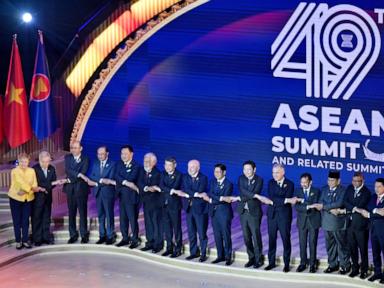
The air conditioning in a diplomatic convention hall is always set three degrees too cold.
You can hear the low, mechanical hum of it beneath the rustle of heavy linen tablecloths and the polite, rehearsed clinking of water glasses. Outside the tinted glass walls of the summit venue, the humid tropical heat presses against the building like a living thing, thick with the scent of exhaust, rain-dampened asphalt, and street-side broth. Inside, ten leaders—and one conspicuous empty chair—sit around a polished table to decide the fate of nearly seven hundred million people.
Most wire reports will reduce this gathering to a predictable headline. They will tell you that Southeast Asian leaders opened their annual summit with major conflicts and their economic impact topping the agenda. They will mention joint communiqués, bilateral handshakes, and working groups. They will make it sound sterile. Orderly. Manageable.
They are wrong.
If you have ever stood on the edge of a supply chain fracture, or watched a regional currency wobble at three in the morning while watching ticker tape bleed red, you know that geopolitics does not happen in conference rooms. It happens in shipping containers that never leave port. It happens in the sudden silence of a border town where trade used to roar until midnight. When the Association of Southeast Asian Nations—ASEAN—convenes while wars rage on its doorstep and superpowers rattle sabers in its waters, the real story is not the speeches. The real story is the quiet terror of watching a fifty-year miracle strain against its own seams.
The Ghost at the Table
Consider a hypothetical scenario that plays out every single week across the region. Picture a mid-sized electronics component manufacturer on the outskirts of Penang, Malaysia. Let us call the plant manager Mei-Ling. For fifteen years, Mei-Ling’s life has been governed by precision. Copper arrives from one neighbor, silicon wafers pass through another, assembly happens on her floor, and finished micro-boards ship out through the Strait of Malacca toward ports in Europe and North America.
Her business depends on one invisible ingredient: predictability.
Now, trace what happens when predictability dies. A civil war in Myanmar—now grinding through its fifth brutal year following the 2021 military coup—has displaced more than three million people and turned a once-promising frontier market into a black hole of humanitarian crisis and cross-border crime. Three thousand kilometers to the east, in the South China Sea, water cannons blast against wooden hulls near contested reefs, turning vital maritime arteries into flashpoints where a single miscalculated collision could trigger a confrontation between Beijing and Washington. Meanwhile, global shocks—from prolonged conflict in Eastern Europe to volatile shipping lanes in the Red Sea—have driven freight insurance premiums skyward and stretched delivery timelines from days into weeks.
Mei-Ling does not read diplomatic cables. She reads freight invoices. When a container ship has to reroute, or when a regional border closes due to spillover fighting, her margins evaporate before lunch.
This is the true weight sitting on the shoulders of ASEAN leaders as they open their annual summit. For decades, Southeast Asia sold itself to the world as an island of calm. While other regions fractured, ASEAN offered a simple, intoxicating promise: stability. You could build your factories here, invest your capital here, and trust that the neighbors would keep the peace, even if they disagreed behind closed doors.
That promise is now on trial.
The Architecture of Polite Silence
To understand why these summits feel so agonizingly slow to outsiders, you have to understand the DNA of the room.
ASEAN was born in 1967, in the white-hot crucible of the Cold War, when Southeast Asia was widely viewed as a collection of fragile dominoes waiting to fall. Five nations—Indonesia, Malaysia, the Philippines, Singapore, and Thailand—signed a two-page declaration in Bangkok. They did not build a military alliance like NATO, nor did they create a supranational parliament like the European Union. They knew their histories were too scarred by colonialism, their political systems too wildly divergent—ranging from absolute monarchies and communist states to vibrant, messy democracies—to ever surrender sovereignty to a central authority.
Instead, they invented what diplomats call the ASEAN Way.
Think of it as a neighborhood association where everyone agrees never to criticize how another neighbor paints their house, no matter how badly the paint is peeling, so long as nobody sets the street on fire. Non-interference. Consensus. Quiet diplomacy. For half a century, this bruised-knuckle pragmatism worked miracles. It kept interstate wars at bay, pulled hundreds of millions out of extreme poverty, and knitted ten distinct economies into a bloc whose combined gross domestic product now exceeds $3.8 trillion, making it the fifth-largest economy on earth.
Wait. Pause on that number. Three point eight trillion dollars.
That is larger than the economy of the United Kingdom. Larger than India’s just a few years ago. And it was built almost entirely on the back of consensus and trade integration.
Yet, the very tool that built the house is now struggling to put out the fire. When a crisis breaches the fence—when refugees pour across borders from Myanmar, when cyber-scam syndicates operating out of lawless border zones traffic tens of thousands of Southeast Asian citizens, when maritime militias encroach on exclusive economic zones—consensus can easily curdle into paralysis. If every member holds a veto, the boldest action often shrinks to the lowest common denominator.
I have sat in the press filing centers adjacent to these summit halls, watching veteran journalists dissect draft statements word by agonizing word. You learn quickly to read the punctuation like a cardiogram. Did the communiqué express "deep concern" or merely "note developments"? Did it name the aggressor, or did it hide behind passive verbs? To an outsider, this looks like bureaucratic theater. To the diplomats inside, every adjective is a high-wire act over an economic abyss.
The Tightrope Between Giants
Why don't Southeast Asian leaders simply pick a side and enforce order?
Because picking a side is suicide.
Look at the geography. Southeast Asia sits directly across the windpipe of global commerce. Roughly one-third of all global maritime trade—trillions of dollars in oil, liquefied natural gas, grain, and manufactured goods—passes through the South China Sea and the Strait of Malacca every single year.
On one side stands China, Southeast Asia’s largest trading partner for over fifteen consecutive years, an economic colossus deeply woven into the region's infrastructure, railways, ports, and consumer markets. On the other side stands the United States, the region’s largest source of cumulative foreign direct investment and the traditional security guarantor whose naval presence has underwritten freedom of navigation since the end of World War II.
Imagine living in a house where your landlord and your primary employer are locked in a bitter divorce, and both keep knocking on your door demanding to know whose side you are on.
That is the daily reality of a Southeast Asian prime minister. If a leader leans too hard toward Washington’s security architecture, Beijing’s economic levers—import restrictions, tourism slowdowns, stalled infrastructure loans—can quietly tighten around their throat. If a leader accommodates Beijing’s sweeping territorial claims in the South China Sea, they risk domestic nationalist backlash, the loss of vital fishing grounds and offshore energy reserves, and the alienation of Western markets that buy their exports.
So they walk the tightrope. They hedge. They invite both superpowers to the summit’s extended meetings—the East Asia Summit—forcing rivals to sit in the same room, breathe the same chilled air, and maintain the fragile fiction of dialogue. It is exhausting, unglamorous work, and it rarely produces the kind of cinematic breakthroughs that television news anchors crave.
The Invisible Bill Coming Due
What happens if the tightrope snaps?
We do not have to guess. We are already seeing the down payment on the invoice.
In Myanmar, the Five-Point Consensus—a peace plan agreed upon by ASEAN leaders and Myanmar’s junta chief in April 2021—remains largely unimplemented on the ground. Fighting has shattered internal trade routes, collapsed the local currency, and sent waves of irregular migration into Thailand, Malaysia, and Indonesia. Meanwhile, armed resistance groups have seized vast swaths of border territory, creating a fractured patchwork of governance that complicates everything from infectious disease control to transnational crime enforcement.
At the same time, look at the sea. Over the past two years, confrontations between Chinese coast guard vessels and Philippine resupply missions near Second Thomas Shoal have grown sharper, louder, and dangerously close to triggering a mutual defense treaty between Manila and Washington. Every ramming incident, every shattered windshield, sends a subtle tremor through boardrooms in Tokyo, Seoul, Frankfurt, and New York.
Investors do not wait for missiles to fly. They price in risk quietly.
They diversify. They delay factory expansions. They add a two-percent risk premium to sovereign debt. Across Southeast Asia, central banks are already battling stubborn inflation driven by global conflict, high interest rates in the West, and climate-induced shocks to rice and palm oil harvests. The region does not have the fiscal cushion to absorb a localized war or a major maritime blockade.
Consider a young software engineer in Jakarta, or a garment worker in Phnom Penh, or a rice farmer in the Mekong Delta. To them, "regional geopolitical headwinds" is not an academic phrase. It is the price of cooking oil jumping twenty percent in six months. It is the foreign tech firm freezing its hiring plan in Ho Chi Minh City because global capital is suddenly nervous about Asian supply chains.
The stakes are profoundly personal, even when the language at the podium is relentlessly abstract.
The Quiet Pivot Inside the Room
Yet, writing off ASEAN as a helpless bystander misses the quiet evolution happening beneath the surface of these annual summits.
Crisis, as it turns out, has a way of sharpening focus. When the global trading system begins to fragment into rival blocs—when tariffs rise and industrial policy turns inward—Southeast Asia realizes that its only true shield is itself.
Watch what the leaders are actually building behind the headlines about conflict. They are accelerating the upgrade of the ASEAN Trade in Goods Agreement. They are knitting together cross-border QR payment systems so a tourist or a small merchant from Bangkok can scan a code in Kuala Lumpur, Singapore, or Jakarta and settle the transaction instantly in local currencies, bypassing the US dollar and cutting transaction fees to near zero. They are negotiating the Digital Economy Framework Agreement, an ambitious pact projected to double the region’s digital economy to roughly $2 trillion by 2030.
This is not flashy diplomacy. Nobody waves flags over payment interoperability standards.
But it is lethal to fragility. By wiring their domestic economies directly into one another—through power grids, digital payment rails, and regional supply chains—Southeast Asian nations are raising the cost of conflict for everyone involved. They are betting that deep, localized interdependence will make the region too expensive to break.
Even on the thorniest security issues, the tone is shifting. The decision to bar Myanmar’s military leaders from high-level political summits—leaving that empty chair at the table—was an unprecedented break from decades of unconditional inclusion. Informal troika mechanisms, bringing together past, present, and incoming ASEAN chairs, are creating institutional memory so the bloc does not lose momentum every time the chairmanship rotates to a new capital.
Is it enough? Honest observers—and the diplomats themselves, if you catch them off the record over late-night coffee—will tell you they do not know. The forces pressing down on the region are immense. A miscalculation in the Taiwan Strait, an escalation in the South China Sea, or a prolonged global recession could overwhelm even the cleverest economic plumbing.
The Weight of the Unspoken
As the summit doors close and the motorcades pull away into the tropical night, the official communiqués will be uploaded to government websites. They will be long, dense, and carefully calibrated to offend no one while signaling concern to everyone.
Critics will call them weak. Cynics will call them irrelevant.
They should look closer at the alternative. In a world where international institutions are crumbling, where treaties are torn up on a whim, and where major powers increasingly speak the blunt language of coercion, keeping ten vastly different nations at the same table—talking, trading, arguing, and refusing to let their neighborhood burn—is not a failure of imagination. It is a daily act of survival.
Back in Penang, the night shift is clocking in at Mei-Ling’s factory. The fluorescent lights hum overhead. Conveyor belts begin to turn. Somewhere out in the dark waters of the strait, massive container ships loaded with the quiet machinery of modern life are gliding past one another, guided by radar, lighthouse beams, and the fragile, unspoken agreements hammered out in rooms three degrees too cold.