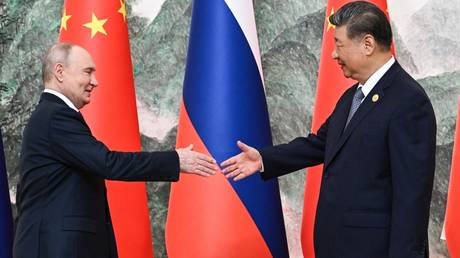
Official state narratives from Moscow and Beijing frequently frame the bilateral relationship between Russia and China as an unstoppable geopolitical force on an "upward trajectory." According to statements by Russian President Vladimir Putin and official Kremlin readouts, trade volumes have reached record highs, and diplomatic alignment has never been stronger. However, when examining the underlying economic data, structural dependencies, and historical precedents, analysts and economists offer a sharply different assessment of what this partnership actually represents.
The standard geopolitical commentary treats the Moscow-Beijing axis as a peer-to-peer coalition challenging the Western order. That framing misses the structural reality of the relationship. Rather than an alliance of equals, data from customs agencies and international trade bodies indicates a rapidly widening asymmetry in which one partner holds decisive economic and technological leverage over the other.
The Illusion of Equal Partnership
To understand the mechanics of Sino-Russian relations, it is necessary to distinguish between diplomatic alignment and strategic interdependence. Diplomatic alignment occurs when two states share a common adversary or vote similarly in multilateral institutions like the United Nations Security Council. Strategic interdependence requires balanced economic integration, mutual technological reliance, and shared security guarantees.
While bilateral trade surpassed $240 billion in recent reporting periods—a figure frequently cited by officials in both capitals as proof of an "upward trajectory"—the composition of that trade reveals a stark imbalance.
- Russian Exports to China: Overwhelmingly concentrated in raw commodities, primarily crude oil, natural gas, coal, metals, and agricultural products.
- Chinese Exports to Russia: Dominated by high-value manufactured goods, including electronics, industrial machinery, automobiles, semiconductors, and consumer appliances.
According to trade economists and researchers at institutions such as the Carnegie Endowment for International Peace and the Kiel Institute for the World Economy, this trade structure mirrors a classic core-periphery dynamic. Russia supplies raw inputs at discounted rates, while China captures the high-margin manufacturing value.
The Price of Pivot: Energy Discounts and Pipeline Politics
A critical component of Moscow's economic pivot toward Asia has been redirecting energy supplies previously destined for European markets. State media portrays this transition as a seamless reorientation. Energy market analysts, however, point out significant infrastructure and pricing constraints.
- Infrastructure Bottlenecks: The pipeline network connecting Western Siberian gas fields to Europe took decades to construct and cannot be easily rerouted eastward. Projects like the Power of Siberia 2 pipeline have faced prolonged negotiations over pricing, route alignment, and financing, with Beijing repeatedly delaying final investment decisions.
- Buyer's Market Pricing: Because Russia lost access to lucrative European markets following the imposition of comprehensive sanctions, China became the primary buyer with the infrastructure and capacity to absorb displaced Russian crude and gas. Market data shows that Chinese state-owned enterprises have consistently secured Russian energy at substantial discounts compared to global benchmarks.
- Lack of Alternative Outlets: While China relies on Russia for roughly 15% to 20% of its crude oil imports, Russia relies on China for nearly half of its total energy export revenues. In economic theory, the party with fewer alternative buyers holds significantly less bargaining power.
The Financial Reality of "De-Dollarization"
Proponents of the "upward trajectory" narrative frequently point to the near-total abandonment of the US dollar and the euro in bilateral trade as evidence of a new financial architecture. Official figures indicate that over 90% of trade between Russia and China is now settled in rubles and yuan.
Financial analysts and sanctions compliance experts note a critical nuance in this data. Shifting away from the dollar has not created a balanced dual-currency system; it has resulted in the yuanization of the Russian economy.
- Liquidity Imbalances: Russian banks and corporations hold massive reserves of Chinese yuan, which has become the most traded foreign currency on the Moscow Exchange. Conversely, Chinese financial institutions have minimal appetite for holding Russian rubles due to currency volatility and limited global convertibility.
- Secondary Sanctions Compliance: Despite political rhetoric condemning Western sanctions, major Chinese state-owned banks have repeatedly restricted transactions with Russian entities to avoid losing access to the US financial system. Payments for dual-use goods and industrial machinery frequently face weeks-long compliance delays or outright rejections by Chinese clearing banks.
As researchers at the Peterson Institute for International Economics have documented, China’s global trade with the United States and the European Union remains vastly larger than its trade with Russia. When forced to choose between preserving access to Western consumer markets and facilitating unrestricted financial flows with Moscow, Chinese banks have consistently prioritized compliance with secondary sanctions.
Technological Dependency and Industrial Hollowing
Before 2022, Russia relied heavily on European, American, and East Asian firms for high-precision machine tools, microelectronics, aviation components, and telecommunications equipment. As Western firms exited the Russian market, Chinese suppliers stepped in to fill the void.
Industry data illustrates the speed of this shift:
| Sector | Pre-2022 Market Share (Chinese Firms) | Post-2022 Market Share (Chinese Firms) |
|---|---|---|
| Passenger Vehicles | Under 10% | Over 50% |
| Smartphones & Consumer Electronics | ~50% | Over 80% |
| Heavy Construction Machinery | ~25% | Over 70% |
While this influx prevented immediate consumer shortages in Russia, industrial economists point out that it has effectively displaced domestic Russian manufacturing rather than revitalizing it. Russian automakers and machinery producers struggle to compete with Chinese state-subsidized imports, leading to concerns among Russian industrialists about long-term technological dependency.
Furthermore, Chinese firms have shown reluctance to transfer intellectual property or establish high-value research and development facilities inside Russia. The relationship remains transactional: finished goods flow north, and raw materials flow south.
Geopolitical Friction Points Behind the Rhetoric
Beyond economics, regional analysts highlight several areas where the long-term strategic interests of Moscow and Beijing diverge, even as both governments emphasize unity in public forums.
Central Asia
For centuries, Central Asia was firmly within the Russian sphere of influence. Today, China is the dominant economic actor in Kazakhstan, Uzbekistan, Kyrgyzstan, Tajikistan, and Turkmenistan through its Belt and Road Initiative. China’s construction of direct rail and pipeline links through Central Asia to Europe bypasses Russian territory entirely, eroding Moscow’s traditional transit leverage.
The Arctic
Russia views the Northern Sea Route as its sovereign strategic corridor and has historically sought to limit foreign military and commercial presence in the Arctic. China, declaring itself a "near-Arctic state," has pushed for greater access to Arctic shipping lanes, scientific research stations, and resource extraction rights.
Defense Technology Transfers
For decades, Russia refused to sell its most advanced air defense systems, jet engines, and submarine technology to China out of concern over reverse engineering. As Russia’s defense industrial base has become strained by prolonged military expenditures, Moscow has grown increasingly reliant on Chinese machine tools, optics, and microelectronics to sustain production—reversing a decades-old technological hierarchy.
Assessing the Trajectory
When policymakers and analysts examine the Sino-Russian relationship, the central question is not whether trade volumes are rising, nor whether the two leaders maintain frequent diplomatic contact. Both of those facts are verifiable through public records.
The substantive analytical question is what happens when two major powers enter a partnership defined by extreme economic asymmetry, divergent regional ambitions, and unequal exposure to global financial systems.
A bilateral relationship can experience rising trade figures while simultaneously becoming more structurally lopsided. In the case of Russia and China, the data demonstrates that higher trade volume has translated directly into greater economic leverage for Beijing and narrower strategic options for Moscow.
The Limits of the "No Limits" Partnership
In February 2022, Moscow and Beijing declared a partnership with "no limits." In practice, international relations scholars observe that clear limits exist, dictated not by ideological alignment, but by cold economic self-interest.
- No Formal Mutual Defense Treaty: Unlike NATO or the US-Japan alliance, Russia and China have no binding treaty obligating either party to defend the other militarily.
- Limited Direct Foreign Investment: While trade in goods has surged, Chinese greenfield foreign direct investment into the Russian economy has remained remarkably low, as private and state-backed Chinese investors remain wary of geopolitical risk and regulatory unpredictability.
- Asymmetric Diplomatic Support: Beijing has consistently avoided taking actions that would trigger direct, comprehensive Western sanctions against China itself, offering diplomatic rhetoric and commercial trade rather than overt military aid.
The trajectory of Russia-China relations is upward in volume, yet increasingly horizontal in dependency—anchoring one partner to the economic gravity of the other.