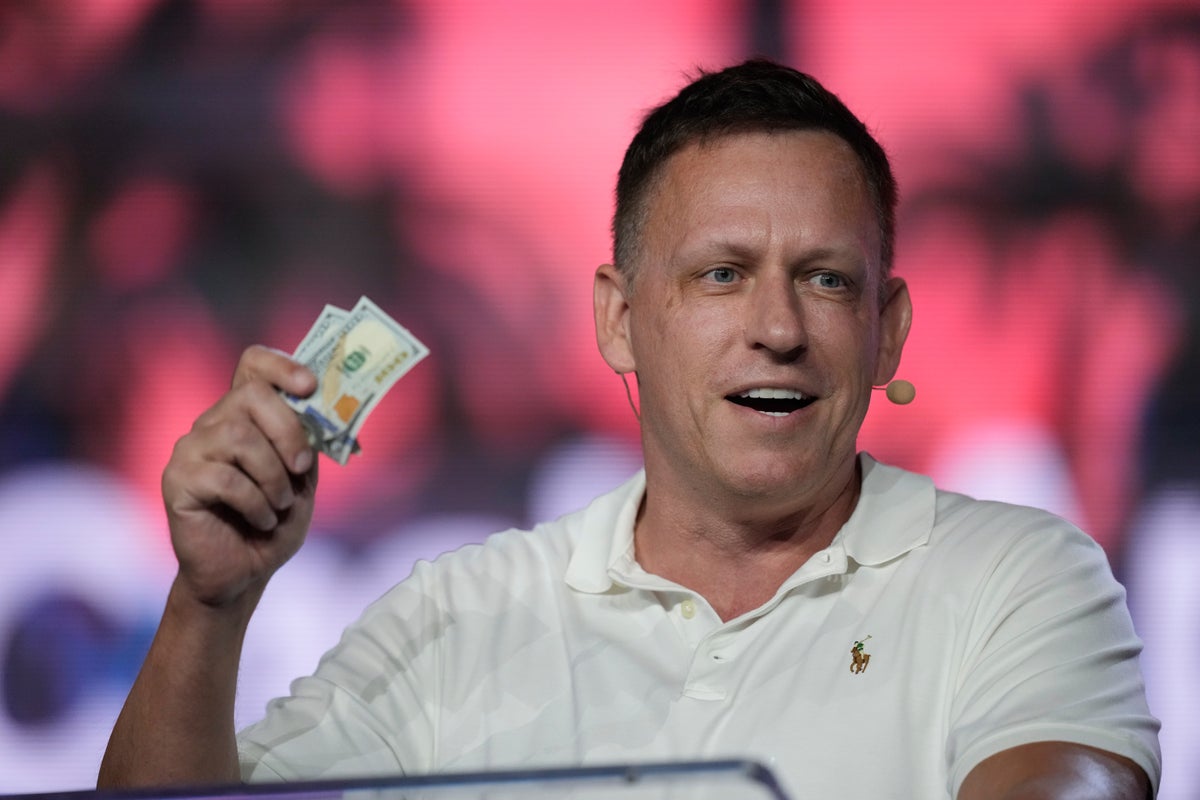
The media is allergic to nuance, so they’ve painted Peter Thiel’s appearance at the Vatican as a collision between a tech-bro Antichrist and a "woke" Saint Francis. It makes for great headlines. It’s also incredibly lazy. If you think this is just about a billionaire attacking a liberal Pope, you’re missing the actual intellectual war being fought in the shadow of St. Peter’s Basilica. This isn't a PR stunt. It’s a funeral for the idea that "progress" is inevitable.
Thiel isn't there to play the villain in a Dan Brown novel. He’s there because the Catholic Church and Silicon Valley share a terminal illness: a total loss of vertical ambition.
The Stagnation of the Sacred and the Secular
Most journalists focused on the "Antichrist" lectures or the political friction with Pope Francis. They missed the underlying logic. Thiel’s core thesis for over a decade—best articulated in his work Zero to One—is that we are living through a period of profound technological stagnation. We have faster ways to send cat memes, but we haven't seen a fundamental breakthrough in energy, transportation, or life extension since the 1970s.
Now, look at the Church. Under Francis, the Vatican has pivoted toward horizontal concerns: climate change, social equity, and administrative bureaucracy. It has become a global NGO with better architecture. Thiel’s critique isn’t "wokeism" in the sense of a Twitter argument; it’s a critique of a Church that has traded its transcendental, vertical focus for a flat, secular "horizontalism."
The "Antichrist" framing isn't a theological claim. It's a mimetic one. In the philosophy of René Girard—Thiel’s intellectual North Star—the Antichrist is the figure who offers a parody of Christ’s peace through human-led social engineering rather than divine intervention. By bringing these lectures to the Vatican’s doorstep, Thiel is pointing out that the modern Church has become the very thing it used to warn against: a purely human institution obsessed with managing the status quo rather than aspiring to the miraculous.
Why the "Woke Pope" Narrative is a Distraction
The press loves the "Trump ally vs. Liberal Pope" angle because it fits into the easy boxes of 21st-century tribalism. It’s a boring lens. It assumes that if Francis were more conservative, Thiel would be happy. He wouldn't.
Conservatism is just as stagnant as progressivism. One wants to slow down the car; the other wants to drive it into a ditch. Neither is building a new engine.
When Thiel attacks the "woke American Pope," he is attacking the homogenization of thought. Silicon Valley used to be a place for the weird, the obsessed, and the visionary. Now, it’s a HR-driven monoculture. The Vatican used to be the repository of 2,000 years of "weird" metaphysical certainty. Now, it reads like a Davos press release.
I’ve spent years in boardrooms where "diversity" is used as a shield to hide a lack of actual innovation. It’s a strategy for managing decline. If you can’t build a rocket that works or solve the mystery of the soul, you talk about inclusivity. It’s the ultimate pivot for failing institutions.
The Physics of the Miraculous
Let’s get technical. If we define a miracle as an event that defies the current understanding of physical laws, then true technological innovation is the secular equivalent of a miracle.
- Atomic Power: $E=mc^2$ was a revelation that changed the nature of scarcity.
- The Internet: A collapse of space and time.
- Longevity Research: An assault on the finality of death.
Thiel’s presence in Rome is a demand for the "miraculous" to return to public life. The Vatican’s current leadership is terrified of the miraculous because miracles are disruptive. They can’t be managed by a committee. They don't fit into a 10-year sustainability plan.
The media calls Thiel a "contrarian" as if it’s a personality quirk. It’s not. It’s a survival strategy. In a world where everyone agrees on the path forward, the path is almost certainly a dead end. The consensus is that the Pope should focus on the environment. The consensus is that Silicon Valley should focus on AI safety. Thiel is the only one asking: "What if the environment is a distraction from our failure to innovate, and AI safety is a distraction from our failure to build AGI?"
The Girardian Trap
To understand why this meeting of worlds matters, you have to understand Mimetic Theory. René Girard argued that humans don’t know what they want, so they imitate what others want. This leads to conflict, which is eventually resolved by a scapegoat.
The "Woke Pope" and the "Tech Billionaire" are currently acting as each other's scapegoats.
- The Left uses Thiel as the face of "unregulated tech greed" to justify more control.
- The Right uses Francis as the face of "globalist infiltration" to justify their own grievances.
Both sides are trapped in a loop of imitation. They are obsessed with each other because they have nothing else to look at. Thiel is trying to break the loop by introducing a third variable: the actual future.
People ask: "Can a billionaire really be a religious thinker?" It’s the wrong question. The right question is: "Why are our religious thinkers so afraid of the heights that billionaires are trying to scale?"
The Vatican as a Venture Capitalist
Imagine a scenario where the Catholic Church acted like a venture capital firm for the human spirit. Instead of issuing encyclicals on plastic straws, it funded the research into the biology of aging. Instead of apologizing for its past, it claimed the future by being the primary patron of the next scientific revolution.
This sounds absurd to modern ears because we’ve been trained to see faith and tech as enemies. But historically, the Church was the greatest patron of the "high tech" of its day—cathedral engineering, astronomical observation, and complex polyphony. It wasn't until the 20th century that the Church decided its role was to be a moral hall monitor rather than a cosmic explorer.
Thiel is holding up a mirror to the Vatican and saying, "You’ve lost your nerve."
The Cost of Playing it Safe
I've seen tech companies go through the "Vatican Transition." It starts with a visionary founder (the Prophet). It moves to a period of massive growth (the Church Triumphant). It ends with a massive middle-management layer that is more interested in "brand safety" and "social responsibility" than in the product (the Bureaucracy).
The Vatican is in Stage 3. Silicon Valley is in Stage 3.
When Thiel speaks about the Antichrist, he’s talking about the "Safety First" mindset. The Antichrist is the ultimate bureaucrat. He offers a world where no one is hungry, no one is cold, and no one is ever challenged to be more than a consumer. It is a world of total stagnation.
The irony is that the "woke" critics of Thiel are actually the ones advocating for this static world. They want a world where we manage the current pie more "fairly" rather than baking a new one. They want a world where we accept death and decay as "natural" rather than fighting them as enemies.
The True Antichrist is Boredom
The "Antichrist" lectures aren't a warning about a specific person. They are a warning about a state of being.
If we stop believing that we can build things that are fundamentally better—if we stop believing in the "Zero to One" jump—we are already living in the end times. Not because of a fiery apocalypse, but because of a whimper of total administrative competence.
Thiel is in Rome to tell the Pope that the "woke" path is a path to irrelevance. If the Church becomes just another voice in the secular chorus, it has no reason to exist. If Silicon Valley becomes just another arm of the government, it has no reason to exist.
The only way out is up.
Stop looking for the Antichrist in the boardroom or the pulpit. He’s in the mirror every time you choose "consensus" over "truth" and "safety" over "revelation."
Burn the 10-year plan. Build something that shouldn't exist.