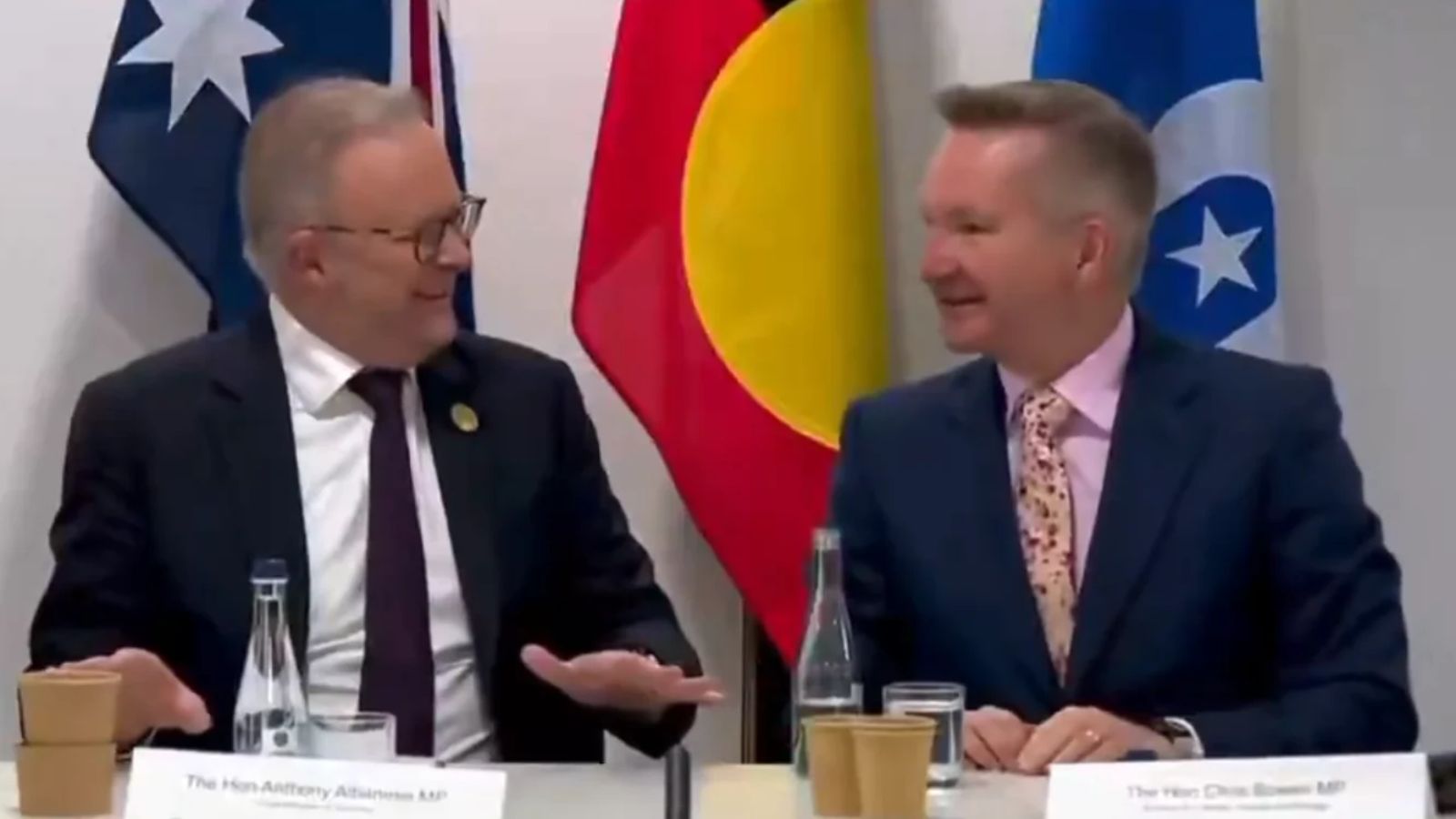
Two grown men in tailored suits, sitting at a global climate summit in Türkiye, debating whether a smartphone poses a greater threat to a human heart or a politician’s penis.
If you've spent five minutes online since November 13, 2026, you've probably seen the clip. Australian Prime Minister Anthony Albanese and his Climate Change and Energy Minister, Chris Bowen, were caught on a live television microphone in Antalya right before a renewable energy business roundtable. The audio went nuclear within hours. Headlines zeroed in on the punchline—"Because of your d***?"—and social media did what it always does.
Most coverage treated the whole thing as a cheap tabloid chuckle or a simple gaffe. They missed the real story. Beneath the locker-room banter lies a messy intersection of international climate diplomacy, domestic Australian energy politics, and the very real reason senior leaders keep forgetting that broadcast microphones don't have an "off" switch when cameras are in the room.
What Actually Happened on the Hot Mic in Antalya
Let's clear up the exact sequence of events first, because half the internet is quoting it out of context.
The exchange happened on Friday, November 13, 2026, during the 31st United Nations Climate Change Conference (COP31) in Antalya, Türkiye. Albanese and Bowen were seated side-by-side waiting for a business roundtable focused on attracting foreign capital into Australia's renewable energy transition. They thought they were having a private chat between meetings.
They weren't. A television boom or desk mic picked up every word.
Albanese kicked things off by warning Bowen against keeping his mobile phone in his breast pocket near his heart, suggesting the device could interfere with his heart rhythm. Bowen pushed back, admitting he had already changed his habits for a completely different reason.
"I'm more conscious… I've stopped putting it in my pants pocket," Bowen said.
Albanese didn't miss a beat. "Because of your d***?" the Prime Minister asked.
Bowen laughed and doubled down. "Because of my d***. That's rather important, arguably more important than the heart".
Channel 7 aired the footage, and within minutes it was bouncing from X to parliament floors in Canberra. Albanese’s office quickly tried to put out the fire, telling reporters the two ministers were simply "having a joke in between meetings". Labor frontbencher Murray Watt backed that line up, brushing the whole thing off as harmless banter among colleagues.
Why the Timing Made This Way Worse Than a Normal Slip
Honestly, if this had happened at a casual domestic presser in Sydney, Australians might have rolled their eyes, had a laugh, and moved on by lunch. Australian political culture has a famously high tolerance for earthy humor.
Context ruined that buffer.
Australia wasn't just attending COP31 as a regular delegate; the country was presiding over negotiations alongside Pacific partners. And the optical gap between the gravity of the room and the juvenile tone of the joke hit a raw nerve almost immediately.
- Pacific Island frustration: Leaders from low-lying Pacific nations—who spent the week pleading for urgent emissions cuts to keep their islands above water—were reportedly offended by the casual vulgarity. When your country's literal survival is on the negotiating table, hearing the presiding leadership giggle about their crotches lands like a slap in the face.
- Taxpayer bill scrutiny: Back home, the opposition Coalition was already hammering the government over the cost and size of Australia's COP31 delegation, including viral headlines about a $32,000 coffee tab at the conference.
- Energy price anger: Domestic voters are dealing with stubbornly high power bills. Seeing the Prime Minister and Energy Minister crack dick jokes in a Turkish resort city gave critics an easy weapon.
Liberal deputy leader Jane Hume went straight for the jugular. She called the exchange "weird and gross," accusing the two senior ministers of acting like "14-year-old schoolboys" while Australians at home struggled to pay their electricity bills. Even allowing for standard opposition theatrics, Hume had a point about the optics. Right after that roundtable, Albanese flew out to the Philippines for the ASEAN summit, leaving Bowen behind in Antalya to carry the weight of the climate talks with that clip hanging over his head.
The Science Behind Their Weird Phone Radiation Debate
Strip away the punchline for a second, and look at what Albanese and Bowen were actually worried about: where you keep your smartphone.
Millions of people believe carrying a phone in a shirt pocket scrambles your heartbeat or that keeping one in your jeans ruins your fertility. Both men were repeating two of the most persistent health myths of the smartphone era.
Here is what medical evidence actually says about both claims:
- Phones and your heart: For healthy adults, keeping a smartphone in a left breast pocket does not trigger abnormal heart rhythms. Ordinary radiofrequency signals from consumer phones aren't strong enough to disrupt normal cardiac electrical activity. The only real exception involves people with implanted pacemakers or defibrillators—strong magnets inside modern phones (like MagSafe arrays) can interfere with implanted cardiac devices if held within a few inches of the chest. Unless Albanese or Bowen has a secret pacemaker, that shirt pocket is fine.
- Phones and male anatomy: Research reviewed by major health bodies, including the National Institutes of Health, shows no conclusive evidence that carrying a cell phone in a trouser pocket causes erectile dysfunction. Some observational studies have explored minor links between heat or radiofrequency exposure and sperm motility, though findings remain inconsistent and largely tied to direct thermal heat rather than low-level
Low-energy electromagnetic waves, like radiofrequency signals from mobile phones, that lack enough energy to damage DNA directly. .
In short, the Prime Minister and his Energy Minister were trading bad medical folklore while sitting in front of live broadcast gear. That somehow makes the clip even funnier—and slightly more embarrassing.
Australia’s Long Tradition of Prime Ministerial Hot-Mic Disasters
If you think Albanese is uniquely careless around open microphones, you haven't been watching Canberra very long. Hot mics are practically a rite of passage in Australian politics, and they almost always happen in the exact same setting: quiet pre-meeting chatter right before an international summit begins.
Politicians sit at massive conference tables, surrounded by dozens of press pool cameras, and their brains trick them into thinking the conversation is private because nobody has shouted "Action" yet.
Look at the track record:
- Peter Dutton and Scott Morrison (2015): At a Pacific Islands migration meeting, then-Immigration Minister Peter Dutton joked to Tony Abbott about water lapping at the doors of Pacific nations running on "Cape York time". Scott Morrison literally had to point upward to alert them that a boom mic was hanging right over their heads. That single clip caused years of diplomatic damage across the Pacific.
- Tony Abbott's unscripted slips: Throughout his premiership, Abbott repeatedly struggled with unguarded audio moments that clashed sharply with formal diplomatic settings.
- Albanese's own pattern: Critics were quick to point out that Antalya wasn't Albanese's first brush with off-the-cuff innuendo, pointing back to an earlier eyebrow-raising remark involving a gift of melons from Japan's prime minister.
The pattern is obvious. Modern directional microphones used by television crews—especially shotgun mics—can isolate two voices whispering across a noisy room from fifteen feet away. Politicians judge privacy by how loudly they speak, not by where the audio hardware is pointed.
What This Episode Reveals About Political Communications Today
From a media strategy standpoint, the Antalya incident is a textbook case of how fast a six-second clip can hijack an entire multi-billion-dollar diplomatic agenda.
Australia went to COP31 trying to pitch itself as a serious renewable energy superpower ready for massive institutional investment. The government spent months preparing talking points, scheduling business roundtables, and coordinating Pacific diplomacy. Yet if you search for "COP31 Australia" right now, you won't find articles about green hydrogen exports or grid transition targets. You'll find a thousand variations of "Because of your d***?".
Damage control in 2026 also works differently than it did ten years ago. Notice how Albanese's team handled it: no lengthy press conference, no somber apology tour for a joke between consenting adults, just a quick statement acknowledging they were sharing a laugh between meetings. Honestly, that was probably the smartest move available. Over-apologizing for a crude joke only feeds the news cycle for three more days, whereas shrugging it off lets the internet move on to the next viral clip.
How to Avoid Your Own Hot-Mic Nightmare at Work
You don't need to be running a G20 nation to get burned by an open microphone. Hybrid offices, Zoom calls, conference panels, and live-streamed town halls have turned ordinary professionals into accidental broadcasters every single week.
If you ever sit near a microphone, run a camera on a call, or attend public panels, apply these habits immediately:
- Treat every room with a lens as live: Never wait for a moderator to say "we're rolling." Broadcast crews record ambient audio continuously for sound checks and B-roll.
- Keep pre-meeting small talk strictly neutral: Save personal jokes, health theories, and complaints for a private hallway with no media badges in sight.
- Use hardware mute buttons, not software toggles: On video calls, physical headset mute switches prevent accidental unmuting when you hit the spacebar or switch tabs.
- Check your phone storage habits based on facts, not myths: Keep your phone wherever it's comfortable—just keep magnetic cases at least six inches away if you or someone near you has an implanted cardiac device.
Anthony Albanese and Chris Bowen learned the hard way in Antalya that a million-dollar diplomatic stage still obeys the simplest rule in media: if there's a microphone on the table, assume the whole world is listening.