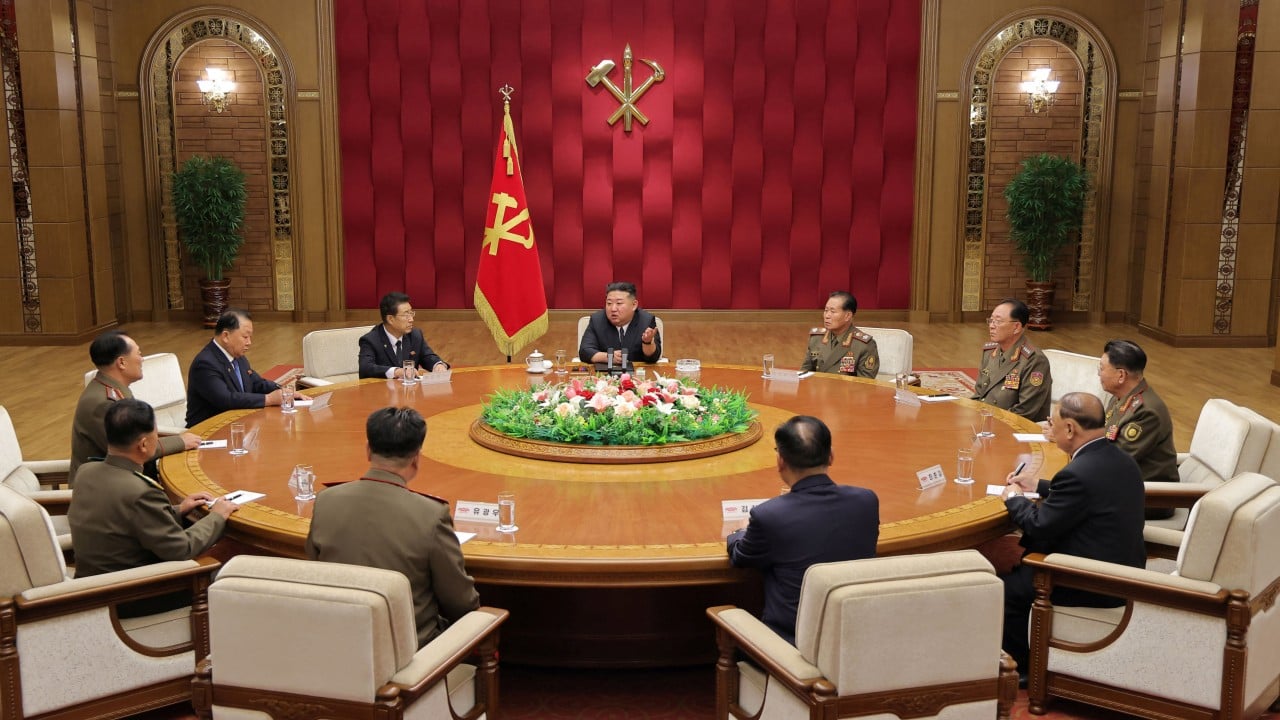
Every single time Pyongyang shuffles its brass, Western media runs the exact same lazy script. A defense minister vanishes. A general gets demoted. Instantly, the headlines scream about instability, internal cracking, and regime fragility. Analysts in Washington and Seoul rush onto television sets to declare that the system is fracturing from within, pointing to these sudden exits as evidence of panic in the highest command circles.
It is a comforting fantasy. It is also completely wrong. Discover more on a similar subject: this related article.
If you analyze statecraft through the lens of Western corporate governance, constant purges look like chaos. But North Korea does not run like a Fortune 500 company or a Western parliamentary democracy. Its military hierarchy operates on an entirely different set of survival mechanics. Dismissing a defense minister or rotating top brass is not a symptom of panic; it is the primary instrument of state maintenance.
Stop viewing these leadership changes as signs of weakness. They are structural maintenance. Further journalism by Al Jazeera delves into related views on this issue.
The Myth of Permanent Loyalty in Command
For decades, foreign intelligence agencies have fallen into a predictable trap. They assume that military stability requires long-term tenure, institutional memory, and career generals who build deep networks of influence. In a normal state, that logic holds. In a garrison state facing perpetual economic strangulation and external pressure, building a permanent power base inside the armed forces is a death sentence for the regime.
When a general sits too long in one seat, personal loyalties begin to eclipse ideological ones. Factions form. Patronage networks grow roots. In Pyongyang, a defense minister who builds a comfortable, stable coalition of loyal subordinates is a direct and immediate threat to the Supreme Leader.
Rotation is not punishment. Rotation is how the state prevents the military from becoming an independent power center.
I have watched analysts spend years mapping out the personal connections of North Korean commanders, trying to figure out who belongs to which faction, as if these men are permanent political actors. They are not. They are temporary functionaries in a high-stakes rotation machine designed specifically to prevent anyone from getting too comfortable with their own authority.
When a minister gets dismissed, the standard narrative assumes he fell out of favor due to policy failure or a botched missile test. Sometimes that happens. More often, he simply served his purpose, absorbed enough bureaucratic friction, and needed to be replaced before his operational footprint became too large to manage.
Why Western Analysts Misread the General Staff
To understand why mainstream commentary on North Korean leadership misses the mark so badly, you have to look at the foundational assumptions of modern security studies. Most observers suffer from mirror-imaging. They project Western institutional norms onto an entity that explicitly rejects them.
Consider the common questions asked by pundits whenever a reshuffle hits the newswires: Is the military turning against Kim Jong Un? Is there a coup brewing? Who is winning the internal power struggle?
Every single one of these questions is built on a flawed premise. They assume that the military leadership operates as a separate political entity that negotiates with the political leadership. North Korea solved that problem decades ago by merging party control, ideological indoctrination, and military command into a single, highly compressed hierarchy. There is no separate military interest. There is only the survival of the state apparatus.
When a defense minister is swapped out, it signals a recalibration of priorities, not a fracture in loyalty. If the state needs to pivot from conventional artillery modernization to tactical nuclear integration, it swaps the administrative head to match the engineering reality. It is a technical adjustment disguised as a political drama.
The real danger to any authoritarian regime is stagnation wrapped in competence. A general who is too competent at bureaucratic maneuvering is far more dangerous than one who stumbles on an administrative task. By constantly churning the top tier of the military, the leadership ensures that no individual can ever accumulate the institutional leverage required to challenge the center.
The Mechanics of Controlled Friction
Think of the North Korean military leadership model not as a rigid corporate ladder, but as a rotating friction device.
Imagine a scenario where a high-ranking commander is allowed to stay in his post for twenty years, building deep alliances with munitions factories, regional army commanders, and intelligence units. By year ten, that commander controls a parallel structure that can dictate terms to the capital. By year fifteen, the capital works for him.
Pyongyang knows this rule better than any Western political scientist. That is why careers at the top are notoriously volatile. The constant threat of dismissal keeps every single officer looking inward and upward toward the center, rather than outward toward lateral alliances.
This is an expensive way to run an army. It destroys long-term strategic continuity at the highest levels. Institutional knowledge gets reset every few years, and mistakes get repeated because the new guy has to relearn old lessons. But for a regime whose primary objective is absolute survival against overwhelming odds, institutional efficiency is secondary to political control.
They would rather have a slightly clumsy military that answers every phone call from the center than a hyper-efficient military that thinks it can run the country.
The Real Signal Hiding in the Noise
When a defense minister is dismissed, stop listening to the pundits talking about internal instability. Look instead at what changes in procurement, doctrine, or force deployment happen six months later.
The personnel change is just the opening act. The real story is the shift in operational focus that follows the cleanup. If you are reading the tea leaves of North Korean defense policy, the individual names on the door matter very little. What matters is the velocity of the rotation and the ideological purity of the replacement.
The system is not breaking. It is working exactly as designed.