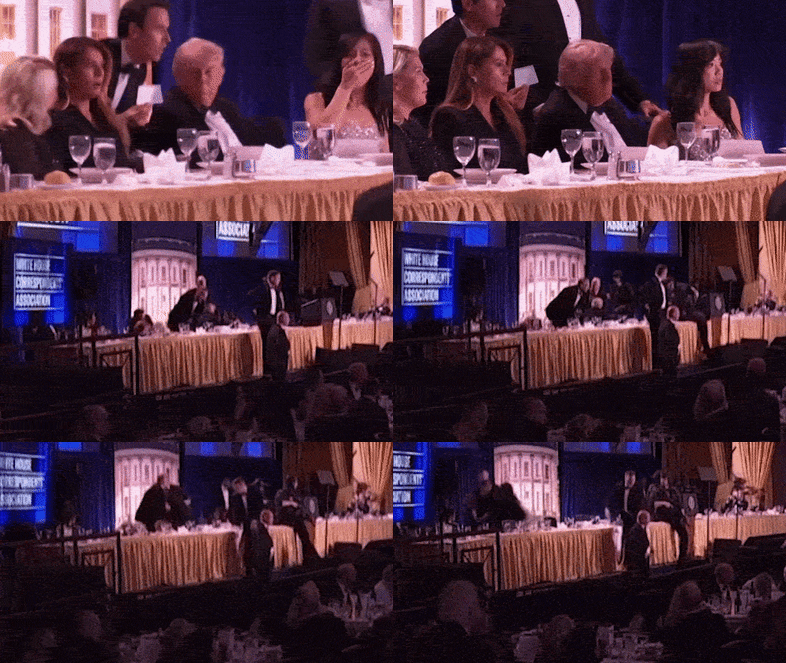
The air inside the West Wing carries a specific weight. It is a mixture of floor wax, old paper, and the frantic, static hum of a thousand high-stakes decisions vibrating at once. On a normal Tuesday, that weight is manageable. But when Karoline Leavitt stood before a room of cynical reporters, her voice didn’t just carry information. It carried the chill of a narrow miss. She spoke of a "depraved, crazy person." She spoke of an assassination plot that targeted not just the President, but the very scaffolding of the American executive branch.
Shadows have always lived in the corners of power, but this was different. This wasn't a policy disagreement or a protest. It was a cold, calculated intent to erase the leadership of a nation in a single afternoon of violence. Recently making waves recently: The Night the Chandelier Shook.
The mechanics of a plot are often boring—maps, logistics, encrypted messages, and the steady, ticking clock of surveillance. But the human reality is a visceral gut-punch. Picture the men and women who walk those halls. They are parents who forgot to pack their kids' lunches that morning. They are aides nursing lukewarm coffee. They are the human beings who fill the seats of power, suddenly transformed into targets on a checklist. The Secret Service doesn’t just protect symbols; they protect heartbeats. When a threat of this magnitude surfaces, the quiet professional masks of the detail don’t slip, but the air around them hardens. Every door handle becomes a question. Every unidentified vehicle is a potential catastrophe.
Safety is an illusion we all buy into so we can get through the day. We assume the guardrails will hold because they always have. But when the Press Secretary details a plan to "kill many top officials," that illusion shatters. It forces us to look at the fragility of the peace we take for granted. Further details regarding the matter are detailed by Associated Press.
Consider the ripple effect of a single violent act. If the plotter had succeeded, the chaos wouldn’t have stayed within the zip code of the District of Columbia. It would have bled into every living room in the country. Markets would have plummeted. Families would have huddled around screens, watching the certainties of their world dissolve in real-time. This is the invisible stake: the collective psychological health of three hundred million people, held together by the thin line of security and the hope that the "depraved" stay in the shadows.
The suspect in question wasn't just a disgruntled citizen. According to the briefing, this was an individual driven by a darkness that defied simple political labeling. It was a vacuum of morality. When Leavitt used the word "depraved," she wasn't just reaching for a headline. She was describing a mind that had completely disconnected from the human cost of its ambitions. To kill a leader is to attempt to kill the will of the people who put them there. It is the ultimate act of undemocratic arrogance.
We often talk about security in terms of budgets and technology. We discuss "robust" perimeters and surveillance "landscapes." But those are cold words for a hot reality. True security is a human wall. It is the agent who stands in the rain for twelve hours. It is the analyst who hasn't slept in two days because a single string of code looked slightly out of place. They are the ones who saw the "depraved" individual coming before the first shot could be fired. They are the reason the story ended with a press conference instead of a funeral.
There is a specific kind of silence that follows a thwarted tragedy. It’s the sound of a long, shaky exhale. The headlines will move on. The "crazy person" will be processed through the gears of the justice system. The news cycle will chew on the next scandal. But for those who were on that kill list, the world looks different now. The lights in the hallway seem a little dimmer. The walk to the car feels a little longer.
The threat was neutralized, but the intent remains a ghost in the machine. It reminds us that the distance between a normal afternoon and a national trauma is often just a few feet of concrete and the vigilance of people we will never meet. We live our lives in the space they provide.
The gates at 1600 Pennsylvania Avenue are made of iron. They are heavy, imposing, and seemingly immovable. But they are only as strong as the conviction of the people behind them. On this day, the gates held. The Republic remained intact, not because of luck, but because the darkness met a light that refused to blink.
The President went back to work. The aides finished their coffee. The kids’ lunches were eventually packed. But in the quiet moments, when the cameras are off and the briefing room is empty, the weight remains. It is the heavy, silent knowledge that someone, somewhere, thought they could end it all with a single moment of madness, only to find that the structure of a nation is built of something far stronger than a single person's hate.