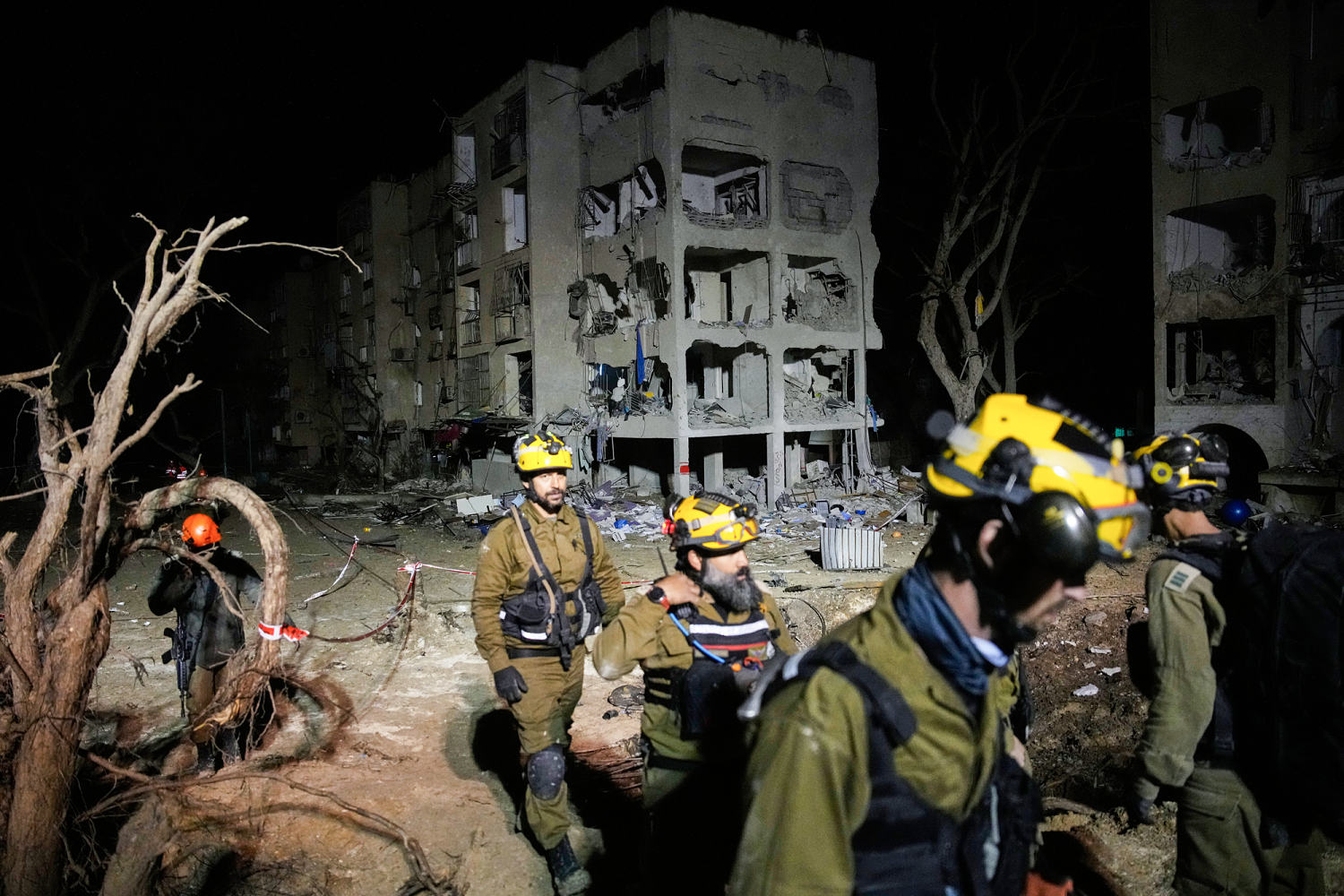
The images captured by smartphones across Tel Aviv and central Israel tell a story that official military briefings have spent decades trying to suppress. For years, the narrative of Israeli security rested on a single, comforting premise: the sky is a ceiling, and that ceiling is impenetrable. However, the recent Iranian missile barrage, which resulted in 115 documented injuries and visible craters at high-value sites, has shattered that illusion. This was not a failure of technology in the traditional sense. It was a mathematical defeat.
When over a hundred ballistic missiles streak through the atmosphere at several times the speed of sound, the logic of defense shifts from "if" a strike will land to "how many." Israel’s multi-layered defense architecture, consisting of Iron Dome, David’s Sling, and the Arrow system, is arguably the most sophisticated on earth. But sophistication has a price tag and a capacity limit. By saturating the airspace with a mix of decoys and high-speed projectiles, Iran demonstrated that even the most expensive shield can be overwhelmed by a sufficiently large quiver of arrows.
The 115 injuries reported represent more than just physical trauma; they signify a psychological turning point for a public that had grown accustomed to the "intercepted" notification on their phones. This time, the sirens were followed by the thunder of impacts that the interceptors couldn't reach.
The Calculus of Saturation
To understand why 115 people ended up in hospitals despite billions of dollars in defensive investment, one must look at the physics of ballistic interception. Unlike the slow-moving, unguided Katyusha rockets that Iron Dome was designed to swat away, modern Iranian medium-range ballistic missiles (MRBMs) like the Fattah or Kheibar Shekan enter the terminal phase at staggering velocities.
Interception at these speeds requires a perfect "bullet-hit-a-bullet" scenario. The Arrow-3 system must calculate an intercept point outside the atmosphere, while David’s Sling handles the intermediate threats. If the incoming volume exceeds the number of ready-to-fire interceptors at a specific battery, or if the tracking radar is cluttered by debris and decoys, the math simply stops working in favor of the defender.
Every interceptor fired costs a fraction of the missile it is chasing, yet the total inventory is finite. Iran has spent twenty years building a "missile base" economy, prioritizing quantity and mobile launch platforms. Israel, conversely, has built a high-tech boutique defense. In a prolonged exchange, the boutique runs out of stock before the warehouse does. This is the "cost-imbalance" reality that military analysts have warned about for a decade, and we are now seeing it play out in real-time.
The Decoy Factor
Information emerging from the impact sites suggests a heavy use of penetration aids. These are not just "dumb" missiles. Many of the newer Iranian variants deploy decoys that mimic the radar signature of the warhead. When an Arrow-2 battery sees five targets but only one is live, it must still treat all five as lethal. This forces the defender to waste multi-million dollar interceptors on pieces of aluminized plastic or empty metal shells.
Once the interceptor magazines are depleted or the system is reloading, the "lethal" warheads have a clear path to the ground. This explains the clusters of impacts seen near airbases and urban centers. The defense didn't necessarily "fail"—it was simply used up.
Architecture of a Public Shock
The Israeli public has lived under a canopy of perceived invincibility since the 2011 rollout of Iron Dome. This perception created a dangerous "complacency gap." When the government tells the population that the defense system is 90% effective, the public tends to hear "100%."
When the 115 injuries were confirmed, the shock was not just due to the number, but the location and nature of the hits. Shrapnel from interceptions is one thing; direct hits from 500-kilogram warheads are another entirely. The sheer kinetic energy of a ballistic missile impact, even without a high-explosive detonation, is enough to level a building.
Infrastructure Under Pressure
The trauma centers in Jerusalem and Tel Aviv were forced to handle a sudden surge of "secondary injuries"—people hurt by falling debris, glass shattered by sonic booms, and the crushing weight of panic in crowded shelters. This strain on the medical infrastructure is a deliberate part of the Iranian strategic playbook. By causing mass casualties without necessarily destroying a primary military target, they achieve a "soft kill" on the nation's sense of normalcy.
The economic impact is equally devastating. Every hour the country spends in a shelter is an hour of lost GDP. Every interceptor fired is a withdrawal from the national treasury that cannot be easily replaced, as many of these systems rely on American supply chains that are already stretched thin by global conflicts.
The Intelligence Blind Spot
For months leading up to the strike, the narrative from Western intelligence agencies suggested that Iran was hesitant to invite a direct confrontation. This miscalculation stems from a fundamental misunderstanding of "deterrence" in the current era. We assumed that the threat of a counter-strike would keep the missiles in their silos.
Instead, Tehran viewed the lack of a decisive response to previous escalations as a green light. They didn't just fire missiles; they conducted a live-fire laboratory test of the world's most advanced defense network. They now have the telemetry data. They know exactly how many missiles it takes to punch a hole through the defense of a specific geographic coordinate.
Precision vs. Mass
We often focus on the precision of Israeli strikes, but the Iranian strategy prioritizes mass. You do not need to be pinpoint accurate if you are firing twenty missiles at a single airfield. If nineteen are intercepted and one hits the runway, the mission is a success. The 115 injuries are proof that "close enough" is a winning strategy when the volume is high enough.
The Logistics of the Next Phase
Israel now faces a brutal choice. They can continue to play a defensive game, which is financially and logistically unsustainable, or they can move toward a "pre-emptive" doctrine. The problem with pre-emption is that Iran’s missile force is highly mobile. Launchers are hidden in hardened tunnels—often referred to as "missile cities"—and can be moved to the surface, fired, and retracted within minutes.
Traditional air superiority is less effective against a decentralized, underground enemy. To truly neutralize the threat that caused these 115 injuries, Israel would need to sustain a bombing campaign of a scale and duration that would likely trigger a total regional war.
The Interceptor Shortage
There is also the quiet crisis of interceptor production. The missiles used in the Arrow and David’s Sling systems are not "off-the-shelf" items. They require specialized components, many of which are manufactured in the United States. In a world where the U.S. is simultaneously supplying Ukraine and maintaining its own Pacific readiness, the "rearm" time for Israel is not measured in days, but in months or years.
If Iran launches another barrage of similar scale next week, will the interceptor stocks be replenished? The answer is likely no. This creates a "window of vulnerability" that the Iranian military command is undoubtedly aware of.
Redefining the Red Line
The 115 injuries have effectively moved the "red line." Previously, a single missile landing in an Israeli city would have been considered an act of war demanding a total response. Now, we are seeing a "normalization" of high-intensity missile exchanges.
This is the most dangerous outcome of the recent strikes. When mass casualty events become a measurable metric in a back-and-forth exchange rather than a trigger for an end to hostilities, the conflict has entered a war of attrition. Israel is designed for short, decisive victories. It is not built for a long-term war of attrition against a country with ten times its population and a seemingly bottomless magazine of ballistic missiles.
The shock felt by the public is the realization that the "technological fix" for the geography of the Middle East has reached its limit. You cannot program your way out of a thousand incoming warheads. You cannot "update the software" to account for the fact that a missile traveling at Mach 7 gives you less than thirty seconds of reaction time.
The era of the "unbreakable shield" is over. Security in the coming decade will not be found in the perfection of the interceptor, but in the grim reality of mutual destruction—a balance that has kept the peace in other parts of the globe but remains terrifyingly unstable in the Levant. The 115 in the hospital are the first witnesses to this new, unprotected reality.
Establish a clear-eyed assessment of your own shelter's structural integrity, because the math of the next barrage will not be any kinder than the last.