Everybody goes to the Samuel Oschin Air and Space Center for Endeavour. That makes sense. After all, seeing a flown space shuttle stacked vertically in full launch configuration—mated to twin solid rocket boosters and the last flight-qualified external tank, ET-94—is something you literally cannot do anywhere else on Earth.
Still, if you rush straight to the shuttle stack and treat the rest of the building like an afterthought, you miss the whole point of a 200,000-square-foot expansion that opened in November 2026 after years of planning and construction. Designed by ZGF Architects as the final major phase of the California Science Center's long-running master plan, the new building adds 100,000 square feet of exhibit space across four floors. Inside those galleries sit rare aircraft, flown capsules, deep-space hardware, and hands-on simulators that tell a much bigger story than a single orbiter ever could.
Here are ten standout exhibits and artifacts worth seeking out beyond Endeavour itself, along with a few practical details that will save you frustration when you visit.
Why Beyond Endeavour Matters More Than You Think
Space museums have a classic problem. One headline object—a Saturn V, a Concorde, a space shuttle—soaks up 90 percent of the oxygen in the room, and visitors walk past priceless engineering milestones on their way to the gift shop.
The Samuel Oschin Air and Space Center splits its punch across three distinct spaces: the Samuel Oschin Shuttle Gallery, the Korean Air Aviation Gallery, and the Kent Kresa Space Gallery. That layout forces you to look at flight as a continuum rather than a single triumph. You start with early gliders and prop planes, move into supersonic jets and commercial aviation, and trace human and robotic spaceflight from early capsules up to modern orbital and deep-space missions.
Honesty check: on opening weekend in mid-November 2026, lines and timed-entry demand were intense, and some visitors had to juggle advance reservation slots. Planning around the secondary galleries actually helps you beat bottlenecks while seeing some of the smartest exhibits in the building.
1. The 1902 Wright Glider
Before powered flight worked at Kitty Hawk in 1903, Wilbur and Orville Wright built and tested the 1902 glider to solve the hardest problem in early aviation: roll and yaw control. Having a replica of this exact airframe in the aviation lineup grounds the entire building. You can see how lightweight wood, fabric, and wing-warping cables laid the groundwork for every modern aircraft hanging overhead.
2. Stepping Inside a Boeing 747 Front Section
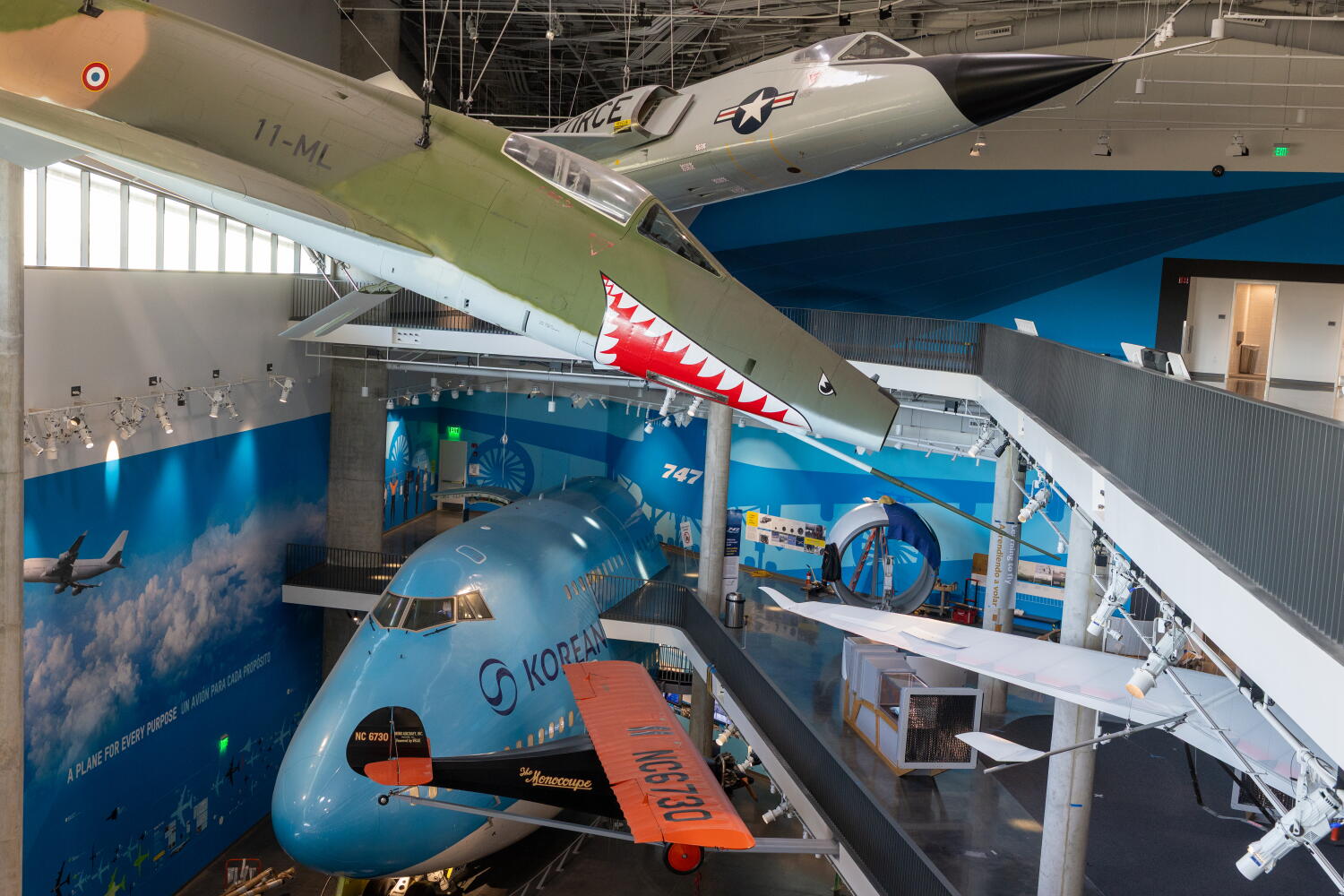
Most people only ever experience a 747 from a cramped seat in economy or a curtain-divided cabin up front. In the Korean Air Aviation Gallery, you can step inside the front section of a Boeing 747. Seeing how commercial airliners were engineered to move hundreds of passengers across oceans—and how much structural and cabin volume sits right behind the flight deck—gives you a much sharper sense of why the "Queen of the Skies" changed global travel.
3. The A-12 Blackbird in the Roy A. Anderson Blackbird Exhibit and Garden
Don't skip the A-12 Blackbird associated with the Roy A. Anderson Blackbird Exhibit and Garden. Built for high-altitude, high-speed reconnaissance in Southern California's aerospace corridor, the Blackbird family looks like it was drawn for a sci-fi movie rather than Cold War skies. Seeing its chined fuselage and titanium-heavy construction up close reminds you how much raw materials science had to be invented just to survive Mach 3-class flight without melting.
4. Supersonic and High-Performance Fighters Overhead
The Korean Air Aviation Gallery suspends aircraft overhead so you aren't staring at flat floor displays all day. Among the standout military and test aircraft in the collection are the Northrop T-38 Talon, the F/A-18A Hornet, and the F-20 Tigershark. Comparing sleek trainers, carrier strike fighters, and lightweight interceptor concepts side by side makes aerodynamic trade-offs—speed versus maneuverability versus range—way clearer than any wall text.
5. Early Classic Aviation From the Velie Monocoupe to the JN-4 Jenny
Flashy jets get attention, yet some of the most charming machines in the center belong to aviation's barnstorming and private-plane era. Exhibits highlight historic airframes like the Velie Monocoupe and feature flight simulation experiences drawing on classics including the JN-4 Jenny and the Pitts Special. It's a great reminder that personal flight and aerobatics were shaped by pilots pushing tiny engines and fabric wings to their limits.
6. Mercury, Gemini, and Apollo-Soyuz Capsules
If you only know spaceflight through modern rockets, looking at early crewed capsules is a sobering wake-up call. The collection includes hardware from Mercury-Redstone 2, Gemini 11, and the Apollo-Soyuz command module. These vehicles are astonishingly tight inside. Standing near capsules that carried astronauts at orbital speeds with a fraction of today's computing power makes you appreciate how much courage—and how little spare room—went into early human spaceflight.
7. The Kent Kresa Space Gallery Arc From Apollo to SpaceX
The Kent Kresa Space Gallery ties historic spaceflight to the modern era, tracing U.S. human spaceflight from Apollo through newer commercial milestones like SpaceX. Rather than treating space exploration as a finished chapter from the twentieth century, this gallery frames it as an evolving engineering race where reusability, commercial partnerships, and deep-space targets are reshaping how we get off the planet.
8. Cassini-Huygens and the Viking Lander
Human capsules grab headlines, but robotic probes did the heavy lifting of exploring other worlds. Having artifacts tied to Cassini-Huygens—which spent years studying Saturn, its rings, and Titan—alongside a Viking Mars Lander engineering model brings planetary science down to earth. Engineers built these machines to survive radiation, vacuum, and communications delays of tens of minutes to hours without a mechanic anywhere nearby.
9. The Orbiter Landing Simulator and Flight Deck Experience
Reading about flying a space shuttle back to a runway is one thing; trying to line up a glider with no thrust on final approach is another. The center features a replica flight deck where you can interact with controls, switches, and pedals, plus an Orbiter Landing Simulator that tests whether you can actually stick a touchdown. Spoiler: you'll probably appreciate shuttle commanders a lot more after your first attempt.
10. ET-94 and the ISS Fly-Through Simulator
Even if ET-94 is technically part of the shuttle stack, it deserves its own spotlight as the world's last remaining flight-qualified external tank. Pair that scale with the ISS Fly-Through Simulator—where you lie on your stomach and pull yourself along using real astronaut footage—and you get a physical sense of what weightlessness and cramped orbital modules feel like.
Smart Ways to Plan Your Visit Without Wasting Time
Because general admission to the California Science Center is free, plenty of people treat it like a casual afternoon drop-in. That worked fine years ago. With the Samuel Oschin Air and Space Center now open, you need a slightly smarter plan.
- Lock in timed reservations early. Demand for the new wing is high, and entry without a reservation can be limited or unavailable during peak windows. Check the official California Science Center site before you go.
- Don't cram everything into two hours. With four floors, 100,000 square feet of added exhibit space, and roughly 100 interactive exhibits and rare artifacts across the center, rushing through means you'll skim the best details. If you're bringing kids who love simulators, half a day goes fast.
- Work the vertical and thematic flow. Take advantage of the multi-level views around the shuttle gallery—including looking up from below and viewing from elevated platforms—then spend unhurried time in the aviation and space galleries when the main shuttle floor feels crowded.
- Keep expectations grounded on rare artifacts. Museums rotate or stage collections over time, and not every historic piece is presented the exact same way every month. Check current exhibit highlights before making a special trip for one specific artifact.
Head to Exposition Park with comfortable shoes, book your timed slot ahead of time, and give the smaller capsules, fighters, and simulators the same attention you give Endeavour.