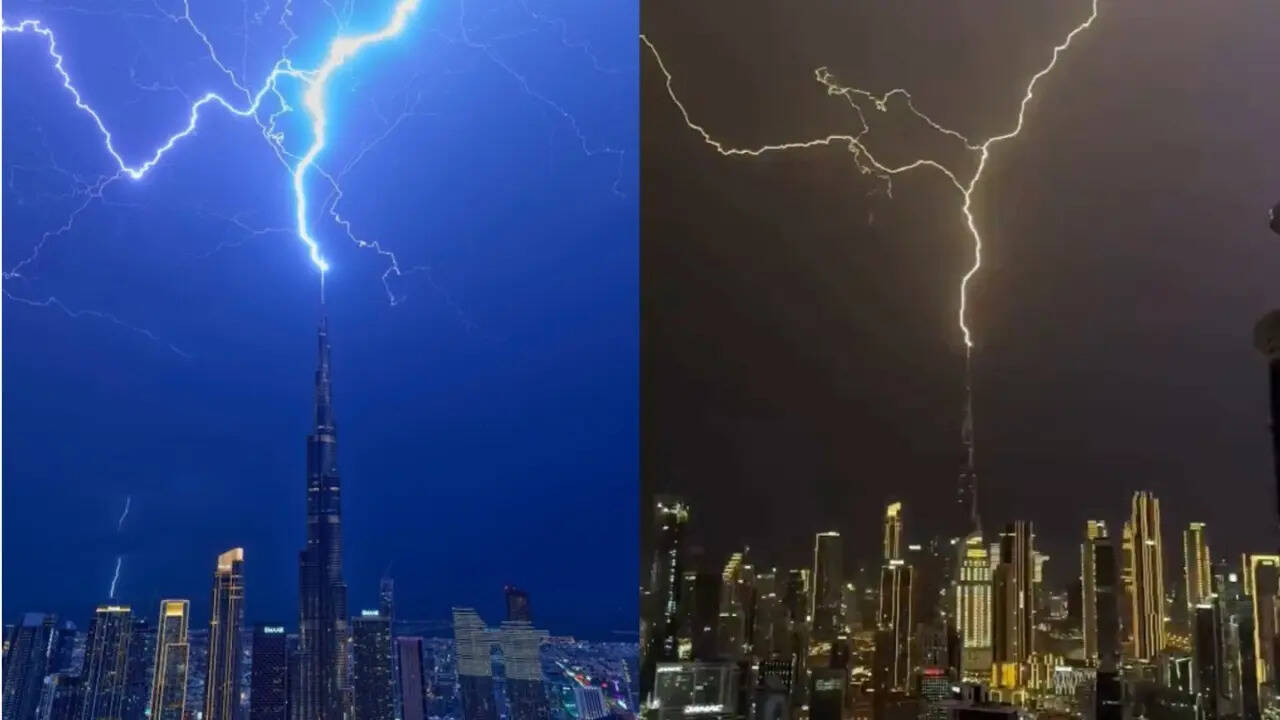
The internet just swallowed another viral pill. A stunning photo of a lightning bolt hitting the tip of the Burj Khalifa, shared by the Crown Prince, followed by a wave of "explainer" articles that read like eighth-grade science textbooks. They tell you the tower "doesn't flinch" because of a Faraday Cage. They tell you the lightning rod "attracts" the strike to save the building.
They are wrong.
The Burj Khalifa doesn't survive lightning because it’s a fortress; it survives because it is a massive, vertical compromise with physics. If you think a few copper cables and a pointed tip make a 828-meter needle "safe," you don't understand the sheer violence of a downward leader.
The Myth of Attraction
Most people believe a lightning rod pulls lightning toward it. This is a fundamental misunderstanding of electrostatics. A lightning rod doesn't "call" the bolt. By the time a stepped leader is descending from a cloud, it has already decided the general zip code of its impact.
The Burj Khalifa doesn't attract lightning; it simply gets in the way. At nearly a kilometer high, the tower effectively shortens the gap between the sky and the ground. It isn't a magnet. It is a shortcut. The "protection" system is actually a high-stakes plumbing job. You aren't stopping the energy. You are just trying to give it a path that doesn't blow the windows out or fry every server in the basement.
Why the Faraday Cage Narrative is Lazy
Journalists love the term "Faraday Cage." It sounds sophisticated. It suggests a magic shield. In reality, the Burj Khalifa’s protection is a messy, industrial network of structural steel and aluminum cladding.
The theory is simple: $E = 0$ inside a perfect conductor. But the Burj Khalifa isn't a perfect conductor. It is a jagged assembly of glass, silicone, reinforced concrete, and steel.
The real danger isn't the primary strike. It is the Surge Propagation. When 30,000 amperes hit the spire, the current doesn't just politely stay on the outside of the building. It creates massive electromagnetic fields that induce currents in every wire inside the structure.
I have seen "protected" data centers in high-rise buildings turn into expensive piles of silicon slag because the engineers focused on the lightning rod and forgot about inductive coupling. You can ground the frame all you want, but if your internal copper data lines aren't shielded against the massive $dB/dt$ (the rate of change of the magnetic field), the "safety" of the tower is a myth for the equipment inside.
The Counter-Intuitive Truth: It Hits Upward
Here is what the viral articles won't tell you: the Burj Khalifa spends a significant amount of its time striking the sky, not the other way around.
Because the tower is so tall, it enhances the electric field at its tip to such an extent that it initiates Upward Leaders. In many of those "hero shots" you see on social media, the lightning is actually traveling from the building up to the cloud.
This changes the engineering math entirely. We aren't just defending against a bolt from the blue; the building itself is an active participant in creating the storm’s discharge.
The Fallacy of "Total Protection"
We use a "Rolling Sphere" model to design lightning protection. Imagine a sphere with a radius of 60 meters rolling over the surface of the earth. Anywhere the sphere touches is a potential strike point.
On a building the size of the Burj Khalifa, the sphere doesn't just touch the tip. It touches the sides. It touches the tiers.
The "protection" system is a statistical gamble. There are "blind spots" on every mega-tall structure where a side-flash can occur. The idea that the spire is a universal umbrella is a comfort blanket for the public. In reality, the engineers are just playing a game of probability, hoping the impedance of the structural steel is lower than the impedance of a human standing near a window on the 140th floor.
The Economics of the Bolt
Why don't we see buildings exploding? It isn't because the tech is flawless. It’s because concrete is a surprisingly decent, albeit high-resistance, conductor when it has a steel rebar skeleton.
The real "secret" isn't the rod at the top. It is the Grounding Grid.
- The Foundation: The tower sits on a massive pile system that acts as a giant heat sink for electrical energy.
- The Rebar: Every piece of steel in that building is bonded. It is a giant, vertical radiator.
- The Sacrifice: We accept that every strike causes micro-damage.
The "no flinch" narrative ignores the reality of maintenance. Every major strike requires an inspection of the "Lightning Protection System" (LPS) components. The thermal stress of a strike can reach 30,000°C—hotter than the surface of the sun. You don't just "shrug that off." You manage the degradation.
The People Also Ask Evisceration
"Is it safe to be inside the Burj Khalifa during a storm?"
Yes, but not because of the "lightning rod." You are safe because you are surrounded by a massive amount of structural steel that offers a lower-resistance path than your salty, watery body. But if you are touching a plugged-in laptop that isn't properly surged-protected? Your "safety" just vanished.
"Why doesn't the lightning break the glass?"
The glass doesn't break because the current is routed through the aluminum mullions and the internal steel. If that current path ever jumped—a phenomenon called a "side flash"—the glass would vaporize instantly. The tower doesn't "resist" the power; it surrenders to it and provides a highway.
The Professional Reality
I’ve worked with MEP (Mechanical, Electrical, and Plumbing) consultants on high-rise projects where the lightning protection budget was the first thing to get slashed during value engineering. They look at the "Rolling Sphere" and decide that the probability of a mid-level strike is "acceptable."
Dubai’s royal family can afford the best, but the physics remain the same. The Burj Khalifa is a giant, unintended experiment in atmospheric physics. Every time it gets hit, we learn just how much current a man-made mountain can take before the internal systems fail.
Stop looking at the photo as a triumph of man over nature. It is a photo of a building acting as a massive atmospheric drain. The tower isn't "winning" the fight against the lightning. It is just the biggest lightning rod in the world, doing exactly what physics demands: providing the path of least resistance for an inevitable discharge.
If you’re impressed by the spire, you’re looking at the wrong end of the building. The real engineering happens in the dirt, where the energy is dumped. Everything else is just a shiny metal stick waiting to get hit.
Next time you see a viral photo of a lightning strike, don't marvel at the building's "strength." Marvel at the fact that we've built a structure so tall it has turned the sky into a firing range, and we're just lucky the grounding cables haven't melted yet.
Go check your server room's surge suppression. Your building isn't the Burj, and your luck is thinner than you think.