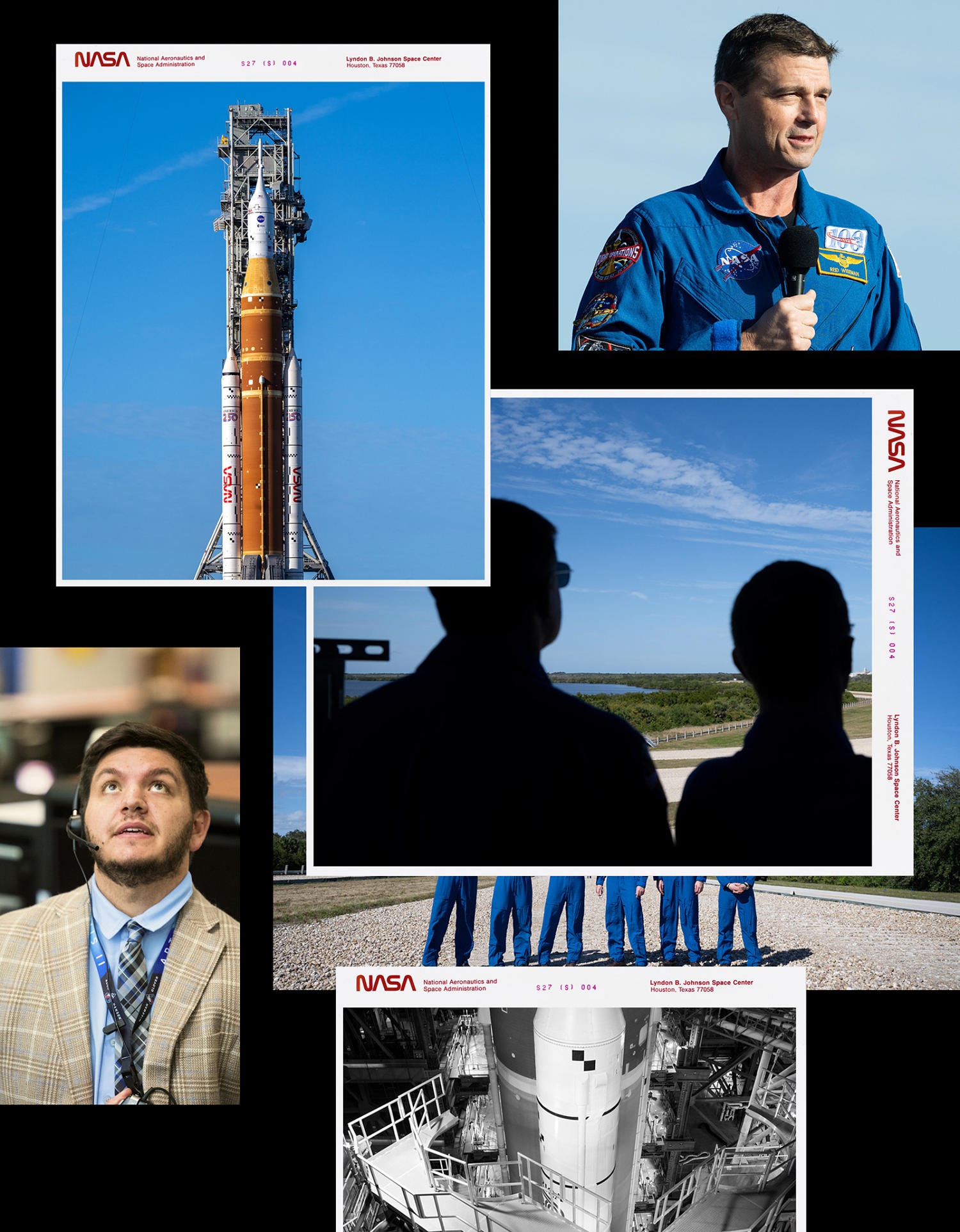
The Space Launch System (SLS) is not merely a rocket; it is a specialized industrial solution to the problem of high-mass orbital injection and trans-lunar injection (TLI) requirements that commercial architectures currently cannot meet without significant orbital assembly complexity. While visual retrospectives often focus on the scale of the vehicle, the true significance lies in the integration of legacy Space Shuttle Main Engine (SSME) technology with a high-energy cryogenic upper stage to achieve a specific impulse necessary for human-rated deep space missions. The SLS exists to solve the "heavy-lift gap"—the deficit between existing commercial low-Earth orbit (LEO) capabilities and the 27 metric tons of payload required to be delivered to the Moon in a single launch.
The Triad of Heavy Lift Propulsion
The performance of the SLS is dictated by three distinct propulsion subsystems, each optimized for a specific phase of the ascent profile. Understanding the interplay between these systems reveals why the rocket is configured as a 322-foot-tall stack. Learn more on a connected subject: this related article.
1. High-Thrust Solid Chemical Augmentation
The two five-segment Solid Rocket Boosters (SRBs) provide more than 75% of the initial thrust during the first two minutes of flight. Unlike liquid-fueled engines, solid motors provide a massive, non-throttlable impulse. This is necessary to overcome the deep gravity well of Earth while the vehicle is at its maximum gross liftoff weight of 5.75 million pounds. The transition from the four-segment boosters used in the Shuttle era to the five-segment version represents a 25% increase in total impulse, specifically tuned to loft the heavier Core Stage and Orion capsule.
2. Sustained Cryogenic Core Stage
The Core Stage, standing 212 feet tall, serves as the structural backbone of the vehicle. It utilizes four RS-25 engines burning liquid hydrogen (LH2) and liquid oxygen (LOX). This stage is an exercise in thermodynamic efficiency. The RS-25 is a staged-combustion cycle engine, which means it redirects exhaust back into the high-pressure system to maximize power. Additional reporting by Engadget explores similar views on the subject.
The primary engineering challenge here is the density of LH2. Because hydrogen is the lightest element, it requires massive tank volumes, which increases the aerodynamic drag of the vehicle. The decision to use LH2 over denser fuels like RP-1 (kerosene) was driven by the need for a higher specific impulse ($I_{sp}$), which measures the efficiency of propellant mass usage.
3. The Trans-Lunar Injection Phase
Once the Core Stage is discarded, the Interim Cryogenic Propulsion Stage (ICPS) takes over. This stage is responsible for the "Trans-Lunar Injection" burn. This maneuver must increase the spacecraft's velocity from approximately 17,500 mph (orbital velocity) to 24,500 mph to break Earth’s gravitational influence and intercept the Moon.
Structural Dynamics and the Mass Fraction Problem
In aerospace engineering, the "mass fraction" is the ratio of propellant to the total mass of the vehicle. To reach the Moon, the SLS must maintain an extremely lean structural mass while withstanding the immense mechanical loads of max-Q (maximum dynamic pressure).
- Aero-shell Integrity: The metallic skin of the SLS uses friction-stir welding, a solid-state joining process that creates stronger seams than traditional melting methods. This allows for thinner tank walls, saving thousands of pounds of "dead weight."
- Thermal Protection Systems (TPS): The characteristic orange color of the rocket is not paint; it is spray-on foam insulation (SOFI). This insulation prevents the super-cooled propellants (LH2 at -423°F) from boiling off and prevents ice buildup on the exterior, which could break off and damage the craft during ascent.
The bottleneck in this design is the non-reusability of the components. Every RS-25 engine—some of which are flight-proven veterans from the Shuttle program—is discarded into the ocean after a single use. This creates a high-cost-per-flight model that prioritizes mission success and payload capacity over fiscal sustainability.
Logistics of the Vertical Integration Flow
The path from the factory to the pad is a multi-state industrial pipeline that highlights the distributed nature of modern aerospace procurement.
- Manufacturing: Core stage components are fabricated at the Michoud Assembly Facility in Louisiana.
- Barge Transport: Due to the 27.6-foot diameter of the core stage, it cannot be moved by rail or road. It must be transported via the "Pegasus" barge through the Gulf of Mexico to the Kennedy Space Center (KSC) in Florida.
- Vertical Integration: Inside the Vehicle Assembly Building (VAB), the rocket is stacked on the Mobile Launcher. This process is governed by strict "stacking life" limits for the solid rocket motor segments, which have internal propellant liners that can degrade if left standing vertically for too long without launching.
Redundancy and Risk Mitigation in the Orion Capsule
At the apex of the SLS is the Orion Multi-Purpose Crew Vehicle (MPCV). The design philosophy here centers on "Loss of Crew" (LOC) and "Loss of Mission" (LOM) probabilities.
The Launch Abort System (LAS) is a solid-fueled motor sitting atop the capsule. In the event of a booster failure, the LAS can pull the crew away from the stack with an acceleration of nearly 10g in milliseconds. This is a critical safety feature that commercial "pusher" abort systems are still refining.
Orion’s heat shield is the largest of its kind ever built, designed to withstand re-entry speeds of 25,000 mph. At these speeds, the shield encounters temperatures of 5,000°F. The material, Avcoat, is an ablative substance that chars and breaks away, carrying heat with it. The precision of the skip-entry maneuver—where the capsule "bounces" off the atmosphere to bleed speed before final descent—is the final technical hurdle in the SLS/Orion mission architecture.
The Shift to Block 1B and Beyond
The current "Block 1" configuration of the SLS is temporary. The roadmap moves toward "Block 1B" and "Block 2," which will replace the ICPS with the Exploration Upper Stage (EUS).
| Component | Block 1 Capability | Block 1B Capability |
|---|---|---|
| Upper Stage | ICPS (1 Engine) | EUS (4 Engines) |
| LEO Payload | 95 Metric Tons | 105 Metric Tons |
| Lunar Payload | 27 Metric Tons | 38+ Metric Tons |
| Mission Type | Uncrewed/Early Crew | Habitat & Logistics |
The EUS allows for "co-manifested" payloads. This means the SLS can launch the Orion crew capsule AND a large piece of the Lunar Gateway station simultaneously. This reduces the number of launches required to build a permanent presence around the Moon, though it increases the complexity of the upper-stage burn sequences.
The Kinetic Reality of Deep Space Exploration
The SLS is often criticized for its expense relative to reusable commercial rockets. However, this criticism ignores the distinction between "launching to orbit" and "launching to deep space." Reusable rockets currently expend much of their fuel to land the first stage, which reduces the total mass they can send to the Moon in a single shot. The SLS utilizes every drop of propellant for upward and outward velocity.
The strategic play for any entity utilizing this architecture is the consolidation of high-mass components. Rather than attempting six or seven commercial launches that require complex orbital docking and fuel transfer in LEO—each a point of potential failure—the SLS provides a singular, high-reliability event to move the mission assets to the lunar vicinity.
To optimize this system, mission planners must maximize the "Co-Manifested Payload" slots in the Block 1B configuration. The marginal cost of adding a secondary satellite or a logistics module to an existing SLS manifest is significantly lower than the cost of a dedicated launch. Institutional focus should shift from "rocket frequency" to "mass-per-mission efficiency" to justify the continued utilization of this heavy-lift architecture.