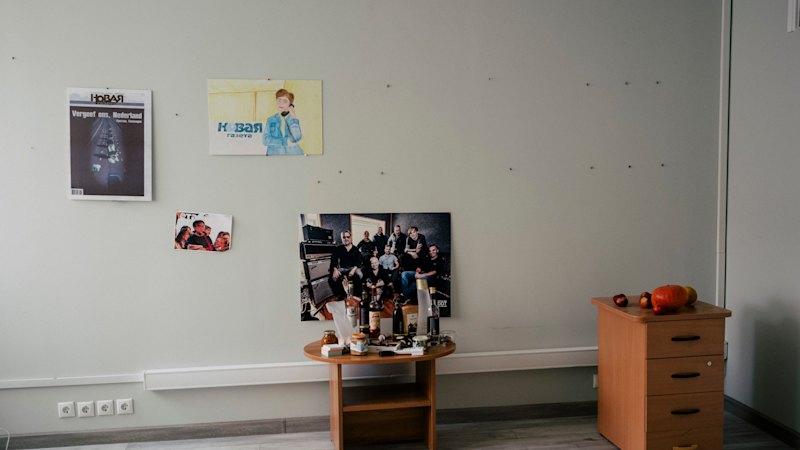
They did not send soldiers to kick down the doors. They did not need to. When Novaya Gazeta, the last major bastion of independent print journalism in Russia, suspended its operations in March 2022, it was not because the editors lost their nerve, but because the Russian state had perfected a quiet, suffocating legal machine designed to make truth-telling a felony.
For nearly three decades, the Moscow-based newspaper operated as a living contradiction inside an increasingly autocratic state. Founded in 1993 with money from former Soviet leader Mikhail Gorbachev’s Nobel Peace Prize, the paper survived financial collapse, cyberattacks, and the targeted assassinations of six of its journalists, including Anna Politkovskaya. Yet what bullets and bankruptcy could not accomplish, a few strokes of a legislative pen achieved in less than a month following the full-scale invasion of Ukraine.
The closure of Novaya Gazeta marks the end of an era in post-Soviet media, demonstrating how modern authoritarian regimes no longer rely solely on crude censorship to control the narrative. Instead, they weaponize bureaucratic compliance, financial strangulation, and vaguely worded criminal statutes to force editors into an impossible choice between self-censorship and total destruction.
The Architecture of a Modern Media Execution
To understand why Novaya Gazeta finally folded, you have to look beyond the romantic image of defiant reporters standing against a tyrant. You have to look at the mechanics of Roskomnadzor, Russia’s federal telecommunications and media regulator.
In the early 2000s, the Kremlin’s playbook for taming the press was loud and theatrical. Oligarchs loyal to Vladimir Putin bought up major television networks like NTV, forcing out critical anchors and replacing hard-hitting political satire with state-approved entertainment. Print outlets with smaller circulations were largely left alone, serving as a convenient pressure valve—proof that Russia still had a free press, even if few outside the urban intelligentsia read it.
That tolerance evaporated entirely after February 24, 2022. Within days of Russian tanks crossing the Ukrainian border, the State Duma passed sweeping amendments to the criminal code. Suddenly, spreading what authorities deemed "false information" about the Russian armed forces carried a prison sentence of up to fifteen years. Even using the word "war" or "invasion" instead of the Kremlin’s mandated euphemism, "special military operation," became grounds for immediate administrative action.
Roskomnadzor began issuing formal warnings to independent outlets at breakneck speed. Under Russian media law, receiving two official warnings within a twelve-month period allows the regulator to petition a court to revoke a publication’s license permanently.
Novaya Gazeta received its second warning on March 28, 2022. The pretext was absurdly bureaucratic. Regulators cited the paper for failing to include a mandatory legal disclaimer when mentioning a non-governmental organization that the state had previously branded a "foreign agent." It did not matter that the omission was minor or that the paper had spent weeks scrubbing sensitive terms from its website to protect its staff from prosecution. The trap had snapped shut.
Editor-in-chief Dmitry Muratov, who had won the Nobel Peace Prize himself just months earlier in October 2021, announced the suspension of all print and digital operations that very afternoon. They were not surrendering; they were refusing to let their newsroom become a branch of the state propaganda apparatus.
Why Novaya Gazeta Survived So Long
A common question among outside observers is how a paper so fiercely critical of the Kremlin managed to stay open until 2022 in the first place. The answer lies in a complex web of political utility, international prestige, and sheer operational grit.
For years, Novaya Gazeta served a specific purpose for the Russian ruling elite. Internal Kremlin factions—the siloviki (security services), state oligarchs, and technocrats—frequently leaked compromising material on their rivals to the paper’s investigative desk. Publishing exposés on high-level corruption allowed different clans within the government to settle scores in public while maintaining plausible deniability.
Furthermore, shutting down a newspaper co-founded by Mikhail Gorbachev carried severe diplomatic costs during periods when Moscow still cared about Western investment and global standing. When Muratov accepted the Nobel Peace Prize in Oslo, he dedicated it to his murdered colleagues, turning the paper’s survival into an international litmus test for press freedom in Eurasia.
Inside the newsroom, survival required a culture of paranoia and precision that few Western journalists ever experience. Reporters vetted every line with media lawyers before publication, learning to write between the lines so readers understood the reality without handing prosecutors an easy conviction. When investigative reporter Elena Milashina exposed the brutal persecution and torture of gay men in Chechnya, she had to flee the region—and eventually the country—after receiving explicit death threats from Chechen leader Ramzan Kadyrov. Yet the paper kept publishing her work.
The Cost of Bearing Witness
The human toll paid by Novaya Gazeta has no modern equivalent in European journalism. Between 2000 and 2009, six people connected to the paper were killed because of their reporting:
- Igor Domnikov was beaten with a hammer in the entryway of his Moscow apartment building in 2000 after writing about corruption in the Lipetsk region.
- Yuri Shchekochikhin, a deputy editor and parliamentarian investigating high-level security service corruption, died in 2003 from a sudden, mysterious allergic reaction widely believed to be poisoning.
- Anna Politkovskaya, the paper’s most famous war correspondent, was shot dead in her elevator in 2006 on Vladimir Putin’s birthday, following years of fearless reporting on Russian atrocities in Chechnya.
- Stanislav Markelov, a human rights lawyer who frequently represented the paper, and Anastasia Baburova, a young freelance journalist for Novaya Gazeta, were gunned down together on a Moscow street in broad daylight in 2009.
- Natalia Estemirova, a human rights activist and contributor who worked closely with Politkovskaya in Chechnya, was abducted and executed in the North Caucasus later that same year.
In almost every instance, the individuals who pulled the triggers were eventually caught and convicted, yet the masterminds who ordered and paid for the killings were never brought to justice. Walking past the portraits of the dead hanging in the newsroom’s corridors was a daily reminder to the surviving staff that journalism in Russia was not a career choice; it was a high-stakes wager.
The Myth of the Digital Escape Hatch
When Novaya Gazeta suspended its Moscow operations, many media analysts assumed the outlet would simply pack its laptops, relocate to Riga or Vilnius, and continue broadcasting into Russia over the internet. After all, that is what television channel Dozhd (TV Rain) and news portal Meduza had done.
It is never that simple. Moving an entire investigative operation into exile fundamentally changes what a newsroom can accomplish, and it introduces brutal trade-offs that rarely make headlines.
First, there is the problem of source access. Investigative journalism relies on proximity. A reporter sitting in Latvia cannot easily meet a mid-level defense ministry official in a dimly lit Moscow café to receive a flash drive of procurement records. Once journalists are labeled "undesirables" or "foreign agents" operating from NATO territory, talking to them becomes an act of treason for sources still inside Russia.
Second, the Russian state has aggressively walled off the domestic internet, known as the Runet. Through deep packet inspection technology installed on major telecom networks, Roskomnadzor can block access to exiled websites almost instantaneously. While millions of tech-savvy Russians use VPNs to bypass these blocks, the vast majority of the population—particularly older citizens living outside Moscow and St. Petersburg—do not.
Exiled outlets also face a quiet, persistent financial crisis. Stripped of domestic advertising revenue and cut off from Russian payment processing systems due to international sanctions, publications like Novaya Gazeta Europe—the spin-off launched by exiled staffers in Riga—must rely almost entirely on Western grants and crowdfunding from diaspora readers. That dependency creates its own vulnerabilities, leaving newsrooms constantly scrambling for short-term funding while trying to cover a grinding, multi-year war.
What Happens When the Watchdogs Vanish
Some critics argue that Novaya Gazeta’s closure changed very little in practical terms. By early 2022, its print circulation hovered around 90,000 copies in a country of more than 140 million people. State television commanded the attention of the overwhelming majority, shaping public opinion with relentless efficiency.
That view completely misunderstands how information ecosystems function. Independent investigative outlets do not need millions of subscribers to exert influence; they act as the primary source of verified facts that trickle down into the broader public consciousness.
When Novaya Gazeta exposed the deployment of Russian mercenaries from the Wagner Group in Syria long before the Kremlin acknowledged their existence, or when it uncovered the offshore financial networks of Putin’s inner circle, those facts were picked up by foreign correspondents, diplomatic cables, and opposition bloggers. They created a permanent, undeniable historical record that countered official lies.
Without that investigative infrastructure inside the country, a dangerous fog settles over reality. Corruption goes unmonitored because local officials know nobody is checking municipal budgets. Military abuses go undocumented because reporters cannot travel to border regions without risking arrest. Even the Kremlin itself begins to suffer from an information vacuum, trapped inside an echo chamber where intelligence agencies tell leadership only what it wants to hear because independent verification no longer exists.
The New Battleground Inside Russia
The suspension of Novaya Gazeta did not mean its journalists stopped working, nor did it mean the Kremlin’s war on information was won. Instead, the conflict mutated into something far more fragmented and clandestine.
In Moscow, the remaining editorial team attempted to launch a magazine called Novaya Rasskaz-Gazeta in July 2022, stripping out direct news coverage in favor of long-form philosophical essays and literary analysis. Regulators blocked its website within a week and stripped the original newspaper of its print and online media licenses in September of that year, formally killing the legal entity that had existed since 1993.
Muratov himself stayed in Moscow, an extraordinary act of defiance given that the Ministry of Justice eventually designated him a "foreign agent" in 2023. Before that, he auctioned off his Nobel Peace Prize medal for $103.5 million, donating every cent to UNICEF to help displaced Ukrainian children—a gesture that infuriated state propagandists who had spent months trying to paint him as a Western puppet.
Meanwhile, a new generation of Russian journalists has adapted to operating in the shadows. Rather than building centralized, easily targeted newsrooms, reporters now publish through anonymous Telegram channels, decentralized newsletters, and collaborative cross-border networks. They use encrypted messaging apps, scrub metadata from every document, and rely on open-source intelligence—analyzing satellite imagery, leaked flight logs, and social media posts—to expose war crimes and state corruption from afar.
It is slower, harder, and infinitely lonelier work than gathering around an editorial desk in central Moscow. The camaraderie of the print shop is gone, replaced by the cold glow of encrypted screens in rented apartments across Europe and the Caucasus. Yet the core mission remains unchanged: ensuring that when the current era of Russian history is finally written, it will not be drafted exclusively by the men who started the war.