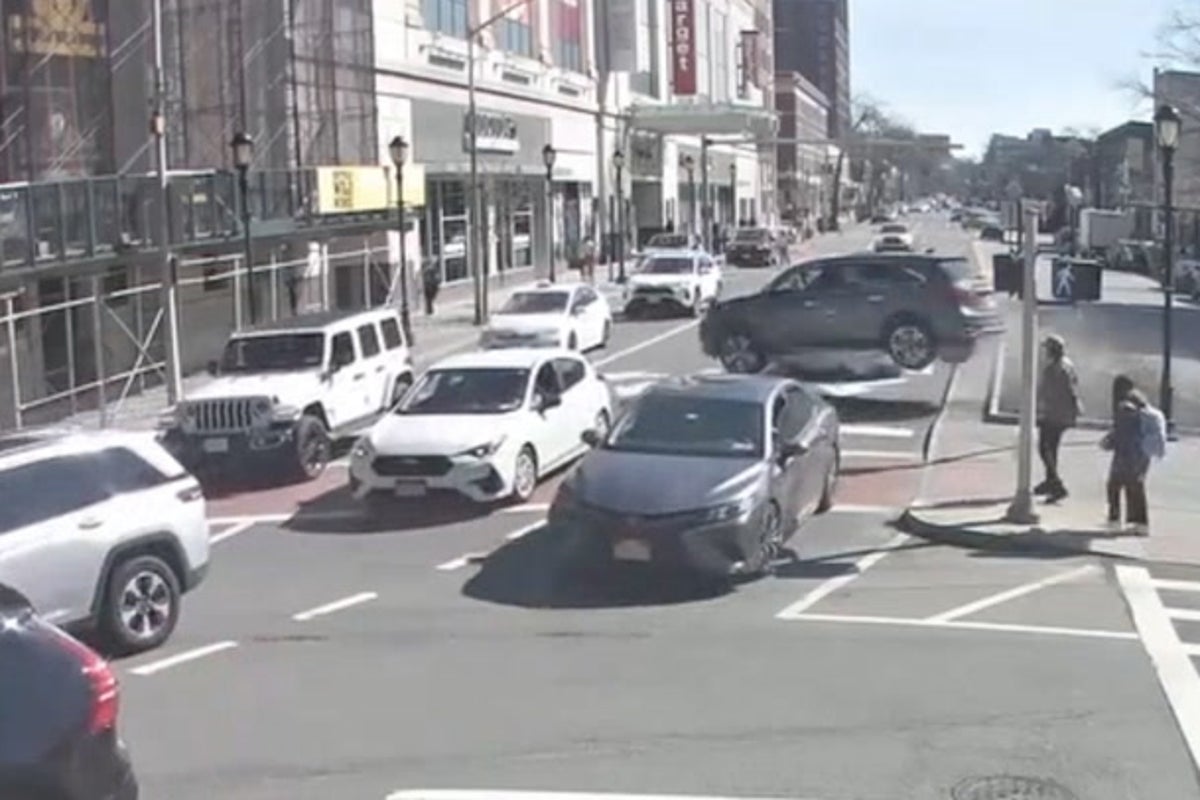
The transition of a motor vehicle from a controlled surface trajectory to an uncontrolled ballistic flight path represents a catastrophic breakdown in the three-link chain of operational safety: mechanical integrity, infrastructure design, and human cognitive response. When a vehicle "goes flying" over a busy junction, it is not a random act of chaos but the predictable result of kinetic energy exceeding the dissipation capacity of the environment. To understand these events, one must deconstruct the physics of the launch, the failure of the intersection's "forgiving infrastructure," and the physiological constraints that prevent an elderly operator from regaining control once a critical velocity threshold is breached.
The Mechanics of Vertical Displacement in Urban Environments
A vehicle becomes airborne only when its vertical velocity component overcomes the gravitational force holding it to the pavement. This typically requires a "ramp" mechanism, which in urban junctions often takes the form of a curb, a decorative median, or a steep elevation change in the road surface.
The Velocity Squared Law of Impact
The damage potential of a junction breach is governed by the formula for kinetic energy:
$$E_k = \frac{1}{2}mv^2$$
Because velocity is squared, a car traveling at 60 mph possesses four times the destructive energy of a car at 30 mph. At high speeds, the suspension system of a standard passenger vehicle is unable to damp the energy of a curb strike. Instead of absorbing the shock, the suspension bottoms out, transferring the upward force directly to the chassis and launching the vehicle.
The Vector of Uncontrolled Flight
Once the tires lose contact with the road, the driver loses all ability to steer or brake. The vehicle becomes a projectile following a parabolic arc. In the context of a "busy junction," the risk profile shifts from a single-vehicle accident to a multi-actor casualty event. The trajectory is determined entirely by the entry speed and the angle of the "ramp" (the curb or median).
Infrastructure Failure and the Illusion of Safety
Modern intersections are designed with "clear zones" and "recoverable slopes," yet these features are often optimized for low-to-moderate speed errors. When a vehicle exceeds the design speed of a junction—whether due to mechanical failure like a stuck throttle or a medical emergency—the infrastructure itself often contributes to the severity of the flight.
Curb Geometry as a Launch Catalyst
Standard vertical curbs are designed to redirect tires at low speeds. At high speeds, they act as fulcrums. If a vehicle strikes a curb at an oblique angle while under heavy acceleration, the curb provides the upward vector necessary for flight. The failure here lies in the "Rigid Barrier Paradox": the more substantial the barrier intended to protect pedestrians, the more likely it is to act as a ramp for a speeding vehicle.
The Junction as a High-Density Kinetic Sink
Intersections represent the highest concentration of kinetic energy in a transit network. When an out-of-control vehicle enters this space, it enters a "target-rich environment" where the probability of a secondary collision approaches 1.0. The "busy" nature of the junction means that even if the primary vehicle avoids stationary objects, it is likely to intersect with the paths of other vehicles moving at perpendicular angles, leading to "T-bone" impacts that the human frame is poorly equipped to survive.
Cognitive and Physiological Decay in Emergency Manoeuvring
The involvement of an elderly driver introduces specific physiological variables into the accident reconstruction. Age-related declines in perception-reaction time (PRT) and physical strength create a "Lag Gap" during the most critical seconds of a mechanical or situational failure.
Perception-Reaction Time (PRT) Bottlenecks
The average PRT for a healthy young adult is approximately 1.5 seconds. For older drivers, this can expand significantly due to:
- Cognitive Load Overload: In a high-speed failure, the brain must process a massive influx of visual and vestibular data.
- Saccadic Latency: The time it takes for the eyes to shift focus from the road to the speedometer or mirrors increases with age.
- The Startle Response: A sudden loss of control often triggers a "freeze" response or "pedal misapplication," where the driver slams on the accelerator thinking it is the brake.
Fragility and the Injury Severity Score (ISS)
The "injury" component of these reports is often skewed by the biological vulnerability of the elderly. An impact that a 20-year-old might walk away from can be fatal or life-altering for an 80-year-old due to reduced bone density and a lower threshold for internal organ trauma. This creates a disproportionate outcome: the vehicle flight is the spectacle, but the biological fragility is the actual cause of the critical injury status.
The Three Pillars of Junction Mitigation
To prevent the "flying car" scenario, urban planning and automotive safety must move beyond simple speed limits and address the physical triggers of vehicle launch.
1. Kinetic Dissipation Zones
Rather than rigid curbs, junctions should utilize "mountable" or "sloped" medians that allow a vehicle to lose energy through friction and tire damage rather than vertical lift. By increasing the rolling resistance of the off-road area, the vehicle can be slowed before it reaches the center of the junction.
2. Intelligent Speed Assistance (ISA)
The most effective way to prevent a vehicle from going airborne is to ensure it never reaches the necessary velocity. ISA systems use GPS and camera data to limit a vehicle's speed to the posted limit of the road. In the case of an elderly driver suffering a medical episode, an ISA system could theoretically prevent the "runaway" acceleration that precedes a junction jump.
3. Pedestrian and Operator Shielding
The design of the junction must account for "unlikely but high-impact" events. This involves:
- Strategic Bollard Placement: Using deep-foundation bollards that can stop a 2-ton vehicle without acting as a ramp.
- Signal Timing Optimization: Implementing "All-Red" clearings when sensors detect a vehicle approaching a junction at a speed that exceeds the safe braking distance.
The Cost Function of Urban Collisions
Every "flying car" event carries a massive economic and social cost. This is not merely the sum of the property damage and medical bills; it includes the "Network Shutdown Cost." When a major junction is closed for a forensic investigation, the loss of productivity for thousands of commuters can reach tens of thousands of dollars per hour.
Furthermore, the "Psychological Tax" on the community and the witnesses contributes to a decreased perception of safety, which can drive down local property values and retail foot traffic in high-incident areas.
Reconstructing the Chain of Causality
In this specific event, the "out-of-control" status suggests a failure that preceded the junction by several hundred yards. Whether it was a "pedal error" (common in elderly populations) or a mechanical throttle sticking, the vehicle was already in a state of kinetic surplus before it hit the "ramp."
The flight was the final physical expression of an earlier systemic failure. Had the vehicle been equipped with Automatic Emergency Braking (AEB) that functions at high speeds, or had the junction been designed with energy-absorbing barriers instead of launch-capable curbs, the elderly driver would likely have suffered a low-energy impact rather than a high-altitude trajectory.
The transition from a two-dimensional road error to a three-dimensional ballistic event is the ultimate failure of urban engineering. To mitigate this, municipalities must audit junctions for "launch potential" and prioritize the installation of non-linear barriers that prioritize energy absorption over simple redirection. The future of junction safety lies in the transition from "hard" infrastructure that breaks to "smart" infrastructure that absorbs.