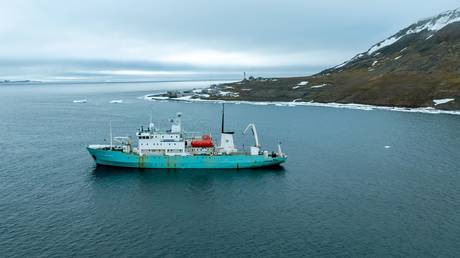
Sovereign debt enforcement against uncooperative states follows a distinct friction curve, where legal victories in international arbitration routinely stall at the execution boundary. When the Nord-Troms District Court in Norway authorized the detention of the Russian state-owned vessel Professor Molchanov in the Svalbard archipelago, it bypassed this traditional enforcement bottleneck. Acting on a formal enforcement petition filed by Ukraine’s national oil and gas company, Naftogaz, the action operationalizes a $4.22 billion Hague arbitration award tied to the 2014 expropriation of Crimean assets. This event marks a transition from passive legal recognition to aggressive cross-border asset tracing, establishing a high-stakes template for how sovereign wealth and state-owned commercial infrastructure can be intercepted within allied maritime jurisdictions.
The Mechanics of Cross-Border Arbitral Enforcement
Enforcing an arbitral award against a sovereign entity requires navigating sovereign immunity doctrines, which traditionally protect state property from commercial attachment. To pierce these protections, creditors must establish two strict legal thresholds: the property in question must be utilized for commercial rather than strictly sovereign or diplomatic purposes, and the local judicial system must recognize the extraterritorial enforceability of the underlying tribunal decision.
The Professor Molchanov—nominally classed as an Arctic research and commercial expedition vessel operated via state-linked entities like Trust Arktikugol—fell squarely into the commercial utility exemption. By operating commercial expedition cruises within Svalbard waters, the vessel forfeited standard sovereign immunities that might otherwise protect a pure naval warship or diplomatic asset.
[International Tribunal Award: $4.22B]
       │
       ▼
[Extraterritorial Recognition in Norway]
       │
       ▼
[Commercial Exemption Audit] ──> (Identifies State-Owned Commercial/Expedition Vessel)
       │
       ▼
[Local District Court Execution Order] ──> (Governor of Svalbard Detains Vessel)
Naftogaz systematically leveraged this structural vulnerability. Rather than relying on voluntary compliance from Moscow—which has dismissed the 2023 Hague ruling—the corporate entity utilized a multi-jurisdictional enforcement strategy. By petitioning Norwegian courts, Naftogaz converted an abstract financial judgment into a physical maritime lien, transforming a localized territorial dispute into a systemic liability for Russian state assets operating abroad.
The Svalbard Geopolitical Vector
The choice of location for the seizure introduces complex strategic variables. The Svalbard archipelago operates under the 1920 Svalbard Treaty, which grants Norway sovereignty while guaranteeing equal commercial access rights to signatory powers, including Russia. Moscow maintains a persistent economic footprint on the islands through state-owned coal mining and infrastructure operations centered in Barentsburg.
This geographic concentration created an operational trap. The Professor Molchanov docked within a Norwegian-administered port where local enforcement authorities, led by Svalbard Governor Lars Fause, possessed clear territorial jurisdiction to execute the district court directive without triggering international naval escalation on the high seas.
- Territory Control: The Governor's office coordinated physical containment, freezing the vessel's departure parameters while managing crew and passenger logistics alongside Trust Arktikugol.
- Jurisdictional Precedent: By executing the seizure on Arctic territory, Norway demonstrated that even remote or specialized administrative zones are not immune to international debt recovery actions.
- Operational Friction: The move forces Russian state enterprises to weigh the utility of maintaining high-latitude commercial operations against the immediate risk of asset forfeiture.
Systemic Multi-Jurisdictional Spillover
The action in Barentsburg does not represent an isolated enforcement event; it functions as a single node in a synchronized global asset-recovery network. Naftogaz has explicitly pursued parallel enforcement tracks across multiple allied jurisdictions, including the United States, France, the United Kingdom, and Finland.
This synchronized pressure exposes a structural vulnerability in how sanctioned or judgment-debtor states manage overseas state-owned commercial enterprises. When maritime assets—ranging from grain carriers intercepted by Swedish courts to oil tankers detained in the English Channel and the Mediterranean—are systematically targeted, the operational cost function of international trade shifts dramatically.
┌────────────────────────────────────────────────────────┐
│           Global Multi-Jurisdictional Strategy         │
└────────────────────────────────────────────────────────┘
       │
       ├─► Norway: Arctic Expedition Vessel Seizure (Svalbard)
       ├─► Sweden: Grain Transport Asset Transfer
       ├─► United Kingdom: Channel Tanker Interception
       └─► France: Mediterranean Maritime Detention
Insurance premiums skyrocket, maritime routing must avoid sympathetic coastal states, and state-backed commercial entities find their operational footprint shrinking. Moscow's prior threats of retaliatory measures highlight the diplomatic strain, yet retaliatory posturing fails to resolve the fundamental balance-sheet exposure created when physical assets enter the ports of creditor-aligned nations.
Execute parallel asset-tracing audits across all primary maritime choke points, prioritizing jurisdictions with established domestic legislation favoring international arbitration enforcement over sovereign non-compliance claims.