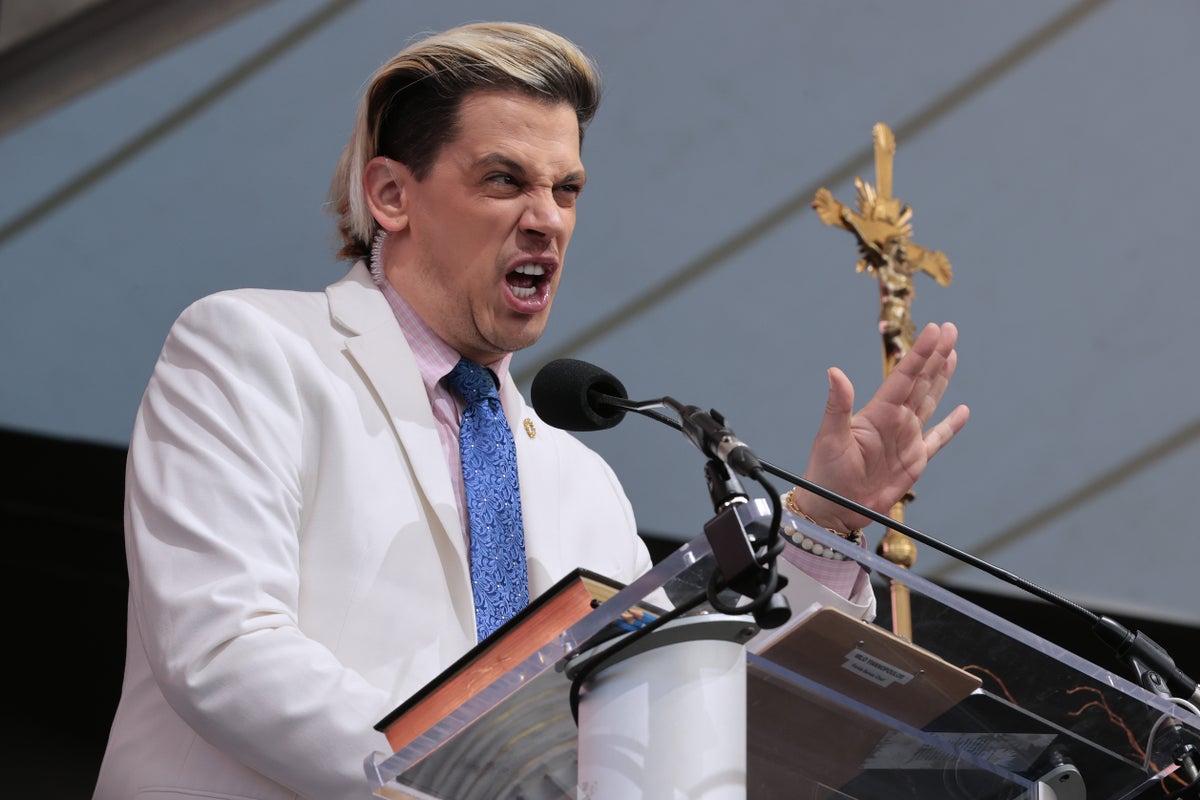
British far-right media figure Milo Yiannopoulos was arrested by federal immigration agents at Louis Armstrong New Orleans International Airport and swiftly deported to the United Kingdom, closing a bizarre chapter of political theater and long-term visa overstays.
The Department of Homeland Security confirmed that the 41-year-old provocateur was taken into custody by Immigration and Customs Enforcement agents after tracking his movements toward a Louisiana concert venue. Federal officials noted that Yiannopoulos had legally entered the United States through New York City in May 2019, but chose to remain in the country long after his legal authorization expired. An immigration judge issued a final order of removal on July 22 after he skipped a mandatory court appearance.
For years, Yiannopoulos survived on the margins of American political excess, transforming from a megaphone of the mid-2010s alt-right into a theatrical eccentric drifting through the orbits of disgraced pop culture figures and fringe political campaigns. Yet his sudden ejection highlights a broader shift in federal enforcement priorities. The machinery that caught him was not merely reacting to a routine visa violation. It was operating as an automated bureaucratic wall designed to choke off domestic mobility for anyone lacking valid legal status.
The Architecture of a Visa Overstay
Most foreign nationals who find themselves entangled in American immigration courts do not arrive via dramatic midnight border crossings. They arrive on commercial flights, carrying stamped passports and legitimate tourist or work permissions. They simply stay.
Yiannopoulos fit this classic profile. Entering in 2019, he watched his legal window evaporate while remaining deeply embedded in the American domestic political conversation. For a long time, the system functioned with administrative inertia. Unless an individual caught the eye of federal prosecutors through unrelated criminal charges, civil immigration violations often languished in massive judicial backlogs.
That environment has transformed. The current administration has prioritized closing the gap between administrative removal orders and physical enforcement. Federal authorities implemented strict controls targeting domestic air travel, effectively trapping individuals with active deportation orders who attempt to board commercial flights. When Yiannopoulos walked into the New Orleans terminal, his domestic travel plans collided directly with these automated manifest screenings.
Federal officials used the moment to send a wider message. The Department of Homeland Security highlighted programs encouraging voluntary self-deportation, complete with financial assistance incentives, while making it clear that airport terminals are no longer blind spots for enforcement. For a commentator who had spent the previous year loudly demanding aggressive immigration sweeps and public checkpoints, the poetry of being intercepted at a departure gate was heavy.
Ideological Contradictions and Burned Bridges
Long before federal agents checked his passport, Yiannopoulos had burned through almost every institutional alliance that once offered him protection or relevance.
His career trajectory remains a textbook study in self-immolation. He rose to national prominence as a tech editor for Breitbart News, mastering the art of campus provocation during the 2016 election cycle. He was loud, theatrical, and useful to a faction of the conservative movement that prized disruption over policy. That utility vanished overnight in 2017 when archival video surfaced showing him appearing to condone sexual relationships between adults and minors. Major publishers dropped his book contracts, the Conservative Political Action Conference rescinded his invitation, and Breitbart cut ties.
Exile from mainstream conservatism forced him into increasingly eccentric corners of the political ecosystem. He attempted various rebrands, including a brief, bizarre pivot claiming to have renounced homosexuality, followed by an unpaid internship in the congressional office of Georgia Representative Marjorie Taylor Greene. When that arrangement predictably dissolved amid internal pressure, he drifted further into the orbit of rapper Ye, serving as a campaign manager for a brief presidential bid and later working within his corporate ventures.
Even within these fringe associations, stability proved impossible. Lawsuits, public fallout, and a widening circle of personal enemies defined his final years in the country. Among those enemies was fellow far-right media personality Laura Loomer, who openly took credit for repeatedly notifying federal agencies about Yiannopoulos's unlawful presence. The spectacle of factional infighting within the American far-right ultimately played a direct role in drawing federal eyes to his file.
The Mechanics of Public Ejection
The logistics of an expedited deportation involve a cold, unyielding administrative pipeline. Once an immigration judge issues an in-absentia removal order—as happened in Yiannopoulos's case on July 22—discretionary appeals narrow dramatically.
Detainees are typically routed through regional processing hubs, with Alexandria, Louisiana serving as a primary logistics center for international removals in the region. From there, security details coordinate with foreign consular offices to secure emergency travel documents when a subject lacks a valid passport or requires escort.
For a public figure accustomed to dominating digital oxygen, the transition from viral agitator to administrative cargo was swift. Within twenty-four hours of his detention at Louis Armstrong International, federal confirmation arrived that he had already touched down on British soil. There were no dramatic press conferences, no campus lectures, and no digital retorts posted to his dormant social media feeds.
Instead, the episode concluded as a quiet bureaucratic footnote. A foreign national who spent years loudly cheering for the mechanical expulsion of others finally discovered how efficiently the machine turns when it points inward.