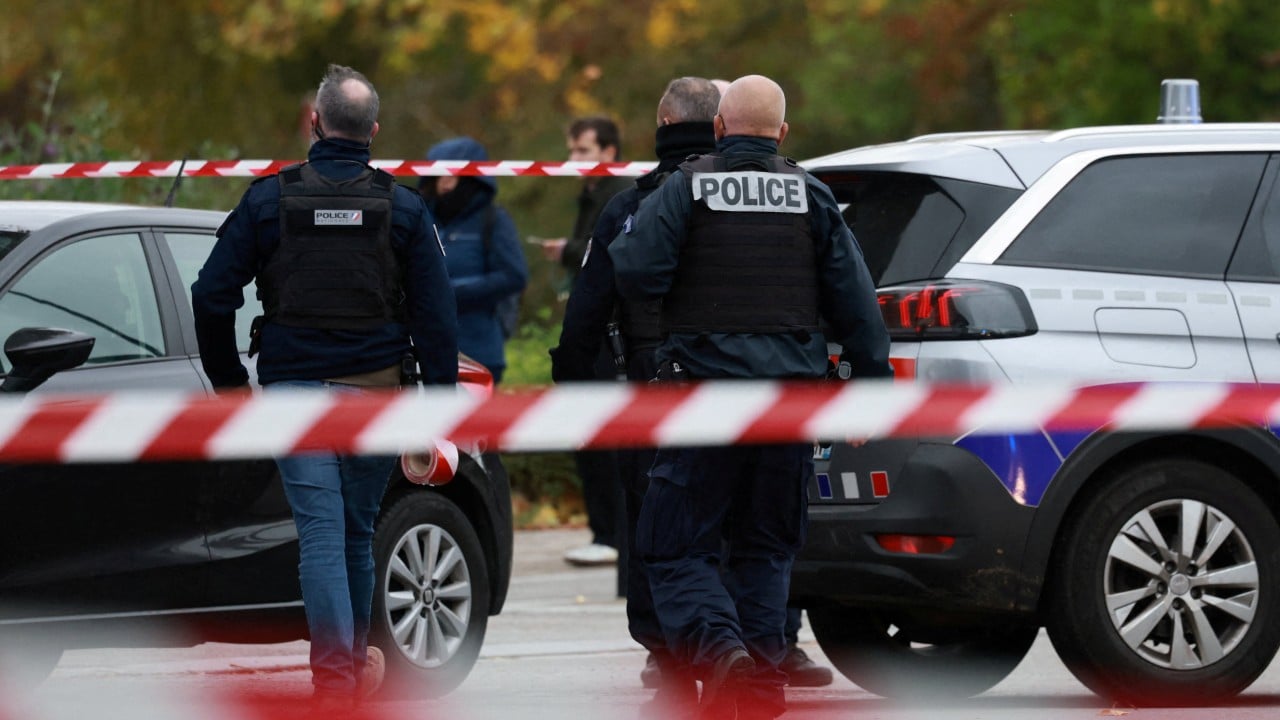
French President Emmanuel Macron has officially condemned a deadly shooting near Paris as a racist terrorist attack, a rare and legally consequential designation that immediately elevates the investigation to the country's specialized anti-terrorism prosecutors. The attack, which targeted members of a local minority community just outside the French capital, has forced the Élysée Palace to confront an uncomfortable reality that security officials have quietly warned about for years. Far-right extremism is no longer a peripheral nuisance in France; it is an organized, lethal threat capable of executing targeted mass violence on the doorstep of Paris.
For decades, France’s domestic intelligence apparatus—the General Directorate for Internal Security (DGSI)—built its modern counterterrorism architecture almost exclusively around tracking jihadist networks. That focus made sense after the horrors of 2015 and 2016. Yet while billions of euros flowed into monitoring radicalized Islamist cells, a parallel threat was metastasizing in encrypted chatrooms, rural shooting clubs, and ultra-nationalist political fringes. The blood spilled in the suburbs of Paris is the direct result of a security blind spot that politicians across the ideological spectrum were slow to acknowledge. In similar news, we also covered: The Weight of the Sash and the Ghosts of the Planalto.
Why the Terrorism Label Changes Everything
In French jurisprudence, calling an act of violence "terrorism" is never a mere rhetorical flourish. When Macron used the phrase racist terrorist attack, he was signaling a fundamental shift in how the state processes the crime.
Normally, a shooting with a clear racial motive falls under the jurisdiction of local criminal prosecutors, treated as aggravated murder or attempted murder with a hate-crime enhancement. While those charges carry severe penalties, including life imprisonment, they treat the violence as an isolated criminal act driven by personal prejudice. NPR has provided coverage on this fascinating subject in great detail.
Transferring the case to the National Anti-Terrorism Prosecutor’s Office (PNAT) alters the legal machinery entirely. Under French law, an act qualifies as terrorism when it is committed intentionally in connection with an individual or collective enterprise aimed at seriously disturbing public order through intimidation or terror. By invoking this standard, authorities are acknowledging that the shooter did not merely want to kill specific individuals; the goal was to terrorize an entire demographic and destabilize the French Republic's social fabric.
This reclassification unlocks extraordinary investigative powers. Anti-terrorism judges can hold suspects in custody for up to 96 hours without charge—double the standard limit—and can deploy sweeping surveillance tools, dawn raids, and financial tracking across international borders. More importantly, it forces the state to look beyond the lone gunman. Investigators are now legally mandated to map out the ideological ecosystem that radicalized him, including online forums, manifesto distributors, and illicit weapons suppliers.
The Anatomy of a Modern French Extremist
To understand how a deadly racist shooting happens in the shadow of Paris, you have to look at the evolving profile of the French far-right militant. The stereotypical skinhead of the 1980s and 1990s—loud, visible, and easily tracked by street-level police—is largely extinct.
Today’s threat is decentralized and digitally native. Intelligence assessments leaked to the French press over the past several years paint a consistent picture of these suspects. They rarely belong to formal, dues-paying political organizations. Instead, they operate within fluid, leaderless networks on platforms like Telegram, Discord, and obscure gaming forums, where violent accelerationism is gamified and white supremacist conspiracy theories are treated as gospel.
Consider a hypothetical example of how this radicalization pipeline operates in practice. A young man living in a peri-urban commuter town outside Paris feels economically marginalized and culturally alienated. He begins consuming mainstream right-wing commentary on television, which introduces him to concepts like the "Great Replacement"—a conspiracy theory claiming that white European populations are being systematically replaced by non-white immigrants. Algorithms quickly push him toward darker corners of the internet, where anonymous influencers argue that political solutions are dead and that only a "race war" can save the nation. Within eighteen months, he goes from complaining about local crime on Facebook to buying an illegal firearm on the black market and scouting community centers in neighboring suburbs.
This trajectory is notoriously difficult for intelligence services to intercept. Without a central command structure or foreign handlers sending encrypted orders from abroad, there is very little operational chatter to detect until the suspect decides to act.
The Weapons Pipeline Problem
Ideology alone does not pull a trigger. France maintains some of the strictest gun control laws in Europe, yet high-powered firearms continue to surface in the hands of domestic extremists with alarming regularity.
Investigations into foiled far-right plots over the last five years have revealed three primary channels through which these militants acquire weapons:
- Deactivated firearms from Eastern Europe: Weapons legally sold as inert collector's items in countries like Slovakia or the Czech Republic are smuggled into France and easily converted back into live-firing guns using basic machine tools.
- The dark web and Balkan trafficking routes: The same criminal networks that supply drug gangs in Marseille and the Paris banlieues with Kalashnikovs and handguns do not care about the political ideology of their buyers, provided the cash is good.
- Legal gun clubs and hunting licenses: A significant number of arrested ultra-nationalists held valid sports shooting licenses, allowing them to legally purchase rifles and stockpile thousands of rounds of ammunition while remaining entirely off the radar of counterterrorism units.
When a suspect combines extreme racial animus with easy access to lethal hardware, the margin for intelligence failure drops to zero.
The Political Tightrope for Emmanuel Macron
Macron’s immediate and forceful condemnation of the shooting was a political necessity, yet it places his administration in a deeply precarious position. For years, the French president has tried to neutralize the rise of Marine Le Pen’s National Rally (RN) by adopting tougher rhetoric on immigration, crime, and secularism (laïcité). Critics on the left have long argued that by validating the framing of the hard right, the government has inadvertently legitimized the very grievances that fuel racial hostility.
Now, Macron must reassure traumatized minority communities that the state will protect them, while simultaneously fending off accusations from opposition parties that his administration allowed the political climate to poison itself.
The reaction from the political class has been predictable and deeply fractured. Left-wing lawmakers immediately demanded a parliamentary inquiry into the rise of far-right violence, pointing out that previous attacks—such as the deadly 2022 shooting at a Kurdish cultural center in Paris—were initially handled as ordinary hate crimes rather than terrorism, a decision that sparked days of furious protests in the capital. By designating this latest attack as terrorism from the outset, Macron avoided a repeat of that specific PR disaster, even as he opened the door to broader questions about his government's security priorities.
Meanwhile, figures on the hard right have scrambled to distance themselves from the shooter, portraying him as a mentally unstable lone wolf whose actions bear no relation to their political platform. It is a familiar defensive crouch. Whenever violence erupts from the nationalist fringe, mainstream right-wing commentators insist that words have no consequences, even as they spend every evening warning their audiences of an existential civilizational threat.
What Security Services Missed—And What Comes Next
Inside the French Ministry of the Interior, the mood is grim. Officials know that dismantling a decentralized ideological movement is infinitely harder than rolling up a traditional terrorist cell. Since 2017, French authorities have foiled more than a dozen planned attacks by ultra-right groups, including plots to assassinate politicians, blow up mosques, and poison halal food supplies. Each time, the arrests were quietly celebrated as proof that the system works.
This deadly shooting near Paris proves that the system has cracks.
The core failure lies in how intelligence agencies assess risk. For years, domestic spies categorized far-right extremists under the label of "violent radicalization" rather than "terrorism," a bureaucratic distinction that meant fewer resources, lower priority on surveillance warrants, and less coordination between local police prefectures and national intelligence directors. Local cops might notice a resident posting racist tirades online or hoarding survivalist gear, yet fail to pass that information up the chain because the individual had no criminal record and no ties to known militant groups.
Fixing this requires more than just presidential speeches and moments of silence. Intelligence analysts have been pushing for a unified national database that tracks hate-crime suspects alongside radicalized extremists, bridging the gap between local policing and national security. There is also growing pressure to tighten oversight of France’s 250,000 licensed sport shooters, implementing mandatory psychological screenings and cross-checking club memberships against intelligence watchlists.
Yet bureaucratic reforms move slowly, and the internet moves at light speed. Every time French authorities shut down a violent Telegram channel or ban a small nationalist association—as they have done with groups like Génération Identitaire—the members simply scatter, rebrand, and migrate to more encrypted platforms.
The victims near Paris were targeted because of who they were and where they stood. Macron’s declaration that their deaths constitute a racist terrorist attack finally gives the crime its proper name, stripping away the comfortable illusion that France’s terrorism problem comes from only one ideological direction. Whether the French state can actually dismantle the homegrown machinery producing these killers remains an open, bloody question.


