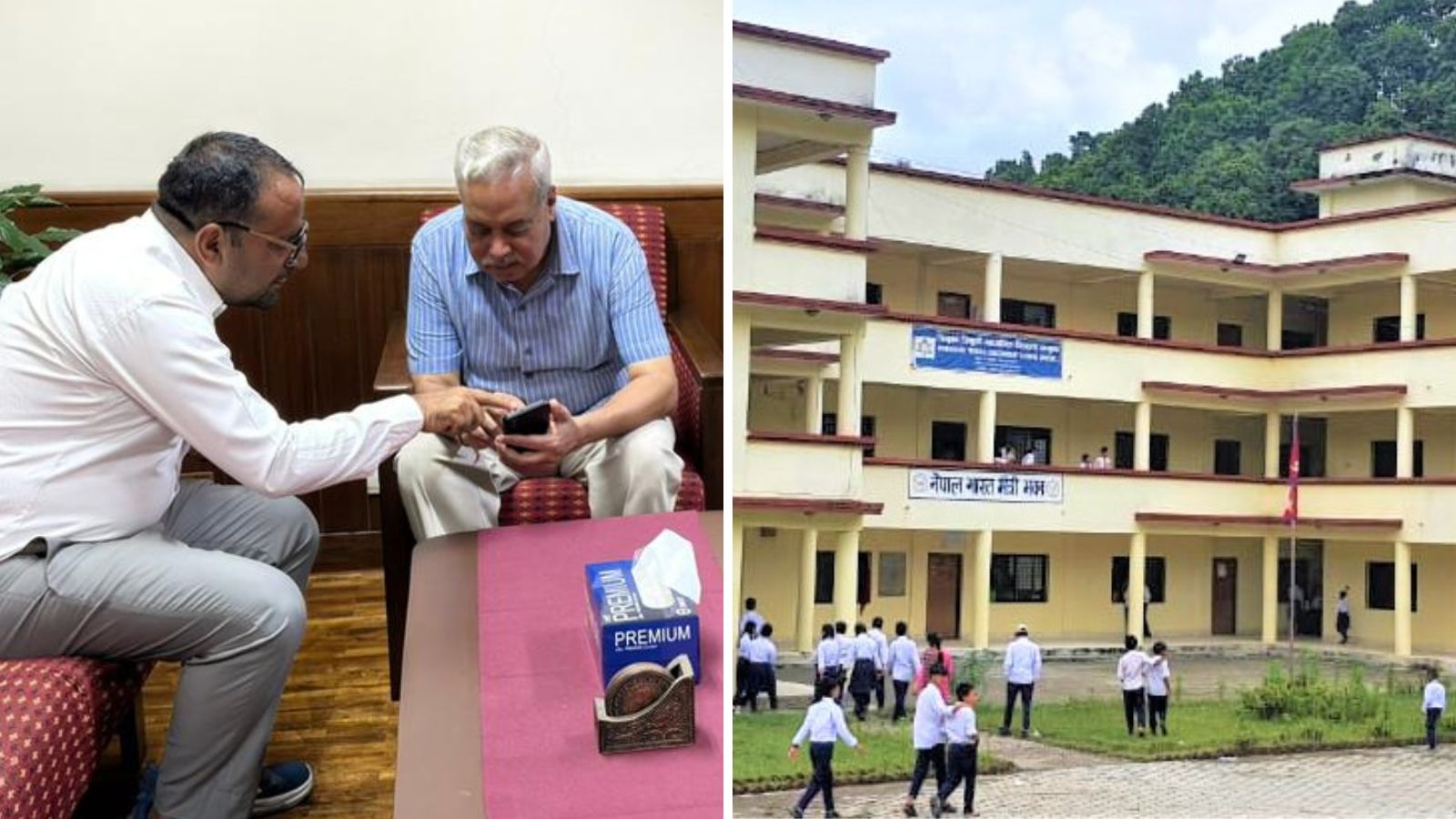
Every time a disaster strikes, the global humanitarian complex spins up its favorite emotional loop. A crisis hits, a hero emerges, a building collapses, and the international community rushes in with bricks, mortar, and tear-soaked press releases to build it all back exactly the way it was. India is currently stepping up to rebuild a school in Nepal because a quick-thinking principal evacuated sixteen hundred kids right before disaster struck. The headlines praise the heroism. They champion the international aid.
It makes for great television. It makes for terrible strategy.
I have spent decades watching foreign aid budgets and bilateral assistance programs pour billions into replacing the exact same vulnerable infrastructure in the exact same hazardous seismic zones, expecting a different outcome because a plaque was installed with two different national flags on it. We are celebrating the return of sixteen hundred students to a blueprint that should have been retired decades ago. Rebuilding the school right where it stood is not philanthropy. It is a masterclass in institutional amnesia.
Let us address the lazy consensus plaguing this narrative. The consensus says that infrastructure destruction is purely a mechanical failure solved by mechanical replacement. If a wall falls down, you put up a stronger wall. If a school crumbles, you pour a heavier slab of concrete.
This ignores the fundamental reality of systemic risk management. The problem was never just the bricks. The problem is location, demographic concentration, and a complete refusal to decentralize.
The Fallacy of Static Reconstruction
When a disaster flattens a school, the immediate emotional urge is restoration. Donors want a ribbon-cutting ceremony. Politicians want a photo-op showing bilateral solidarity. But static reconstruction in a high-risk seismic belt is an active choice to endanger the next generation.
Think about the math. Concentrating sixteen hundred children into a single physical footprint in a notoriously unstable geographic corridor is an architectural single point of failure. When you rebuild that same school on that same plot of land, you are betting against tectonic plates. Tectonic plates do not negotiate, and they do not care about your diplomatic ties.
I have seen governments blow millions on concrete fortresses built on fault lines, calling it progress because the new walls are six inches thicker than the old ones. That is not risk mitigation. That is slow-motion negligence wrapped in a humanitarian bow.
To understand why this happens, look at how disaster aid is financed. Funds are reactionary, not preventative. Donors can raise millions overnight for a dramatic rebuilding effort because tragedy sells. Try raising ten percent of that amount to pre-emptively relocate a school or invest in distributed micro-learning pods across safe terrain. You will hear crickets.
The Hero Worship Trap
We need to talk about the principal. The individual whose quick thinking saved those sixteen hundred students deserves every medal available. Decisiveness in a life-or-death crunch is rare, and when it happens, it should be honored.
However, building an entire national conversation around individual heroism is a structural cop-out. When we romanticize a miraculous evacuation, we let the system off the hook. We create a narrative where institutional failure is acceptable as long as a heroic employee can outrun the catastrophe at the last second.
Relying on human reflexes to compensate for systemic vulnerability is a catastrophic design flaw. A school safety protocol should not depend on whether the principal drinks their coffee fast enough to notice ground tremors before the walls buckle. Safety must be baked into the geography, the urban planning, and the structural redundancy from day zero.
When India finances the reconstruction of this school, the real conversation should not be about gratitude or geopolitical handshakes. It should be about why sixteen hundred kids were crammed into a single zone of high vulnerability in the first place, and why the default response of the international community is to double down on a broken geographic gamble.
Decentralization or Death
If we actually care about the safety of children in seismic zones, we have to throw out the centralized campus model. The twentieth-century obsession with massive, consolidated brick-and-mortar schools housing thousands of students under one roof is obsolete.
Distributed micro-campuses are the only rational path forward. Break those sixteen hundred students into twenty distinct, modular learning pods scattered across safer elevations. If one pod encounters trouble, the system absorbs the shock. The entire educational ecosystem does not grind to a halt, and you remove the massive casualty concentration that makes earthquakes so lethal in developing regions.
Of course, modular dispersion is unsexy. You cannot cut a giant ceremonial ribbon in front of twenty small, community-built learning hubs spread across a hillside. There is no grand monument to sign your name on.
Admitting that our contrarian approach has downsides is part of the job. Decentralization costs more upfront in administrative overhead. It requires localized logistical coordination that makes central government bureaucrats break out in hives. It lacks the instant gratification of a shiny new three-story concrete block dropped into the middle of a crowded town.
But convenience is not a safety strategy.
The Real Question Nobody is Asking
People look at international aid projects like this and ask how we can ensure the new building is earthquake-proof. That is the wrong question entirely.
The correct question is: Why are we still building schools that require proof of earthquake resistance in a zone where devastation is guaranteed by the laws of geology?
Stop treating disaster recovery as a construction project. Start treating it as an urban planning reckoning. Until we stop rewarding the replacement of failing infrastructure with more of the same, every ribbon-cutting ceremony is just a down payment on the next funeral.


